
WASSILY KANDINSKY
Wassily Kandinsky, born in Moscow in 1866, influenced an entire generation of artists in Germany and France with his personal artistic approach by the age of thirty. He began studying law at Moscow University early on and distinguished himself with various writings and a dissertation on social issues. After declining a professorship at an Estonian university, he moved to Munich and, in 1900, began studying under Franz von Stuck at the Munich Academy of Fine Arts. Just a few years later, he was teaching at a private art school.
Kandinsky devoted considerable intellectual effort to exploring the “spiritual dimension of art,” which led him to contact the Berlin Secession in 1902. This artists’ association included painters such as Klimsch, Leistikow, Liebermann, Slevogt, Corinth, Beckmann, Barlach, and Feininger. The art world during this period was characterized by a focus on paintings of nature, but also by shifts towards abstraction, resulting in inevitable divergences and differences regarding what was considered worthy of exhibition. Consequently, in 1906, he founded and exhibited with the group “Die Brücke” in Dresden. In 1907, he founded the “Neue Künstlervereinigung” (New Artists’ Association) in Munich, from which—with Franz Marc as a pioneer and leading figure—the group “Der Blaue Reiter” (The Blue Rider) emerged. Trips to Paris and Italy brought Kandinsky into contact with the stylistic trends there, with Cubism and Fauvism, and contributed to his thinking increasingly focusing on the substantial question of modern art, namely the function of the image in a world consumed by materialism.
All conventional artistic means seemed to him insufficiently immaterial to transcend the materiality of reality. For Kandinsky, only music could overcome this materiality without relying on representational forms. His paintings became increasingly abstract, leading to a distinct new focus on nuanced color palettes and rhythmic forms. Exhibitions of his work in Munich, Zurich, the USA, and Moscow attest to the restless, yet always agile and innovative artist, also in search of self-discovery. After periods in Moscow and Berlin, he moved to Weimar in 1922 and, at the invitation of Walter Gropius, became a teacher at the Bauhaus there. He met other important artists such as Lyonel Feininger, and together with Paul Klee and the Russian painter Jawlensky, he founded the artists’ group “The Blue Four.”
When the Bauhaus closed in 1933, Kandinsky moved to Paris. There, he met other important artists such as Robert Delaunay, Fernand Léger, Joan Miró, Piet Mondrian, and Hans Arp. In 1937, the Nazis defamed his work. Over 57 paintings were confiscated and removed from German museums.
1. DELICATE TENSION No. 85, 1923 (Zarte Spannung Delicate Tension)
WASSILY KANDINSKY (1866-1944)
Abstract Expressionism.
Watercolour and ink on paper. 13.8 × 9.8″ (35.0 × 25.0 cm)
Madrid, Thyssen-Bornemisza Museum

Ink and coloured pencils on Arches drawing paper.
Among the large series of aquarelles painted by the artist in 1922-1923, this work is listed at number 85. They are all quite similar in style: closed forms filled with colour and intersecting straight lines as if they are floating in the space of the canvas. Circles and triangles dominate – they are, in the artist’s opinion, two primary and the most contrasting figures.
This geometric abstraction of the Bauhaus period perfectly demonstrates the well-recognized artist’s hand that reached the peak of expressiveness in Composition VIII. The influence of Russian constructivism of the revolutionary years and the laconic aesthetics of Bauhaus, in which Kandinsky was just beginning to teach at that time, laid the foundation for his further development in abstract art.
Delicate Tension was executed by Kandinsky at the Bauhaus during the prestigious school’s most rationalist period under the directorship of Theo van Doesburg, from 1923 to 1925. During these years, the initial Expressionistic style of this avant-garde centre evolved towards greater commitment to the Constructivist aesthetic, which was spreading internationally. Kandinsky delved more deeply in his investigation of the correspondences between forms and colours, and the geometric shapes found in his works from this period, which is sometimes described as “cold, ” are basically the circle and the triangle, which he considered to be “the two primary, most strongly contrasting plane figures.”
The abstract painter Rudolf Bauer (1889–1953), who belonged to the circle of the Der Sturm gallery in Berlin, acquired the present watercolour in 1929, through the Galerie Ferdinand Möller, and a few years later, in 1936, it passed to Baroness Hilla Rebay. In 1930, Rebay, who was involved in a relationship with Bauer, established the non-Objective private art museum in Berlin called Das Geistreich (The realm of the spirit), closed by the Nazis in 1937, where his exhibition Werke von Kandinsky und Bauer was shown in 1932. After emigrating to the United States, she became the director and curator of the new Solomon R. Guggenheim Foundation and the organiser of the exhibition entitled The Solomon R. Guggenheim Collection of Non-Objective Paintings at the Gibbes Memorial Art Gallery in Charleston, which included the present watercolour as part of the Guggenheim collection, to which it belonged from 1936 to 1971.
Presently in the Museo Nacional Thyssen-Bornemisza in Madrid, Spain.
2. KOMPOSTION VIII 1923
WASSILY KANDINSKY
Geometric abstraction. Oil on canvas 201 cm x 140 cm (55.1 x 79.!”)
New York, The Solomon R. Guggenheim Museum

Ink and coloured pencils on Arches drawing paper
The audience was quite shocked by the transition from the apocalyptic emotion of Composition VII to the geometric rhythm of Composition VIII. “Composition VIII” was painted ten years later, in 1923. It is a logical development of the creative genius of the painter, and to a certain extent, it reflects the influence of Suprematism and Constructivism assimilated by Kandinsky in Russia and in the Bauhaus
In 1926, the most important theoretical work of the painter, “Point and Line to Plane,” was published. Of course, most of the painter’s canvases of this period are the practical expression of his theoretical ideals. However, this is not a literal implementation, but rather an intuitive and poetic interpretation. Kandinsky, as a writer, was consistent and methodical, but when working on the canvas with figures and colours, he became sensual and impulsive. And, of course, he hoped that the audience would perceive his work emotionally, too.
Kandinsky aimed to formulate an abstract language which would cause strong emotions in the audience to a large extent, the same way as music does. “Form itself, even if completely abstract … has its own inner sound,” he wrote. Kandinsky was looking for a universal law of harmony in the visual arts, which must be present in the center of each creation, and this mystical belief was being reinforced by the convincing inner strength of the painter.
Composition VIII was one of the first paintings which were bought by Solomon R. Guggenheim. In 1930, Guggenheim visited the Bauhaus, where he bought several paintings of Kandinsky. It was the beginning of a large collection which is now exhibited in the Guggenheim Museum in New York.
3. SEVERAL CIRCLES 1926
Geometric abstraction. Oil on canvas. 55 3/8 x 55 1/4 inches (140.7 x 140.3 cm)
Solomon R. Guggenheim Museum, New York
In the early 1920s, after Kandinsky’s return from Russia to Germany, his works developed a characteristic geometricity, more space started to appear on the canvas, and the spontaneity gave way to order. Fascinated by the educational process and the theoretical work in Bauhaus, he investigated interaction and the influence of the main elements of the canvas, the colours and forms.
He brought to life his own theoretical studies in his “Several Circles”. Deliberately limiting himself to only one form, the circle, Kandinsky focused all his attention on other aspects such as colours and masses and their relative position on the canvas. Several Circles, unlike many of Kandinsky’s abstract works, has no objective connotations. It is a pure abstraction.
While at the Weimar Bauhaus, he was in a more sympathetic environment in which to pursue his art. Originally premised on a Germanic, expressionistic approach to artmaking, the Bauhaus aesthetic came to reflect Constructivist concerns and styles, which by the mid-1920s had become international in scope. While there, Kandinsky furthered his investigations into the correspondence between colours and forms and their psychological and spiritual effects. In Composition 8, the colourful, interactive geometric forms create a pulsating surface that is alternately dynamic and calm, aggressive and quiet. The importance of circles in this painting prefigures the dominant role they would play in many subsequent works, culminating in his cosmic and harmonious image, Several Circles. “The circle,” claimed Kandinsky, “is the synthesis of the greatest oppositions. It combines the concentric and the eccentric in a single form and in equilibrium. Of the three primary forms, it points most clearly to the fourth dimension.”
4. CIRCLES IN A CIRCLE 1923
Geometric abstraction
Oil on canvas 38.9 × 37.6″ (98.7 × 95.6 cm)
Philadelphia. Philadelphia Museum of Art
Circles in a Circle” is a compact and closed composition. Kandinsky began a thoughtful study of the circle as an artistic unit starting from this painting. In his letter to Galka Scheyer, he wrote, “it is the first picture of mine to bring the theme of circles to the foreground.” The outer black circle, as if the second frame for a picture, encourages us to focus on the interaction between the inside circles, and two intersecting diagonal stripes enhance the effect, adding a perspective to the composition.
5. COMPOSITION 1930 (TRIANGLES)
Watercolour and Indian Ink
Private Collection
In 1930, one of the unique compositions of the exceptional artist Wassily Kandinsky was created, whose abstract paintings are to be found nowadays in many places. Born and raised in Russia, the painter also lived in Germany for a long time and is known, among other things, as co-founder of the Blaue Reiter. He experimented and improvised with his special language of colours and forms, thus creating his picturesque compositions, which he compared to musical compositions. His goal was to express moods and emotions with his paintings. The composition, created in 1930 with watercolours and ink, consists of interlocking triangles and squares that radiate in brightly coloured colours. The colours seem to be carefully matched and have different shades within the shapes. Partly, the colours blend gently into each other, which gives the picture a very special charm.
The first time I saw this in the Kandinsky archives, I knew I would copy it. However, without knowing the method, it was obviously watercolour, something hard to replicate with pencil crayon. This is done with watercolour pencil crayons, but water wasn’t used. I found it great fun to blend the pencils, trying to replicate exactly watercolour.
6. CLEAR CONNECTION 1925
Watercolour and Indian ink on paper. 18.9 × 12.6″ (48.0 × 32.0 cm)
London, Christie’s. Sold 14 March 2017 at Sotheby’s in London for GBR 1,45 million
7. PLATE IV from the PORTFOLIO KLEINE WELTEN 1922
Lithograph, 13.2 × 11.4″ (33.5 × 28.9 cm)
New York, Museum of Modern Art (MoMA)
8. ABSTRACT INTERPRETATION 1925
Oil on composition board
A striking geometric in Art Deco style.
Yale University Art Gallery. (I saw it there on August 15, 2025).
The original is a vertical with a black background.
9. SMALL YELLOW 1926
Oil on composition board.
16 5/16 × 12 11/16 in. (41.5 × 32.3 cm)
Yale University Art Gallery. (I saw it there on August 15, 2025).
The original is vertical with a yellow background.
10. ABSTRACT COMPOSITION

Ink and coloured pencils on Arches drawing paper
BANKSY
Arguably the most controversial street artist in the world, Banksy’s works have become a subculture in their own right. Banksy’s political statements and disruptive vision have impacted cities across the globe at vital moments in modern history, provoking alternative viewpoints and encouraging revolution in the art world.
His identity remained unknown, even after more than 30 years of involvement in the global graffiti scene. He has worked in many street art mediums and in many styles, breaking down the boundaries and expectations of street art critics. His work includes powerful, often controversial images, encouraging the rapid spread of his name and work across the internet. Today, his iconic works have been re-shared and repurposed beyond measure.
At the age of 18, Banksy was nearly caught vandalizing public spaces by the police. Banksy noticed stencil letters sprayed onto a truck, and, as he had been looking for a faster way to paint at the time, he decided stencilling would be his new graffiti style.
Banksy’s works often take the form of multi-layered stencils combined with other media sources. He sometimes includes objects that already exist on his chosen ‘canvas,’ such as street signs and fire hydrants, to turn his work into striking street art installations. His artwork is often satirical, combining dark humour with messages about art, philosophy, and politics.
By the early 2000s, his international work was taking off. He travelled to Palestine and the West Bank, where he stencilled nine now-iconic images onto the newly-erected West Bank Wall, including ‘Love is in the Air.’ These images were an instant hit and exploded online.
As Banksy’s work gained notoriety, he transitioned from local fame to international acclaim. Key exhibitions and provocative street installations solidified his status as one of the most influential artists of his generation. His art caught the attention of media outlets, which amplified his message and expanded the reach of his work beyond the streets into galleries worldwide.
Iconic pieces like “Girl with Balloon” and “Rage, the Flower Thrower” became synonymous with his name, captivating audiences with their poignant messages and stunning imagery. Banksy’s ability to blend humor, pathos, and political commentary ensured that his work would resonate across diverse cultures, establishing him as a pivotal figure in contemporary art.
At this time, Banksy’s silkscreen prints and stencil paintings were racking up record-breaking sales in storied art auctions such as Sotheby’s and Bonhams of London. These successful sales marked Banksy’s dramatic entry into the commercial art world. In 2010, Banksy assumed the role of author and filmmaker for his film ‘Exit Through the Gift Shop.’
Who is Banksy? Very little is known about Banksy himself, as he refuses to be interviewed and carefully maintains his anonymity. A world-renowned mystery man, street art fanatics are consistently impressed by the far-reaching scope, variety, and bravery of every artwork he delivers, but are always left wanting more. This tactic encourages viewers to explore a completely new perspective or idea, often inspiring both amateur and professional artists. This inspiration is also known as the “Banksy Effect.”
Most recently, many sources have suggested he was the Bristol native, Robin Gunninham.
Banksy artwork
In October 2013, Banksy undertook a month-long residency in New York entitled ‘Better Out Than In.’ During this time, he unveiled a new piece of work every day. On Day 13, the artist disguised himself as a typical street vendor and set up a stand in Central Park, where he sold black-and-white original paintings for $60. Only eight pieces of art were sold. The following day, Banksy authenticated those eight canvases on his website, alongside the message: “Yesterday I set up a stall in the park selling 100% authentic original signed Banksy canvases. For $60 each”. A year later, ‘Winnie the Pooh’, purchased during Banksy’s New York residency, sold for £56,250 on July 2nd, 2014 at Bonhams in London.
In the summer of 2015, Banksy opened the dystopian theme park Dismaland in the seaside resort of Weston-super-Mare. Prepared entirely in secret, the project unveiled 10 new works by Banksy as well as works from 58 other artists.
Banksy went on to participate in the design of the Walled Off Hotel in Bethlehem in 2017, opposite the Israeli West Bank Barrier. With nine rooms designed by Banksy himself, guests could literally sleep inside a work of art. Originally intended as a temporary and provocative piece of installation art, the Walled Off Hotel rapidly became a top tourist attraction. Alongside the spot on which Jesus was reputedly born, a traditional pilgrimage site, the controversial 700 km-long wall is now a surprising tourist site.
Banksy’s relationship with tourism is a complex one; while he often stimulates it, he also regularly denounces it because of its negative effects. To criticise the mass tourism that is endangering the Italian city of Venice at the Biennale in 2019, Banksy unveiled ‘Venice in Oil,’ a series of nine oil paintings which, when placed together, depict a large cruise ship.
In October 2018, a painting by the anonymous street artist sold at Sotheby’s auction house in London for £1.04 million. Shortly after the hammer came down, the print of Banksy’s 2006 ‘Girl with Balloon’ began to pass through a shredder installed in the frame, destroying half of it. “It appears we just got Banksy-ed,” reported Alex Branczik, Sotheby’s Senior Director and Head of Contemporary Art in Europe. The piece was a famous Banksy print known as ‘Girl with Balloon’ created back in 2006. Banksy’s balloon girl, which was voted UK’s best-loved work of art in 2017, became the first instance of a self-destructing painting. Banksy posted a video to his Instagram account to confirm the move was intentional and demonstrate how he built a shredding device into the large golden frame. The work was then given a new title: “Love is in the Bin“.
In October 2019, another Banksy artwork took the country by storm. Amidst the political controversy at the time, Banksy released ‘Devolved Parliament,’ a painting that depicts the House of Commons overtaken by apes. It sold at Sotheby’s for an astonishing £9.9 million, making it the most expensive Banksy painting sold to date. In typical Banksy fashion, he responded to the sale on Instagram with a line from Robert Hughes: “But the price of a work of art is now part of its function, its new job is to sit on the wall and get more expensive.”
In a characteristically charitable move, Banksy donated a series of three paintings to auction in 2020, entitled ‘Mediterranean Sea View’, to raise money for a hospital in Bethlehem. The oil paintings were in a detailed, traditional style that had grown more prominent in Banksy’s work around this time. Of course, the stunning landscapes came with a Banksy twist: life jackets washed up on the shore, intended to highlight the growing European migrant crisis.
Banksy’s ability to consistently break and challenge his own records continued to amaze the art market when, in October 2020, Banksy’s reinterpretation of Monet’s famous waterlilies, entitled ‘Show Me The Monet’ sold at auction for £7.5 million. This made it the second most expensive of his works to sell at auction. The piece was part of a series of remixed masterpieces and commented on the threat that society’s wasteful consumerism poses to the natural world.
In response to the global Coronavirus pandemic in 2020, Banksy hung a brand-new black and white artwork, depicting a young boy playing with a ‘superhero’ NHS nurse doll, in the foyer of Southampton General Hospital. He released a statement thanking the NHS for their work and hoping that the painting brightened up the hospital. The piece was later titled ‘Game Changer.’ On the one-year anniversary of the UK entering into lockdown, ‘Game Changer’ sold at auction for £16.8 million, with all proceeds donated to the NHS. This price far exceeded all expectations and firmly secured this piece as the most expensive Banksy ever sold.
Banksy’s artistic endeavours continue to take him around the world. Artworks have cropped up in Australia, France, Italy, the United States, Canada, Jamaica, and Israel, and are instantly protected and revered.
The West Bank Barrier Murals
The West Bank Barrier Murals represent a poignant intersection of art and political commentary, with Banksy’s work illuminating the complex realities of life in Palestine. These murals serve as powerful visual statements that challenge perceptions and provoke thought about conflict and resistance.
Significance of Location. The West Bank Barrier, commonly referred to as the “Apartheid Wall” by critics, is a series of concrete walls and fences separating Israeli and Palestinian territories. This controversial structure has profound implications for the people living in the region. Banksy chose this location deliberately, understanding the symbolic weight it carries. By placing his art in such a charged environment, he emphasizes the stark realities and frustrations experienced by Palestinians.
The placement of art in this area transforms a site of division into a canvas for dialogue. It compels viewers to confront the harsh realities of occupation and the daily struggles for freedom and justice. As such, the murals become a form of resistance, challenging viewers not only to observe but to engage with the pressing issues at hand.
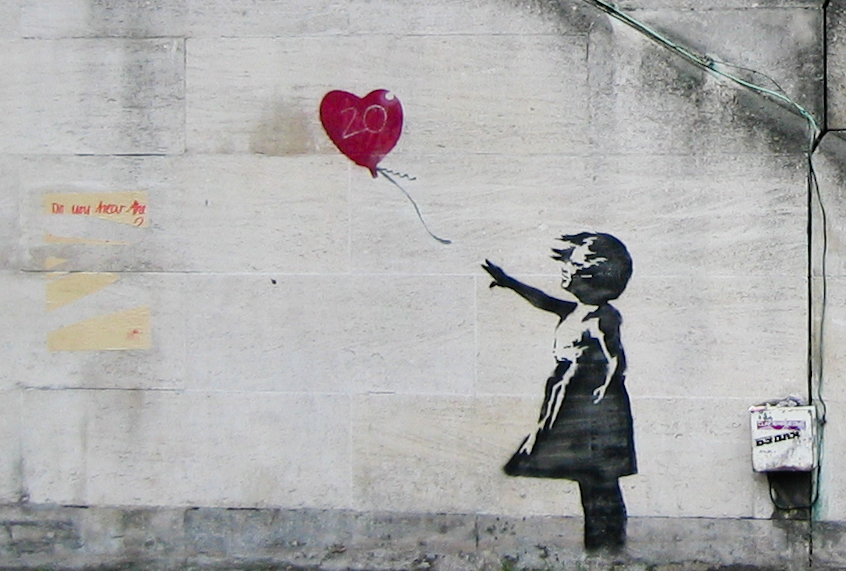
Girl with Balloon: This poignant piece depicts a young girl reaching out toward a red heart-shaped balloon, symbolizing hope and loss.
Rage, the Flower Thrower: A protester throwing a bouquet instead of a weapon critiques violence and promotes the message of peace through creativity.
Love is in the Bin: This work gained notoriety after self-destructing during a live auction, challenging notions of value and ownership in contemporary art.
In October 2018, a painting by the anonymous street artist sold at Sotheby’s auction house in London for £1.04 million. Shortly after the hammer came down, the print of Banksy’s 2006 ‘Girl with Balloon’ began to pass through a shredder installed in the frame, destroying half of it. “It appears we just got Banksy-ed,” reported Alex Branczik, Sotheby’s Senior Director and Head of Contemporary Art in Europe.
The piece was a famous Banksy print known as ‘Girl with Balloon’, created back in 2006. Banksy’s balloon girl, which was voted the UK’s best-loved work of art in 2017, became the first instance of a self-destructing painting. Banksy posted a video to his Instagram account to confirm the move was intentional and demonstrate how he built a shredding device into the large golden frame. The work was then given a new title: “Love is in the Bin“. In October 2019, another Banksy artwork took the country by storm.
https://en.wikipedia.org/wiki/List_of_works_by_Banksy
https://en.wikipedia.org/wiki/List_of_works_by_Banksy_that_have_been_damaged_or_destroyed
1. Festival (Destroy Capitalism) 2006
Festival, also known as Destroy Capitalism, depicts a group of people at a music festival queuing up to buy t-shirts. They are clearly portrayed as punks, goths and hippies attending some sort of music festival with clothes, haircuts and attitudes representative of those subcultures. They represent what society might consider as anti-capitalists or “outsiders.” However, they queue up to buy a $30 t-shirt, just like the rest of society – illustrating the power that capitalism holds even for its most fervent opponents.
Festival can also be read as an ironic comment on how independent and anti-globalization events, like alternative music festivals, for example, have now become hypocritical versions of themselves – contradicting the very thing their attendees cry out against. The irony of the work unintentionally reached its climax in 2013, however, when Walmart – the American multinational retail corporation which is the very embodiment of capitalism – sold a series of Festival at a markup through their online marketplace (without asking Banksy for permission to use the imagery, to boot).
Release History. Festival is one of six prints belonging to the Barely Legal Print Set, which also includes Grannies, Trolleys, Morons, Applause, and Sale Ends. Festival was originally released at Barely Legal as an edition of 100 unsigned prints, printed by Modern Multiples, that sold for $500 a piece.
2. Girl with Balloon 2002
There Is Always Hope… With its striking simplicity and raw immediacy, Girl with Balloon is now one of the most widely recognizable images created by Banksy. Beating Turner’s The Fighting Temeraire, Constable’s The Hay Wain and Hockney’s A Bigger Splash to the top spot, Banksy’s Girl with Balloon was voted UK’s favorite artwork in a 2017 poll; a resounding affirmation of the broad and wide-reaching popularity of this undeniably iconic and culturally formidable image.
Girl with Balloon first appeared as an original graffiti mural first painted outside a Shoreditch shop in 2002 and later at London’s Southbank that very same year, this time accompanied by the epitaph “There is Always Hope”.
Girl with Balloon3.
In the realm of contemporary art, few images resonate as profoundly as Banksy’s Love Is in the Air. Also known as Flower Thrower, this artwork encapsulates the paradox of aggression and peace, revolution and love. Originating as a piece of guerrilla street art, it has since transcended its medium to become a global emblem of nonviolent resistance.
An archetypal example of Banksy’s perceptive and stimulating commentaries on contemporary political and social events, Love is in the Air is one of the most recognizable works by the brilliant graffiti artist and offers a simple message of hope. Love is in the Air has been imitated and replicated countless times as a testament to its visual strength and power. It is indisputable that this bold and powerful work helped to establish Banksy’s place in art history, cementing his reputation as a pivotal and universally heard artistic voice.
In its original guerrilla iteration in Beit Sahour near the West Bank Barrier, Love is in the Air testifies to Banksy’s unique ability to activate urban environments and public architecture in a way that supercharges his message, lending his images a searing immediacy which extends far beyond all those who live in or visit the region, juxtaposing the active gesture of protest with the reconciliatory symbol of a Flower Bouquet.
In 2003, amidst the escalating tensions surrounding the construction of the West Bank Wall, Banksy unveiled Love is in the Air on the side of a garage in Beit Sahour, a Palestinian town east of Bethlehem, close to the Israeli West Bank Barrier. A 708-kilometre wall controlled by a series of checkpoints and observation towers, the Israeli West Bank Barrier separates Israel from the West Bank territories of Palestine.
The mural portrays a masked protester poised to hurl a bouquet of flowers, replacing the expected Molotov cocktail with a symbol of peace.This juxtaposition serves as a poignant commentary on the power of peaceful protest in the face of oppression.
Since “Love is in the Air,” the West Bank barrier wall has become a particular focus for Banksy. Over the years, multiple works have sprung up in the region: notably his 2005 take on his iconic Girl with Balloon, depicting a young girl being lifted over the wall by a bunch of balloons. In 2017, Banksy designed the Walled Off Hotel, with a view of the barrier, to boost tourism in the area while simultaneously highlighting the ongoing conflict.
Love is in the Air
Lady Showering is a satirical, stenciled piece that highlights the themes of surveillance, privacy, and voyeurism.The artwork is interpreted as a critique on the erosion of personal privacy and the rise of a “surveillance culture” in modern society, where individuals are constantly being watched. It combines dark humor with the artist’s signature stencil style.
5. Girl Frisking Soldier 2007
“Banksy’s decorations of the West Bank barrier are widely held up as a genuine expression of political activism in support of both ‘the Palestinians’ and the advancement of human rights.”
This image, created by Banksy in 2007 and located on the West Wall of Bethlehem, subverts expectations. The soldier is being frisked by a little girl, rather than the other way around. It is impossible not to realize that the reverse of this image is a more realistic occurrence in Palestine. Banksy manages to portray a controversial idea, children being persecuted, without showing the image of the girl being frisked. Additionally, the image shows how people dehumanize one another by viewing each other only as threats. As Koensler and Papa write, “Palestine is now the biggest open-air prison of the world”. This image demonstrates the limited freedom of Palestinians with role reversal, confronting the audience with a disturbing image of a child as a persecutor.
As with “The Petrol Bomber” and “The Death of Innocence,” a child is being used to symbolize innocence and vulnerability. The girl even has braided hair, representing youthful innocence, and her pink dress contrasts with the olive green uniform of the soldier. The gun lying next to her represents violence and aggression.
Unlike the murals created by the Bogside Artists, Banksy is an outsider of the struggle he is commenting on. The Bogside Artists live in Ireland and experienced the Troubles firsthand. Their art is personal, at times representing individuals they know, and often portraying members of the community. Banksy, while doing important work by bringing public and international attention to the conflict in Palestine, does not have this personal connection with the community. His work is less about representing what the community is feeling, less about feeling pain in a constructive way, and more about publicity.
Girl Frisking Soldier
6. No Ball Games 2009
A Study in Authority, Childhood and the Quiet Rebellion of Play
The composition presents two children engaged in a game. They appear to be playing catch, their movements light and natural, entirely absorbed in the activity. However, instead of a ball, they are tossing a sign that reads “NO BALL GAMES.” The inversion is immediate and precise. The object intended to prohibit play becomes the very instrument of it. The children do not destroy the sign, nor do they ignore it. They incorporate it.
The figures are rendered with clarity and softness, contrasting with the rigid, graphic authority of the sign. Their gestures are fluid, unforced, and entirely unconcerned with the rule they are subverting. The scene feels balanced, almost harmonious, despite the contradiction at its core.
No Ball Games
HARRY JEROME
This is a copy of the 2.7-metre (9 ft) bronze statue of Harry Jerome at the entrance to Stanley Park in Vancouver.
Harry Jerome (1940 – 1982) was a Canadian track and field sprinter and physical education teacher. He won a bronze medal at the 1964 Olympics in Tokyo and set a total of seven world records over the course of his career.
Harry Jerome was born in Prince Albert, Saskatchewan, and moved to North Vancouver, British Columbia, at age 12. His grandfather was John Howard, an American-born railway porter who represented Canada in the 1912 Summer Olympics. Harry’s sister, Valerie Jerome, was also an Olympian who competed for Canada at the 1960 Summer Olympics in Rome.
Jerome competed at the university level for Bill Bowerman at the University of Oregon. He was a member of the Canadian track and field team at the 1960, 1964, and 1968 Summer Olympics, winning the 100 metre bronze in 1964. Jerome wore his University of Oregon sweats, rather than the contemporary practice of an official national outfit for all Olympic appearances, to warm up for the Olympic 100 metres in Tokyo. He won the gold at the 1966 British Empire and Commonwealth Games held in Kingston, Jamaica.
During his career, Jerome set a total of seven world records, including tying the 100 metre record at 10.0 seconds in 1960, equalling the mark established a month earlier by Germany’s Armin Hary. Later he tied the world record for the 100 yard dash at 9.3 seconds (1961), making Jerome one of the few athletes to own both the 100 yard and 100 metre world record simultaneously. Jerome was a member of the University of Oregon 4 × 100 m relay team that tied the world record of 40.0 seconds in 1962; during the 1962 season, Harry ran 9.2s at the 100 yard dash 2 times. In 1966 he again tied a world record with a 9.1 time in the 100 yard. From 1963 to 1966 he held or equalled four world records concurrently.
He remains the only man to have held the 100 yard world record with 3 different times and is the oldest 100y world record holder, at 25 years old. Jerome never owned the 100y or 100m WR solely but matched his contemporaries. Jerome continued to sprint successfully until the late 1960s.
Jerome received a bachelor’s degree in physical education from the University of Oregon in 1964 and taught with the Richmond School Board (1964–65) and then with the Vancouver School Board (1965–68). In 1968, he received a master’s in physical education from Oregon.
After retiring from athletics in 1969, Jerome was invited by Prime Minister Pierre Trudeau to help create Canada’s new Ministry of Sport. Jerome held a number of senior positions in the ministry but resigned over the government’s cancellation of a large public-private partnership he had negotiated with Kellogg’s to promote youth participation in athletics. During the 1980s, Jerome headed the Premier’s Sport Award program in British Columbia.
Jerome died of a brain aneurysm on December 7, 1982, at the age of 42, in North Vancouver.

Machu Piccu
This is an amalgamation of two pictures, the hills and sky are from a second source. Graphite, pencil crayon,
