
A Study in Authority, Childhood, and the Quiet Rebellion of Play
With No Ball Games, Banksy returns to one of his most enduring subjects: the tension between authority and childhood. The image is immediately accessible, almost playful in appearance, yet beneath its simplicity lies a sharp and controlled critique. By staging a confrontation between children and an imposed rule, Banksy constructs a scene where innocence does not merely resist authority—it effortlessly bypasses it.
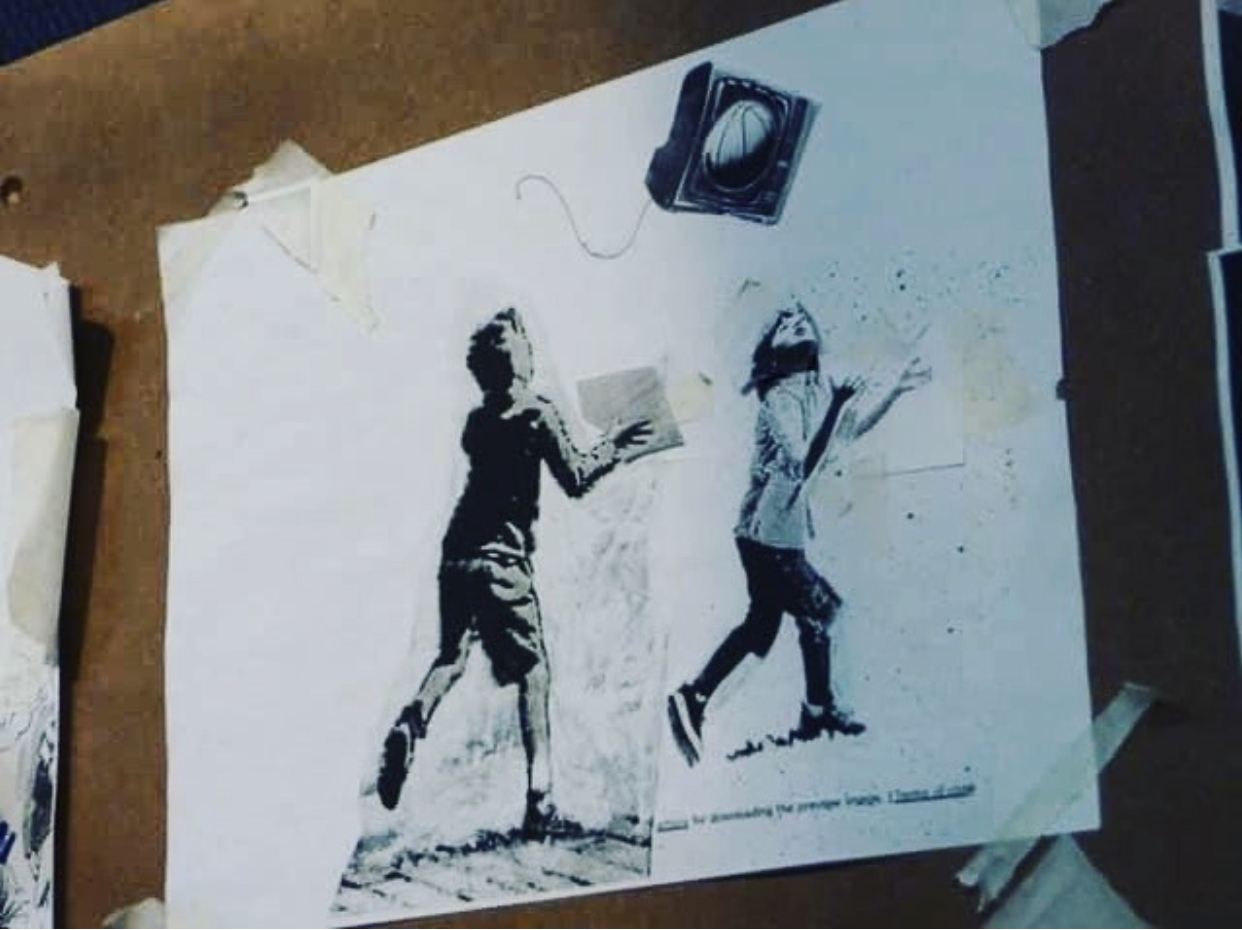
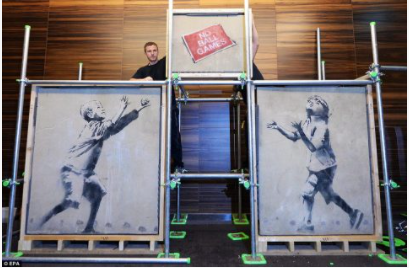
The composition presents two children engaged in a game. They appear to be playing catch, their movements light and natural, entirely absorbed in the activity. However, instead of a ball, they are tossing a sign that reads “NO BALL GAMES.” The inversion is immediate and precise. The object intended to prohibit play becomes the very instrument of it. The children do not destroy the sign, nor do they ignore it. They incorporate it.
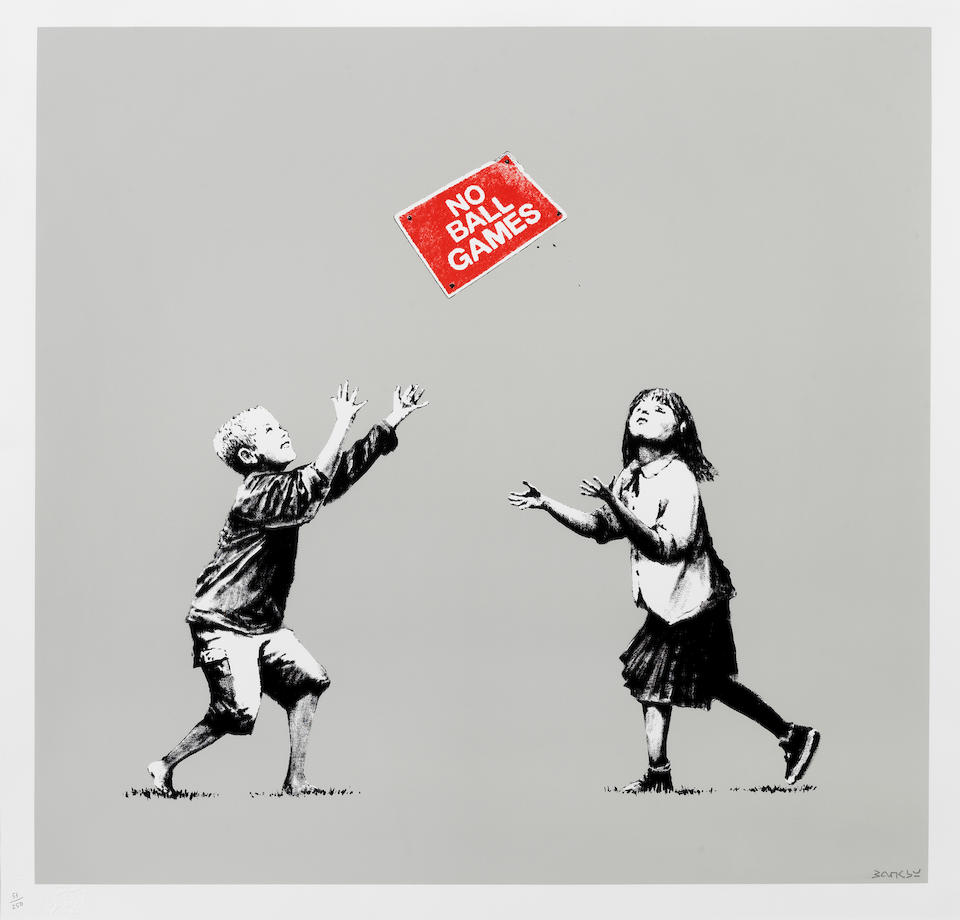
The figures are rendered with clarity and softness, contrasting with the rigid, graphic authority of the sign. Their gestures are fluid, unforced, and entirely unconcerned with the rule they are subverting. The scene feels balanced, almost harmonious, despite the contradiction at its core.
Authority Reappropriated
No Ball Games explores the fragility of imposed authority when confronted with imagination. The sign represents a familiar form of control: urban regulations designed to restrict behavior, often in public or communal spaces. Its language is direct, impersonal, and absolute. It does not negotiate. It imposes. The children, by contrast, do not confront the rule directly. They do not protest or reject it. Instead, they reinterpret it. By turning the sign into a ball, they strip it of its authority without ever engaging in open defiance.

This gesture is essential. It suggests that resistance does not always require opposition. It can emerge through transformation. Banksy proposes a subtle but powerful idea. Systems of control depend on recognition and compliance. When these are withdrawn, even playfully, the system begins to dissolve. The authority of the sign is not challenged; it is rendered irrelevant. The work also speaks to a broader tension within urban environments, where spaces designed for community are increasingly regulated. The children reclaim that space, not through force, but through imagination.
London and Urban Regulation
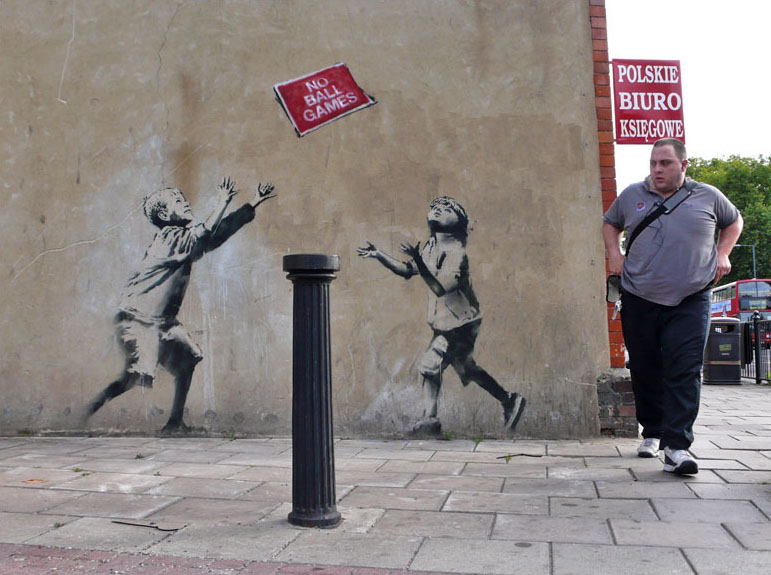
By situating the image directly within this environment, Banksy collapses the distance between artwork and subject. The critique is not theoretical. It is embedded in the very space it addresses.
Childhood as Creative Resistance
The children are central to the work’s meaning. They are not portrayed as rebellious in a conventional sense. There is no aggression, no confrontation, no visible tension. Their resistance is quiet, instinctive, and entirely natural.
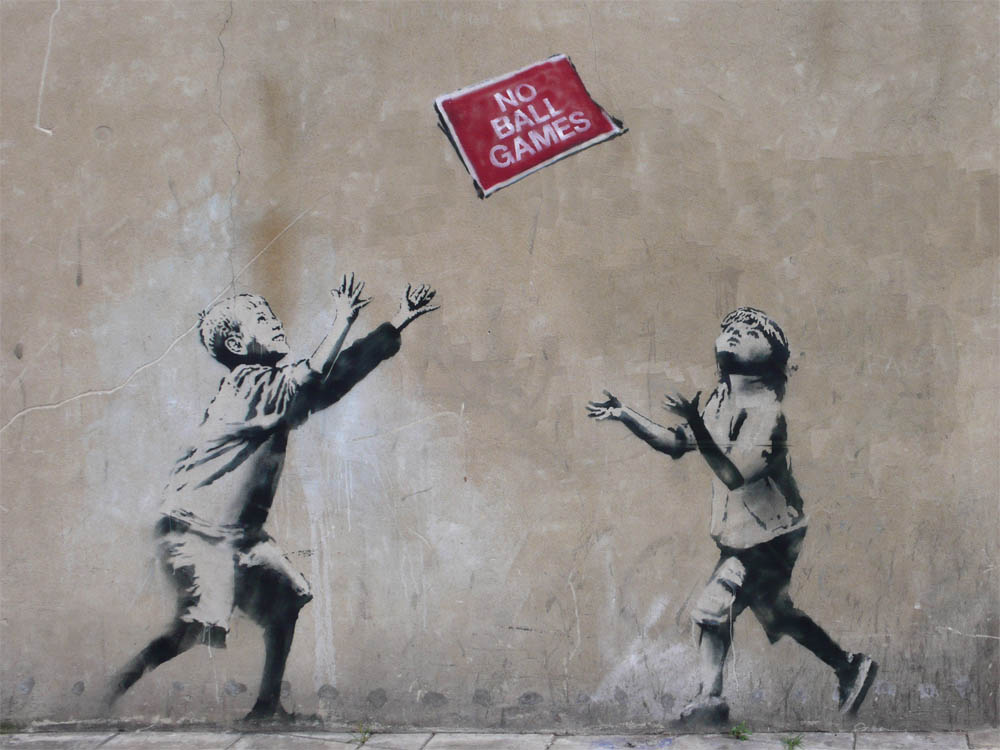
This is what gives the image its strength. The children do not recognize the authority of the sign in the way it is intended. They see an object, and they use it. In doing so, they reveal a fundamental truth. Authority often relies on shared belief. Without that belief, it loses its power. Banksy captures a moment where innocence is not passive, but transformative.
Lesson
No Ball Games remains one of Banksy’s most widely recognized and accessible images. Its clarity makes it immediately engaging, while its conceptual precision ensures its lasting relevance. The work continues to resonate in contemporary urban environments, where questions of space, control, and freedom remain central. It speaks not only to children, but to anyone navigating systems of imposed limitation. Within Banksy’s oeuvre, it stands as a refined example of his ability to communicate complex ideas through minimal means.

Two children play. Their movements are light, effortless, and unconstrained. They follow no instruction, obey no rule. And yet, they do not resist. They simply take what is given and turn it into something else. The sign remains. The authority dissolves. Banksy does not depict rebellion. He shows something far more effective: the quiet disappearance of control.
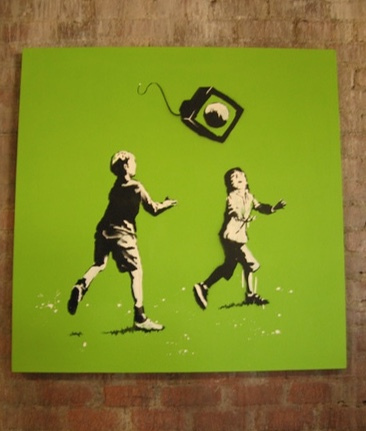
2009 was a turning point for Banksy as he parted ways from long-term gallery Steve Lazarides, and announced a new entity called Pest Control Office would be the unique point of sale for Banksy artworks going forward. No Ball Games (Grey) was sold by Pictures on Walls, at their Commercial Street Gallery in London. No Ball Games (Green) was only sold via online lottery.
No Ball Games
Year: 2009
Editions
No Ball Games (Grey): 250 signed
No Ball Games (Green): 250 signed
