
Can the Aral Sea be reborn?
A generation ago, the vanishing of the Aral Sea became global shorthand for environmental desolation. Today the region has become a test bed for a resilient future.
In 1960, the Aral Sea was the world’s fourth largest lake, a rich and productive ecosystem teeming with carp, bream, and other species—by one estimate, it provided a sixth of all fish consumed in the Soviet Union. Hundreds of feet deep and hundreds of miles across, the sea was a world unto itself for the people who lived and fished on its shores and for the sailors who crossed it.
But change was coming. In 1968, Pravda, the official state newspaper of the Soviet Union, carried a story with an astonishing prophecy. This world would soon vanish, it said. Already the water level had started to fall, and it would fall further, its edges creeping away from the fishing towns on its shores, the lake bed changing to desert. By the turn of the century, “essentially, the Aral Sea will no longer exist.”
There was no magic behind the prophecy—just math. In the preceding years, Soviet officials had built large-scale irrigation projects that diverted the Amu Darya and Syr Darya, the rivers that fed the Aral Sea, into cotton production. Without their inflow, there was nothing to replace the water lost naturally through evaporation. For a brief time, the region enjoyed the best of both worlds: the lake, with its productive fisheries and mild climate, and the cotton industry, with the hard cash it earned. But as the rivers turned away, the lake shrank and shrank to less than 10 percent of its mid-century footprint, leaving behind a salt-encrusted desert.
At the end of a day of picking cotton, workers line up to have their harvests weighed. Cotton is a major part of Uzbekistan’s economy, employing a quarter of its workforce, and the irrigation necessary to sustain it is the main reason little water reaches the Aral Sea anymore.
The prophecy had been duly engineered: The Aral Sea as such no longer existed. “From an environmental perspective, it was a huge mistake,” says Bulat Yessekin, an environmental policy expert who spent decades working on Central Asian water access issues with international nonprofit groups.
Today the Aral Sea stands not only as a worldwide symbol of catastrophe but also as the first domino to fall in a freshwater crisis. Iran’s Lake Urmia has also shrunk over the past half century by 90 percent, as has Lake Chad in Central Africa. In the United States, the Great Salt Lake in Utah has become so salty because of water loss that its brine shrimp are at risk of dying out. All these crises are tied together with the pressures of human population growth and climate change.
But some conservationists are now looking to the fate of the Aral Sea and asking another question: If humanity can create ecological disaster, can we also undo it?
The blunt answer is that we don’t know, and finding the solution will take time. None of these problems sprang up overnight. It’s taken generations for these changes to work themselves through the environment, and it will take generations more to undo them, even in the best-case scenario. Not everyone is optimistic. But some environmental advocates are now exploring the idea—both in theory and alongside a steadily growing list of practical interventions that may allow those still living in the region to see a larger reversal of fate someday.
“We can change the system,” Yessekin says. “We can change the unsustainable activity and have more water for biodiversity. And then it’s possible to start to restore the Aral Sea.”
Five Central Asian nations depend on that water economically. Hydroelectric dams in Tajikistan and Kyrgyzstan generate electricity to heat homes and power industry, while irrigation canals in Uzbekistan, Turkmenistan, and Kazakhstan feed a cotton industry that provides jobs and hard-currency exports. “In order to fully restore the sea, it will be necessary to completely stop all economic activity in the basin for at least 30 to 40 years,” says Vadim Sokolov, an official at the International Fund for Saving the Aral Sea, an intergovernmental organization of Central Asian countries. “That is unrealistic.”
Yet the true cost of that economic activity is immense. With the lake gone, the climate has changed. Temperatures are more extreme, rainfall is lower, and each year sandstorms carry more than 100 million tons of salt, fertilizers, and pesticides into the air.
The parlous state of the Aral Sea has come to seem such an intractable problem that today there’s hardly even any discussion about how to return the ecosystem to its prior state, says National Geographic Explorer and photographer Anush Babajanyan, who over the past six years has turned her lens to the communities living amid the remnants of the once great lake. “The people would all like to have the sea back,” she says. “But I never hear them talk about it coming back. I don’t think they can imagine it.”
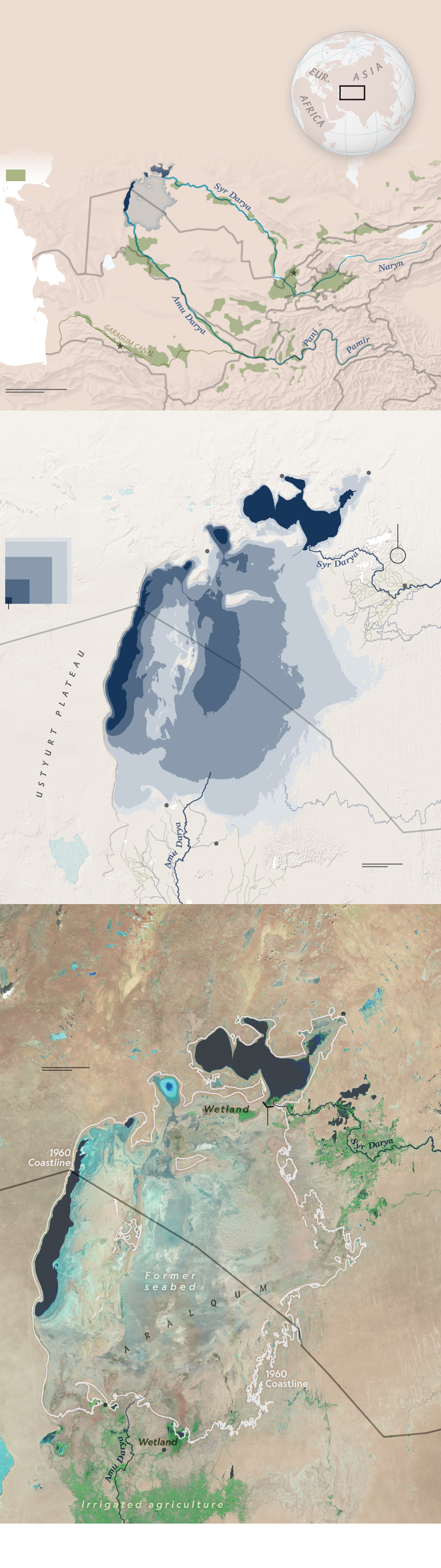 Fading of a Sea. Once the world’s fourth largest lake, the Aral Sea has diminished to a fraction of its former grandeur. By the 1960s, the Soviet practice of diverting water from the Syr Darya and Amu Darya rivers to irrigate cropland began to show an impact. For six decades, evaporation has continued to reduce the lake year after year. Salts are concentrated in remaining waters and exposed lake beds, making the region increasingly inhospitable.
Evaporating away. In the south, the coast has receded to the far western part of the basin. In the north, where water is collected behind a dam, lake levels remain stable.
What remains of the Aral Sea. This colorized infrared view enhances the difference between the waters and the former lake bed now known as the Aralqum, a polluted desert full of salt, pesticides, and fertilizers deposited as the water receded. Winds stir up the toxic mix, blowing it westward into Eastern Europe.
Instead, they adapt and endure. In the westernmost remnant of the former Aral Sea, now called the South Aral Sea, the water has become so salty that all the fish have died, but people can eke out a livelihood harvesting the eggs of the brine shrimp that now live there. The water also draws tourists, who can float effortlessly on it thanks to its high density of dissolved salts. And out in the expanse of the dry lake bed, a hot spring bubbles geothermally warmed salt water that draws locals for its reputed magic healing powers.
Resilience and adaptability are admirable, but it would be better if the environment weren’t so challenging to survive in. Efforts to mitigate the effects of desertification have been underway since even before much of the lake had dried up. In Kazakhstan, the construction of an eight-mile-long dike has allowed the North Aral Sea to stabilize, and though a small fraction of the original lake’s size, it supports a modest fishery. In neighbouring Uzbekistan, the government has worked with nonprofits to fund the planting of millions of saxaul trees on its portion of the former lake bed. This tough, salt-tolerant species is one of the few that can survive in the desert, and it’s hoped that the trees’ roots will bind the soil together and mitigate sandstorms.
One of the most promising incubators of new ideas is the International Innovation Center for the Aral Sea Basin in Nukus, Uzbekistan, where scientists are carrying out about 20 experimental projects that explore the adaptation of plant, animal, and human life to the region’s current ecological reality.
“Our research is simultaneously aimed at improving the living conditions of the population and restoring and protecting the environment,” says Bakhitjan Khabibullaev, the center’s director.
One project is looking into how to grow microgreens using hydroponics. Since the technique doesn’t require dirt, it could provide a way to grow vegetables in a region where the soil has become increasingly degraded. “The idea is to teach the technique to rural communities, to help them become more self-sufficient,” says Babajanyan, who observed the lab during a tour of the center’s research facilities.
The center is also studying an advanced form of drip irrigation called the Buried Diffuser, which replaces traditional leak-prone trenches with a network of hoses that delivers controlled doses of water deep to the roots of plants. Together with lining canals with plastic or cement, this technique can dramatically improve the efficiency of crop production. Since 2021, Uzbekistan’s aggressive adoption of water-saving measures has resulted in a 25 percent improvement in the efficiency of the country’s water use. “We reduced intake and use of water for irrigation by eight billion cubic meters,” says Sokolov. “This is huge progress.”
Although these measures help economically, he says, they haven’t yet resulted in more water being returned to the ecosystem. Two of the region’s biggest export crops, cotton and rice, are notoriously water-hungry, and while the system’s efficiency has improved, those gains have been more than offset by increases in production. Since 2020, the cotton harvest in Uzbekistan has climbed by 50 percent.
This is according to Yessekin, who spent a decade working on environmental issues with the Kazakhstan government and believes that, in the long term, the process of reversing the Aral Sea catastrophe will begin with shifting away from such thirsty crops. “It can take six metric tons of water to grow one kilogram of rice,” he says. “We need to stop the current water-intensive production. Vegetables and fruits take several times less water.”
That shift would be a massive step forward, but no single initiative on its own will be enough to reverse a regional ecological disaster; the scale of the problem is too immense. The fate of the Aral Sea lies not in the lake bed itself but in the high, distant mountains from which its water springs, and in the lands in between, where it gets drained away. To get the most out of the resource will require clear thinking by all the stakeholders about what the optimal use of the water is and what must be done to achieve it. As a next step, Yessekin is campaigning for the establishment of an international commission to study the crisis holistically and then implement a binding regional plan that will halt the ongoing overuse of natural resources and “stop further destruction of rivers, forests, and other ecosystems.”
None of this will be easy, and none of it will be accomplished in the immediate future. But if the Aral Sea was patient zero in the story of environmental disaster, it could also be a case study for how to return to ecological health. “If we do something in this direction, I think it will be a very good example for all humanity about how to survive in future,” says Sokolov. “I am an optimist. I believe that we will find a way.”
