
The Taliban in Afghanistan
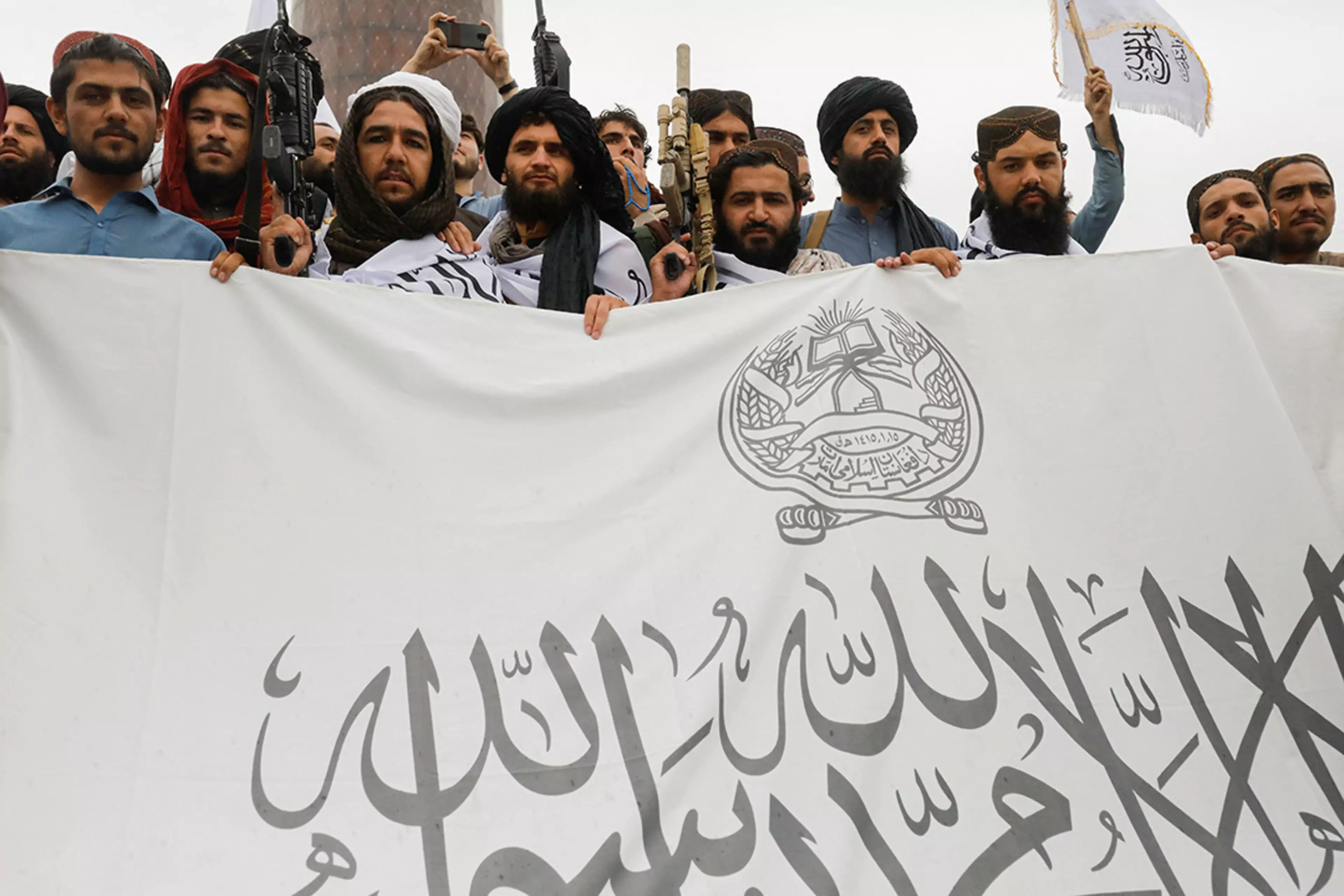
- The Islamic fundamentalist group returned to power in Afghanistan in 2021 after waging an insurgency against the U.S.-backed government in Kabul since 2001.
- Under Taliban rule, Afghanistan’s economy has floundered. Malnutrition has soared, and hundreds of thousands of jobs have been lost. Most women have been banned from working.
- The Taliban maintain close ties with al-Qaeda. Analysts are concerned that the Taliban could provide it with safe haven and allow it to launch international terrorist attacks from Afghan soil.
Introduction
The Taliban are a predominantly Pashtun, Islamic fundamentalist group that returned to power in Afghanistan in 2021 after waging a twenty-year insurgency.
Following the U.S.-led invasion that toppled the original regime in 2001, the Taliban regrouped across the border in Pakistan and began taking back territory less than ten years after their ouster. By August 2021, the Taliban had swept back into power. Their swift offensive came as the United States withdrew its remaining troops from Afghanistan as outlined in a 2020 peace agreement with the group.
The Taliban have imposed a harsh interpretation of Islamic law despite pledges to respect the rights of women and religious and ethnic minority communities. Meanwhile, as they have transitioned from an insurgent group to a functional government, the Taliban have struggled to provide Afghans with adequate food supplies and economic opportunities.
What has the Taliban’s return to power meant for the rights of women and other Afghans?
The Taliban threaten Afghans’ civil and political rights enshrined in the constitution created by the U.S.-backed government. Since regaining control, the Taliban have taken actions reminiscent of their brutal rule in the late 1990s.
The UN mission in Afghanistan has documented numerous human rights violations. The Taliban have intimidated journalists and restricted press freedoms, leading to the closures of more than two hundred news organizations. Their government has violently cracked down on demonstrations, and protesters and activists have been monitored and forcibly disappeared. They also reestablished their Ministry for the Propagation of Virtue and Prevention of Vice, which under their previous rule enforced prohibitions on behavior deemed un-Islamic. In November 2022, they ordered judges to enforce their interpretation of sharia; in the weeks after, authorities resumed public floggings and executions.
Women have seen their rights obliterated. The Taliban have prohibited most girls from attending secondary school, banned all women from attending and teaching at universities, and prevented women from working. In December 2022, the group prohibited women from working at local and international nongovernmental organizations (NGOs). The UN Development Program (UNDP) has estimated that restricting women’s employment could cost up to 5 percent of Afghanistan’s gross domestic product (GDP). Amnesty International has reported a drastic increase in the number of women arrested for violating discriminatory policies, such as rules requiring women to only appear in public with a male chaperone and to completely cover their bodies. The rates of child marriage have also increased.
The Taliban’s takeover has also wiped out gains in Afghans’ standards of living that were made over the two decades after the U.S. invasion, according to the UNDP. In an October 2022 report, the agency said that almost all Afghans were living in poverty. The economy has shrunk by up to 30 percent since the takeover, and an estimated seven hundred thousand jobs have been lost. More than 90 percent [PDF] of the population has been suffering from some form of food insecurity. Exacerbating the crisis is a pause in aid by some countries and international organizations, which had been the lifeline of the economy and public health sector.
At the same time, the takeover brought an end to fighting that pitted Taliban fighters against U.S. and Afghan government forces. The country’s overall security situation has improved and civilian casualties have declined. However, violence remains widespread, particularly as the Islamic State in Khorasan terrorist group has increased attacks on civilians throughout the country.
Could Afghanistan again become a safe haven for terrorists?
International observers remain concerned that the Taliban support terrorist organizations, particularly al-Qaeda, posing a threat to regional and international security. The United States invaded Afghanistan after it refused to hand over Osama bin Laden, the mastermind of the 9/11 attacks. Under the Taliban’s rule, Afghanistan could become a safe haven for terrorists capable of launching attacks against the United States and its allies, experts say, despite Taliban statements that “Afghanistan’s soil will not be used against the security of any other country.”
In its April 2022 report, the UN team that monitors the Taliban said the group “remains close” with al-Qaeda and that “al-Qaeda has a safe haven under the Taliban and increased freedom of action.” Indeed, in August, a U.S. drone strike killed al-Qaeda leader Ayman al-Zawahiri in Kabul. Reports suggested that Zawahiri was living in the home of a Taliban aide, and other al-Qaeda leaders are believed to be based in the country. The UN report said that al-Qaeda is likely using Afghanistan as a “friendly environment” to recruit, train, and fundraise, although it is unlikely to launch an international attack before 2023 at the earliest. Following Zawahiri’s killing, a leaked U.S. assessment said that al-Qaeda has not reconstituted its presence in Afghanistan, though some experts disagreed.
In addition, violence has increased along Afghanistan’s border with Pakistan, which has historically supported the Taliban. (Pakistan is thought to have provided financial and logistical support to the Taliban during the U.S. war, though Islamabad denies this.) The Taliban’s return to power has emboldened Tehrik-e-Taliban, a militant group sometimes referred to as the Pakistani Taliban. In late 2022, the group ended a cease-fire with the Pakistani government and launched attacks across the country. Pakistani officials have accused the Afghan Taliban of providing the militants with a safe haven in Afghanistan.
How has the world responded to the Taliban?
During the U.S. war in Afghanistan, governments and international bodies joined U.S.-led efforts to oust the Taliban and bolster Afghanistan’s government, democratic institutions, and civil society. They have taken various actions since 2001:
Military force. U.S. troops quickly overthrew the Taliban after they invaded Afghanistan in October 2001. The Taliban then waged an insurgency against the U.S.-backed Afghan government. The group withstood counterinsurgency operations from the world’s most powerful security alliance, the North Atlantic Treaty Organization (NATO), and three U.S. administrations over the course of a war that killed more than 6,000 U.S. troops and contractors and over 1,100 NATO troops. Some 47,000 civilians died, and an estimated 73,000 Afghan troops and police officers were killed between 2007 and 2021. Tens of thousands of Taliban fighters are also believed to have died. The number of U.S. troops in Afghanistan peaked at around 100,000 in 2011. NATO assumed leadership of foreign forces in 2003, marking its first operational commitment outside of Europe. At its height, NATO had more than 130,000 troops from fifty nations stationed in Afghanistan. In the 2020 U.S.-Taliban agreement, the United States committed to withdrawing all U.S. and NATO troops from Afghanistan if the Taliban carried out commitments that included cutting ties with terrorist groups. The United States completed its troop withdrawal in August 2021.
Sanctions. The UN Security Council first imposed sanctions on the regime for harboring al-Qaeda in 1999 and expanded the sanctions after 9/11. They target Taliban leaders’ financial assets and ban them from most travel. The Security Council also imposed an arms embargo on the Taliban. The United States and the European Union maintain additional sanctions, which have hindered aid deliveries since the Taliban’s takeover. Meanwhile, the United States has blocked the Taliban from accessing billions of dollars in assets.
Aid. For years, the Afghan government depended on assistance from dozens of countries; 75 percent of the government’s public expenditures were covered by grants from international partners, according to a 2019 World Bank report. Many of these countries suspended aid after the Taliban took over, sparking concerns of further economic turmoil. But in 2022, aid picked up, with donors providing over $2.6 billion. Since the takeover, the United States has provided more than $1.1 billion in aid. Still, UN officials said the commitments fell short of the country’s humanitarian needs.
Diplomatic ties. Many Western countries, including the United States, shut down their diplomatic offices in Afghanistan after the Taliban took over. They have refused to recognize and establish diplomatic ties with the Taliban government, which calls the country the Islamic Emirate of Afghanistan. (A handful of states, including China and Russia, have accredited Taliban-selected diplomats.) In addition, the UN General Assembly has indefinitely postponed a vote on who can represent Afghanistan at the United Nations.
Investigation. The Taliban are now under investigation by the International Criminal Court for alleged abuses of Afghan civilians, including crimes against humanity, carried out since 2003. U.S. and Afghan forces are also being investigated for alleged war crimes.
Who leads the Taliban?
The Taliban have been led for decades by a leadership council, called the Rahbari Shura. It is better known as the Quetta Shura, named for the city in Pakistan where Mullah Mohammed Omar, the Taliban’s first leader, and his top aides are believed to have taken refuge after the U.S. invasion. (Omar died in 2013 and was succeeded by Mullah Akhtar Mohammad Mansour, who was killed in a 2016 U.S. air strike in Pakistan.) Today, the Rahbari Shura is thought by analysts to oversee the Taliban government’s work, though its precise role is unclear. It is led by Mawlawi Hibatullah Akhundzada, who has not been seen publicly in years. (Taliban officials said in 2022 that Akhundzada had visited Kabul, but no photos or videos of such an appearance were made public. An audio recording of a speech he reportedly gave was released.)
The government is led by a thirty-three-member caretaker cabinet. All ministers are men and are former Taliban officials or individuals loyal to the group. A majority are ethnic Pashtuns, and some are considered terrorists by the United States and are sanctioned by the United Nations. Mohammad Hassan Akhund, who was close with Omar, is acting prime minister. Taliban cofounder Mullah Abdul Ghani Baradar, who led peace negotiations with the United States, is Akhund’s deputy. Sirajuddin Haqqani—who is acting head of the Haqqani Network, a militant group in Afghanistan’s southeast and Pakistan’s northwest with close ties to the Taliban, al-Qaeda, and Pakistan’s intelligence services—is the acting interior minister. Mullah Muhammad Yaqoub, Omar’s son, is acting defense minister. Mawlawi Amir Khan Muttaqi is the acting foreign minister, and Zabihullah Mujahid is the government’s spokesperson.
How were the Taliban formed?
The group was formed in the early 1990s by Afghan mujahideen, or Islamic guerrilla fighters, who had resisted the Soviet occupation of Afghanistan (1979–89) with the covert backing of the CIA and its Pakistani counterpart, the Inter-Services Intelligence directorate (ISI). They were joined by younger Pashtun tribesmen who studied in Pakistani madrassas, or seminaries; taliban is Pashto for “students.” Pashtuns comprise a plurality in Afghanistan and are the predominant ethnic group in much of the country’s south and east. They are also a major ethnic group in Pakistan’s north and west.
The movement attracted popular support in the initial post-Soviet era by promising to impose stability and rule of law after four years of conflict (1992–96) among rival mujahideen groups. The Taliban entered Kandahar in November 1994 to pacify the crime-ridden southern city, and by September 1996 seized the capital, Kabul, from President Burhanuddin Rabbani, an ethnic Tajik whom they viewed as anti-Pashtun and corrupt. That year, the Taliban declared Afghanistan an Islamic emirate, with Mullah Mohammed Omar, a cleric and veteran of the anti-Soviet resistance, leading as amir al-mu’minin, or “commander of the faithful.” The regime controlled some 90 percent of the country before its 2001 overthrow.
The Taliban imposed a harsh brand of justice as they consolidated territorial control. Taliban jurisprudence was drawn from the Pashtuns’ pre-Islamic tribal code and interpretations of sharia colored by the austere Wahhabi doctrines of the madrassas’ Saudi benefactors. The regime neglected social services and other basic state functions even as the Ministry for the Promotion of Virtue and Prevention of Vice required women to wear the head-to-toe burqa, or chadri; banned music and television; and jailed men whose beards it deemed too short.
What is the state of the Taliban’s finances?
Foreign trade with Afghanistan has fallen since the takeover. Despite a decline in imports, however, most of the country’s revenue in 2022 [PDF] came from taxes at border crossings. Additionally, it has increased coal exports to Pakistan. The Taliban government’s proposed budget for fiscal year 2022 was $2.6 billion. (The previous government had a budget of around $6 billion in 2021.)
Prior to the takeover, the Taliban primarily earned revenue through criminal activities, including opium poppy cultivation, drug trafficking, extortion of local businesses, and kidnapping, according to the UN monitoring group. In 2021, Afghanistan accounted for 86 percent [PDF] of the world’s illicit opium production. However, in April 2022, the Taliban banned poppy cultivation.
Do Afghans support the Taliban?
For years after their fall from power in 2001, the Taliban enjoyed support. The Asia Foundation, a U.S.-based nonprofit organization, found in 2009 that half of Afghans—mostly Pashtuns and rural Afghans—had sympathy for armed opposition groups, primarily the Taliban. Afghan support for the Taliban and allied groups stemmed in part from grievances against public institutions.
But in 2019, a response to the same survey found that only 13.4 percent of Afghans had sympathy for the Taliban. As intra-Afghan peace talks stalled in early 2021, an overwhelming majority surveyed said it was important to protect [PDF] women’s rights, freedom of speech, and the constitution.
Do any groups threaten the Taliban’s power?
The Islamic State in Khorasan, with up to four thousand members in Afghanistan, has emerged as the Taliban’s main military threat. The terrorist group has continued to launch attacks, particularly against minority communities such as the Hazaras, even as the Taliban work to eradicate it. Analysts say that the group’s attacks on the embassies of China, Pakistan, and Russia in Kabul in late 2022 could hinder the countries’ investment in Afghanistan. Amid the U.S. troop withdrawal, the Islamic State in Khorasan claimed responsibility for an attack near the Kabul airport that killed 13 U.S. service members and at least 170 Afghan civilians. According to the UN monitoring team, that attack elevated the group’s status and led the self-declared Islamic State to provide an additional half a million dollars in funding for the group.
In addition, a resistance movement of former officials, local militia members, and Afghan security forces who call themselves the National Resistance Front formed to oppose the Taliban’s rule, though analysts say the group is currently not strong enough to threaten the Taliban’s control. It is based in the mountainous, northern Panjshir Province and has launched guerrilla-style attacks in several other provinces. The group has called for external support, but U.S. officials have said that Washington does “not support organized violent opposition” to the Taliban.
===============================================================
Life under the rule of the Taliban 2.0
For half of Afghans the mullahs’ regime is less bad than feared

For two decades America and its allies expended thousands of lives and some two trillion dollars in Afghanistan to stop, they said, the Taliban returning the Central Asian country to al-Qaeda plotting and chaos. After the Islamist militants regained power 20 months ago, it was feared that would be Afghanistan’s fate. The reality is a little different.
Ask the hawala dealers, operators of a vast money-transfer market, clustered in a warren-like bazaar beside the Kabul river. Having for years helped the Taliban finance their insurgency, these well-connected moneymen, who are estimated to provide twice the volume of commercial loans that Afghanistan’s banking industry does, thought they had nothing to fear from them. The hawaladars had foiled previous efforts by Ashraf Ghani, the country’s last nato-backed leader, and his predecessor, Hamid Karzai, to regulate their largely untaxed trade. Yet the Taliban government has proved a more committed reformer. It has forced the hawaladars to keep computerised records and follow “Know Your Customer” requirements. Non-compliant businesses have been shut down. The boss of the money-changers’ union was stripped of his licence to operate. “With these guys, you do what you’re told,” says Babarak Amiri, a veteran hawaladar.
The picture in Taliban-governed Afghanistan is not straightforward. The militants’ return has in many ways been disastrous for its 40m people. For women and girls, the disaster has been unambiguous. Afghanistan is now the only country where it is illegal to be female and study beyond secondary-school level, or to work in most professions. According to the un, 80% of Afghanistan’s 2.5m school-age women and girls are not being educated.
Much of the country has been plunged into hunger, due to a combination of volatile global food prices and an economic crisis triggered by the withdrawal of Western support. It led to a collapse in foreign investment and remittances. With foreign banks refusing to facilitate transactions with the country, Afghanistan’s economy shrank by 35% between 2021 and 2022, according to the World Bank.
The Taliban, predictably, have refused to share power with their local rivals. The mullahs are mostly Pashtuns, members of Afghanistan’s biggest ethnicity; many of their opponents belong to the Tajik group, the second-biggest. This raises the risk of a return to the ethnic conflict that ravaged the country in the 1990s, precipitating the Taliban’s first takeover. Extrajudicial killings have accompanied their efforts to stamp out opposition.
Yet the Islamists are in some ways surpassing the—admittedly low—expectations for their rule. Take their approach to terrorism. They do not appear to be trying to constrain al-Qaeda’s remnants in Afghanistan; the group’s former leader, Ayman al-Zawahiri, was living in Kabul when he was killed by an American drone last year. But al-Qaeda is globally at its lowest ebb, superseded by Islamic State (is), a terrorist outfit spawned by the wars in Syria and Iraq. And the Taliban are attacking is’s local affiliate—which they consider a deadly rival—in its rugged hideouts in eastern Afghanistan and elsewhere. Consequently, as Zalmay Khalilzad, a former envoy to the Taliban for Joe Biden and Donald Trump, recently noted, the threat of terrorism launched from Afghanistan has not increased.

Some of the Taliban’s efforts to govern Afghanistan are at least as good as their recent predecessors’. When the country’s currency, the Afghani, crashed to record lows in December 2021, the clerics turned for advice to a central bank stuffed with Western-trained bureaucrats. It did not have the means to stabilise the currency through bulk-buying, as America had frozen $9.5bn of Afghanistan’s foreign-currency reserves. The Taliban therefore stanched the flow of dollars leaving the country by imposing harsh capital controls, a crackdown on smuggling and the hawala overhaul. The Afghani stabilised and is now just 7% lower against the dollar than it was the day before Kabul fell.
The Taliban have improved economic-law enforcement across the board. Tighter controls at the border led to a big increase in recorded exports and customs revenues. Overall revenues for the year ending March 2023 were $2.3bn, up by 10% on the year ending March 2021. The threat of sharia-law punishments, including hand amputation, deters customs officials from taking bribes, notes an adviser to Mullah Baradar, the deputy prime minister in charge of economic strategy. “The core competency of the Taliban government is the enforcement of laws and orders,” he says. “If we find you are doing corruption and we implement sharia laws on you, you will not do corruption again.”
To acknowledge such progress is less a tribute to the Taliban’s harsh methods than an indictment of the corrupt, nato-backed governments the Islamists replaced. In Kabul, a city of 4.5m, there are many signs of better law enforcement. Roadworks held up for years by illegal squatters have been pushed through by Hamdullah Nomani, the city’s mayor. Street vendors have been corralled into designated areas. Drug addicts have been taken off the streets and into rehab. Roundabouts have been beautified, filthy restaurants closed and 30,000 street dogs inoculated against rabies.
The proportion of businesses that bribe customs officials is down from 62% to 8%, according to a recent World Bank survey. Sanzar Kakar, an Afghan-American entrepreneur who owns the country’s biggest auditing company, says his staff are no longer asked for bribes during their regular visits to the finance ministry, previously “a daily headache”. The departure of a “whole crop of corrupt people”, including mps, cabinet ministers and intelligence officials is “one of the biggest blessings”.
Though Afghanistan has lost the 75% of its budget formerly donated by foreigners, the Taliban have raised enough revenue to pay 800,000 government employees. Some have received back-pay to make up for a bumpy early couple of months after Mr Ghani’s government collapsed.
The Taliban are most concerned, their limited budget disclosures suggest, about paying their fighters. A mini-budget last year earmarked 41% of spending for defence and security. That is a vast outlay for a country no longer at war. With an army of 150,000 and 200,000 police, the Taliban have more forces than Mr Ghani’s government. The Taliban army chief of staff says they aim to recruit another 50,000 soldiers and buy anti-aircraft missile systems to knock out American drones.
Too late for the Bamiyan buddhas
Crackpot as they can seem, the Taliban are winning solid reviews from surprising quarters. The boss of a Kabul-based media company, no fan of the mullahs, reckons “Afghanistan is better managed today than Pakistan”. He also believes Afghan tv stations are freer to report the news than those in India and Turkey. A dogged band of foreign and local archaeologists and curators of Afghanistan’s rich heritage, who remain in Kabul, credit the Taliban for backing restoration of pre-Islamic sites.
Zia ul Haq Amarkhil, governor of Nangarhar province before the Taliban takeover, says they are running things “properly”. Like many others in Kabul, he is irritated by the narrative of unremitting doom perpetuated by rights groups and Afghans who fled in 2021. “My brother Afghans outside the country do not agree, but they are not here, they do not know the reality. I am here, I know the reality.”
Any improvement in the Taliban’s performance partly reflects the different circumstances in which the mullahs are governing. In the 1990s Afghanistan’s treasury was a safe-box in the Kandahar compound of Mullah Omar, then their leader. The Afghan state is vastly more capable today. But the Taliban have improved, too. Their reclusive leader, Hibatullah Akhundzada, is a malign figure, responsible for ratcheting up curbs on women from his Kandahar base. Yet the Taliban cabinet in Kabul includes able pragmatists.
Afghanistan’s rulers are also assisted by the fact that they, unlike their immediate predecessors, do not have to contend with their own insurgency. It killed an estimated 69,000 soldiers and police between 2001 and 2021 and made economic development perilous or impossible in much of the country. Because companies no longer have to pay for private security, the cost of building projects has fallen by more than 50%, say businessmen in Kabul. In rural areas, telecoms companies can use masts the Taliban had switched off to prevent locals from reporting their movements.
Despite such improvements, suffering is rife. The un estimates 700,000 have lost their jobs. Middle-class families employed in the sectors that most depend on foreign support—including ngos, business services, hospitality and the media—are especially hard hit. Fahima, a 26-year-old tv presenter who used to cut a glamorous figure in entertainment and news shows, now sells sex in Kabul to support her family. Finding her first customers, while adhering to Taliban dress code, was tricky, she says in a phone interview. She had to flash glossy high heels from under a burqa. Another longtime sex worker describes an influx of competitors from middle-class families. “This work has become more secret and more dangerous as it’s not possible to bribe police any more,” she adds.
In the countryside, home to 75% of Afghans and blighted by years of drought, conditions are tougher. “We no longer have to risk our lives to get our crops to market,” says Mohammed Tahir, a farmer in Nirkh, a district in central Wardak province that saw heavy fighting as the Taliban advanced. “But everyone is cutting back how much they buy, how much they eat.”
In 2019, 6.3m Afghans were considered in need of humanitarian aid; now 28m are. The un reckons 97% of Afghans live below the poverty line. Some areas are on the brink of famine. The un’s World Food Programme (wfp) has set up food-distribution centres across the country, including in a dingy sports hall in Kabul where 2,500 people recently queued for food. They each emerged with 50kg of flour, a bag of pulses, a bottle of cooking oil and a pouch of salt. Nawaz Ali, a disabled head of a family that includes five daughters, says the ration won’t get them through the month.
Last year the un spent over $3.25bn on humanitarian aid. This year it has so far raised $425m of the $4.6bn needed. Due to a shortage of funds, 4m people were recently cut from the list of those being targeted for food aid. The wfp is preparing to stop providing assistance later this month, absent an urgent infusion of $900m.
The aid is dispersed through un agencies and ngos. unicef, the children’s fund, has paid stipends to nearly 200,000 teachers; the International Committee of the Red Cross is paying 10,000 medical staff. The Taliban are naturally irate. “Barely 10% of un money gets to the people,” claims a Taliban finance-ministry official. “Giving it to the government would drastically reduce overheads.”
Some un officials agree that the emerging “republic of ngos” is unsustainable—and undermines two decades of efforts to build Afghan institutions. Inevitably, it also helps the Taliban. The millions of dollars of cash the un regularly flies into Kabul backs the Afghan currency. sigar, an American government watchdog, says the Taliban is also skimming off aid money through “licences”, “taxes” and other “administrative fees” imposed on ngos.
Two big things stand in the way of the Taliban winning a modicum of international acceptance. First, their uneven counter-terrorism efforts. Though they attack is’s local affiliate, the Islamic State Khorasan Province (iskp), they are still said to be pally with their old terrorist ally, the remnants of al-Qaeda, and clearly pally with a newer one, the Pakistani Taliban (ttp), which launches attacks into Pakistan from Afghanistan: in January it blasted a mosque in Peshawar, killing nearly 100 police. Pakistan has mulled launching military raids in retaliation. In April China, Iran, Russia and several Central Asian states moaned about Taliban links to groups that threaten regional security.
Equally damaging to the Taliban’s hopes of recognition are their curbs on women and girls. Even Saudi Arabia, one of the few countries to recognise the Taliban’s first government, condemned the decision on March 22nd to bar them from Afghan secondary schools and universities. The Taliban have also this year banned women from working for ngos and un agencies.
Most of the Taliban’s ministers are said to oppose these measures. During their long exiles in Pakistan and Qatar, some educated their daughters. But Mr Akhundzada, a former judge who once recruited his own son to become a suicide-bomber, has a veto on the issue. Beyond his personal views, he is considered anxious to keep the Taliban rank-and-file on-side. Some have defected to the more hardline iskp. If the Taliban are seen to have gone soft on women’s rights, more may follow.
This difference led the powerful interior minister, Sirajuddin Haqqani, to make a rare public dig at Mr Akhundzada in February. “Monopolising power and hurting the reputation of the entire system are not to our benefit,” he said in a speech at an Islamic school. Mr Haqqani and other Taliban big shots, including Mullah Yaqoob, who is the defence minister and Mullah Omar’s son, have their own power bases within the movement. Their pictures are displayed at Taliban checkpoints.
But there seems little prospect of their forcing a showdown with Mr Akhundzada, who has a bodyguard of thousands of his fellow Noorzai tribesmen in Kandahar. “All the Taliban ministers I meet are shaking their heads over girls’ education,” says Mr Amarkhil, the former provincial governor. “But at the end of the day they don’t have the courage to confront him.”
No place for women
Disagreement with the anti-women policies has led to patchy implementation, especially in Kabul and elsewhere outside the Pashtun south. Some ngos and un agencies, particularly in health services, have been granted exemptions by individual ministers and governors. Women are banned from working at ngos, but not in important private companies, including banks and telecommunications firms. They are supposed to work in separate spaces; but segregation is usually observed only when the vice-and-virtue police visit.

Thousands of girls are being educated underground. A women’s activist took The Economist to visit a secret school in a Kabul side-street. Because she was forbidden to ride in a car with an unrelated man, she arrived separately by taxi, driven by a different unrelated man. She fears this nonsensical loophole will soon be closed. “They are going to come for all of us eventually,” she said. The school, a dimly lit room in a rented house, which is part of a countrywide network, passes itself off as a madrasa. When the Taliban come knocking, the teacher switches from maths to the Koran.
Despite such brave anomalies, it is appalling to witness the freedoms of millions of Afghan women being asphyxiated. Tahira, a 28-year-old in Kabul, formerly worked as a teacher and personal trainer in a now-shuttered women’s gym. (Women have also been barred from parks and women-only public baths.) Now her life consists of housework and daily visits to an actual madrasa. “My parents say I have to obey the new rules,” she says. “They used to be so open-minded, but they have changed.”
It is also demoralising to many men. “I have two daughters and a wife who trained as an engineer and is a teacher,” says a senior civil servant who, unlike many of his peers, decided to stay on after the takeover. If the women’s education ban is not overturned by the end of the year, he will join the exodus, further enfeebling the bureaucracy. A digital system introduced by the Ghani government has already been abandoned. “Everyone used to have a laptop on their desk, now we have to do everything with these,” he says, holding up a piece of paper slowly gathering signatures as it crawls around his department.
Other problems for the Taliban loom. Revenues may not hold up; some businessmen say punitive taxation will force some firms to close. Despite the movement’s fierce reputation, economic desperation is pushing up street crime, many Afghans say. In Kabul even electricity cables are being stolen, says an ngo worker, who has been robbed of two mobile phones at gunpoint in the past year.
iskp is proving resilient, despite the Taliban’s success in killing its commanders. In recent months, this is affiliate has attacked prominent targets in the capital, including a hotel frequented by Chinese visitors. In March a suicide-bomber blew up a provincial governor as he sat in his heavily guarded office. iskp operatives are hard to detect because so many are Taliban defectors. Bearded, long-haired young men now receive the most scrutiny at the Taliban’s roadside checkpoints.
Even so, the Taliban face no serious challenge for now. Their armed rivals control no terrain. The vast majority of Afghans are exhausted with conflict and resigned to Taliban rule. If the mullahs, taking note of public sentiment, could only accentuate their unpredicted positives, that might not end up too badly for Afghanistan. This is the Taliban’s opportunity. If instead they defy public opinion, predicts Mr Amarkhil, disenchantment with the mullahs will build and opposition grow—”from people who are starving, from those the Taliban are suppressing, from those who just want education for their daughters and sisters.”
