
‘It Takes Money to Kill Bad Guys’: Trump’s Iran War Set to Boost Profits For These Defense Contractors
In November, the Pentagon released what it called its “Acquisition Transformation Strategy.” The 46-page document opens with the picture of a flapping American flag above images of missiles, torpedoes, and drones and lays out a blueprint for putting American weapons manufacturing “on a wartime footing.” Now an actual war is accelerating that transformation, providing a boon to U.S. weapons manufacturers.
President Trump’s attacks against Iran have depleted stocks of key weapons amid concerns that the conflict could drag on for weeks or months. But the state of those stockpiles have been a source of alarm for federal officials for years, as Ukraine and other conflicts have sapped supplies.
But expanding production lines of complex weapons takes time, years in some cases. The Pentagon’s November strategy memo calls for awarding weapons makers “bigger, longer deals, so they’ll be willing to invest more to grow the industrial base that supplies our weapons.”
After meeting with major defense contractors at the White House this month, Trump said the companies had agreed to “quadruple” production of “exquisite” weapons, a term of art referring to sophisticated and expensive systems that can repel ballistic missile attacks, such as Patriot missile batteries and Terminal High Altitude Area Defense (THAAD) interceptors. Each THAAD interceptor missile costs roughly $12.7 million, and each Patriot PAC-3 interceptor costs about $3.7 million. That’s millions of dollars going up in smoke each time they’re fired.
As Trump often does, he overstated how much the companies will increase production. Only a few weapons lines are scheduled to quadruple, and some of those plans were previously announced.
Administration officials have signaled that Trump will soon request Congress approve tens of billions of dollars in supplemental funding to replenish U.S. weaponry supplies. Defense Secretary Pete Hegseth confirmed on Thursday that the Pentagon had sent the White House a request $200 billion in additional funds, though he stressed that the figure “could move.”
“It takes money to kill bad guys,” Hegseth told reporters. “So we’re going back to Congress to ensure we’re properly funded, for what’s been done, what we may have to do in the future.” He added that the money was needed to ensure that the country’s stockpile of ammunition is “not just refilled, but above and beyond.”
And the Administration intends to continue to boost spending on weapons of war. Trump himself said in January, weeks before the Iran War began, that he thought the U.S. military’s budget for 2027 should increase from $1 trillion to $1.5 trillion. That would amount to nearly double U.S. spending on national defense from the $874 billion spent in the last year of former President Joe Biden’s term.
Here’s a look at some of the top defense contractors that stand to benefit and the key weapons they produce.
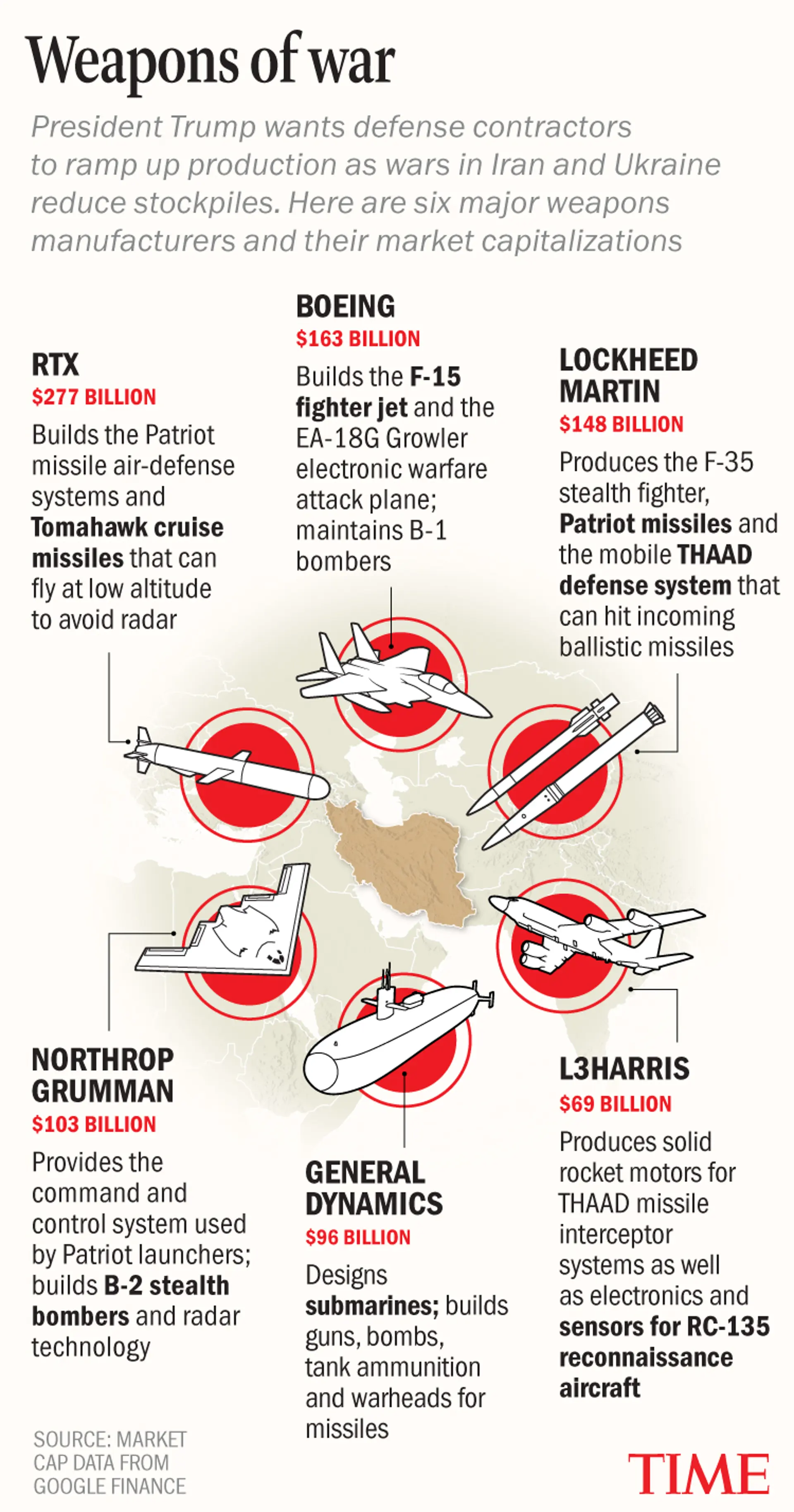
Lockheed Martin: missiles that target missiles
During Israel’s 12-day war with Iran in June, more than 90 THAAD interceptors targeted incoming Iranian ballistic missiles in the region, an estimated 14% of the total U.S. inventory of those missiles at the time, according to analysis published by The Jewish Institute for National Security of America. THAAD batteries are in high demand by allies such as Israel, Saudi Arabia, United Arab Emirates and Qatar for defending themselves from Iranian attacks.
Patriot missile batteries are also used to protect U.S. bases in the Middle East. In June, when Trump ordered bunker-busting bombs dropped on Iranian nuclear sites, Iran retaliated by launching missiles at U.S. bases, sparking the U.S. military’s single-largest use of Patriot defenses ever.
In January, the Pentagon signed agreements with Lockheed Martin to increase annual production of both products, with Patriot interceptor production set to increase from 600 to 2,000 and THAAD interceptor production to quadruple from 96 to 400. But ramping up factory production on those lines could take years.
Lockheed Martin also builds the F-35 Joint Strike Fighter and has a long history of building bombers for America’s arsenal in both world wars. An earlier version of the company built the Vega, the plane flown by Amelia Earhart. During the Cold War, Lockheed’s research division, known as “Skunk Works” developed the stealth SR-71 Blackbird and U-2 bomber.
RTX: Tomahawks and air defenses
The sprawling defense company RTX includes Raytheon, which builds key weapons used to strike targets and down incoming missiles. Decades ago, it helped the U.S. develop cutting-edge guided missiles during the Cold War. When the U.S. started bombing Iran on Feb. 28, early barrages included Raytheon-built Tomahawk missiles, which can fly at high speed and low altitude over undulating landscapes to avoid radar detection. It reportedly was a Tomahawk missile that hit an elementary school in southern Iran during the first day of U.S. strikes.
Raytheon also produces interceptor missiles used to defend Naval ships and fighter jets from incoming fire.
Raytheon is the main contractor for building Patriot missile defense systems. In addition to supplying the U.S. with Patriot air defenses, Raytheon also has contracts to supply Patriots to some other countries in the North Atlantic Treaty Organization (NATO).
In February, Raytheon entered into long-term agreements with the Pentagon to increase production of Tomahawk cruise missiles, air to air defenses, and missile interceptors. “Many of these munitions will grow 2 to 4 times their existing production rates,” Raytheon said in a statement.
General Dynamics: tanks, subs, and missile components
General Dynamics is a sprawling aerospace and defense contractor based in Reston, Virginia. It builds Gulfstream business jets as well as weapons of war like the M1 Abrams tanks and Stryker combat vehicles. It also builds the U.S. Navy’s Virginia-class submarines in a partnership with Huntington Ingalls Industries. The company also produces critical supply chain components for missiles such as warhead casings, housings for guidance hardware, and solid rocket motor materials.
In a statement released on January about the company’s 2025 financial results, General Dynamics chairman* and CEO Phebe N. Novakovic said the company is “preparing aggressively for future growth.”
Boeing: fighter jets and bombers
Boeing started off producing seaplanes for the U.S Navy during the First World War, and its Seattle factories churned out thousands of B-17 Flying Fortresses bombers during World War II. While it is now best known for its massive commercial airline business, Boeing also builds the F-15 fighter jet and the EA-18G Growler electronic warfare attack plane. And it maintains the U.S. fleet of B-1 bombers.
Boeing builds sophisticated radar units called PAC‑3 seekers used by Patriot missile batteries to locate incoming missiles for destruction. The company announced in the fall that it was awarded a $2.7 billion multi-year contract to increase production of its PAC‑3 seekers in its Huntsville, Alabama factory through 2030.
Northrop Grumman: stealth bombers and rocket motors
Northrop Grumman built the U.S. Air Force’s current fleet of stealth B-2 bombers designed to drop conventional and nuclear bombs undetected. The company is currently building a new generation of stealth bomber, the B-21 Raider. In February, Northrop Grumman announced it is building out more manufacturing infrastructure to speed up production of the B-21.
An earlier version of the company—the Grumman Aircraft Engineering Corporation—built the lunar module that astronaut Buzz Aldrin landed on the moon in 1969. Since then, Northrop Grumman has also produced solid rocket motors used by both NASA spacecraft and missiles built for the U.S. military. Such sophisticated motors are critical parts in the supply chain for building missiles.
Last year, Northrop Grumman announced it plans to double its production capacity by 2027. Erik Buice, vice president of missile products, said in a statement that the company is “expediting delivery, expanding range, and enhancing the performance of our rocket motors, all while pushing the boundaries of physics.”
L3Harris: war-ready sensors
The Melbourne, Florida-based L3Harris sells the U.S. military the sophisticated data technology that links together many modern weapons systems. The company’s targeting sensors are built into military drones and aircraft and allow troops to launch precision guided strikes, even in conditions with poor visibility. L3Harris provides the sensors for RC-135 reconnaissance aircraft which provide real-time information about targets and missile threats.
L3Harris also builds solid rocket motors for missiles, including the THAAD interceptors, in its factories in the Alabama communities of Huntsville and Camden. In February, L3Harris announced it had signed a new $400 million contract with the U.S. to build more THAAD rocket boost motors and control systems.
