
CAMAROON
VISAS: Need passport copies for visa / LOI processing. VOA is possible for both countries for all passports. A US passport is visa-free. Fees for visa processing are paid at the airport in exact change or by paying with CFA)
VOA for Cameroon USD100 + €50 processing fee (paid at the airport)
VOA for CAR USD60 + €50 processing fee (paid at the airport)
COST. Single room 3* hotels, full board, guide, transfer, vehicle, fuel, and entrance.
Vehicle. Cameroon – roads are good. CAR 4×4 necessary. Max 7 in van with 3 seats
Cameroon €1525 (5) €1330 (7). Van with 3 seats and a max of 7.
CAR €750 (5) €600 (7). 4×4.
Covid tests, if necessary can be arranged by the guide without have to do swab.
CAMEROON Nov 4-10, 2022
Day 1 Fri Nov 4. Arrive Douala, transfer hotel, city tour.
DOUALA (pop 5,768,400) Is the largest city in Cameroon and its economic capital. Home to Central Africa’s largest port and its major international airport, Douala International Airport (DLA), it is the commercial and economic capital of Cameroon and the entire CEMAC region comprising Gabon, Congo, Chad, Equatorial Guinea, Central African Republic and Cameroon. Consequently, it handles most of the country’s major exports, such as oil, cocoa and coffee, timber, metals and fruits. The city sits on the estuary of Wouri River and its climate is tropical.
Doual’Art (museum)
Cathédrale Saint Pierre et Saint Paul
La Nouvelle Liberté. 12m sculpture made with recycled material located at a main roundabout in Douala. The wingspan is 5 meters.
Le Monument aux Morts
Marche Central
Maritime Museum
Day 2 Sat Nov 5.
Ekom Nkam waterfalls (170 km). 80 meters (262 feet) high.
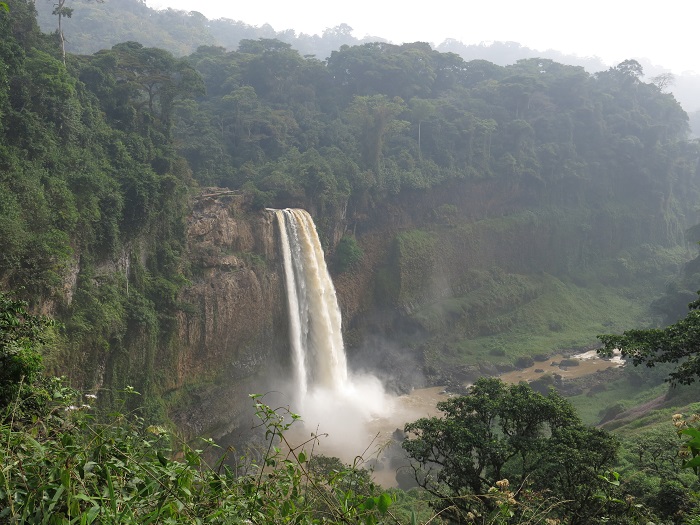
WEST CAMEROON
Bafoussam (347,517 2008) capital and largest city of the West Region. Farm coffee, Potatoes, maize and beans. Akwa features several bars, stores, and a live music venue, vendors of Soya (barbecue beef meat brochettes), Poisson braisé (barbecue fish) and other foods.
Batoufam & Bandjoun royal palaces (110 km). Batoufam is a town and commune with a population of 27,000. Batoufam is also a language (Bantu).
The founder of Batoufam was named Nankap. He was a hunter and a member of the Bleble, a Tikar people who moved from the Adamawa Plateau to Bali. During the migration to Bali, Nankam deserted the Bleble and served the Bangwa Chief. He was very similar to the Bangwa Chief, who gave the title of “Fodoum” (translation: “Chancellor”). Batoufam (translation: “village of Tou-fam”). The first eleven chiefs of the dynasty fought for Batoufam’s autonomy and independence against Bandjoun, Bayangam, and Bangwa. Pseudo bamboo or Raffia palm energized the economy and was used for home construction, furniture, and granaries, plus a drink. Finally, farm instruments were introduced, as well as war armament, jewellery, drums and statues.
The twelfth chief, Chief Fotso, was open-minded and eloquent and when he died in 1954, he had 60 wives and 123 children. In 1989, at the age of 22, Chief Nayang Toukam Innocent became the fourteenth Chief. Batoufam had a history violent reactions against the colonial regimes and it was not uncommon for whole families to commit suicide by hanging in Batoufan as a sacrifice for the cause of their peoples.
Batoufam is located on the N4 highway, 291 km from Douala, 288 km from Yaoundé and 25 km south of Bafoussam. The commune, with an area of 172 km2, contains villages such as Bayangam, Bandrefam, Bandjoun, Bangoua, Bangang-Fokam, Bangwa and Bangang-Fondji. The altitude ranges 1400-1700m. The economy is agriculture and livestock. The large, square house of the Bamileke chief is located in the village and it has a courtyard. It is the largest building in the village.
Bafoussam (35 km) overnight
BAFOUSSAM (commune pop 1,146,230) capital and largest city of the West Region in the Bamboutos Mountains. It is the 3rd most important (financially) city in Cameroon, after Yaoundé and Douala.
The city had an urban population of 347,517 inhabitants (2008). Bafoussam is the West Region centre of trade, and people are farming coffee, potatoes, maize and beans. The city has a coffee processing facility and brewery. It is the main city of the Bamiléké people and is home to the Bafoussam chief’s palace. Bafoussam is a group composed of 7 villages (Bamendzi, Banengo, Ndiangdam, Ndiangsouoh, Ndiangbou, Toukouop, Ngoueng, and Banengo city B) with 46 districts or sub-villages.
Bafoussam has two main markets, several internet cafés, restaurants and supermarkets, and a movie theater. Most nightlife centers on Akwa with bars, stores, and a live music venue, along with customary vendors of Soya (barbecue beef meat brochettes), Poisson braisé (barbecue fish) and other foods.
The Bafoussam are originally a Bamileke ethnic group, the natives of the region. They had left Egypt in the ninth century and arrived here in the late 14th century. By 1950, at the intersection of the tracks connecting the two Cameroons and local cities, on July 10, 1959, five rebel leaders were shot in the market square.
Bafoussam is built in the foothills of the Banengo and Baleng hills, which are covered with savannah vegetation. The city is located at about 1500 m.
Climate. The climate is constantly cool at 15-22 °C and now sometimes reaches 28 °C during the dry season from mid-November to mid-March. Oceanic Climate with dry and cool to cold winters and warm to cool summers (with cool nights in summers) with a few hot days due to its high elevation.2015 population 1,146,230 inhabitants.[11][12] This places Bafoussam as the third largest city in Cameroon after Yaounde and Douala.
The Foumban Royal Palace and colonial architecture are in the city of Foumban, capital of Noun. It is the seat of the Kingdom of Bamum, where the Chief-Superior of the peoples of the valley of the East bank of the Noun resides.
The royal palace of Foumban, where the king of the Bamum still resides today, was built in 1917. The Palace Museum tells the history of the dynasty of the Bamum kings from 1394 to the present day, with information on the most famous of the Bamum kings, Ibrahim Njoya, who died in 1933 and who created a writing system at the end of the 19th century called Bamum script.
The Chefferie of Bandjoun. The Bandjoun chieftaincy is an area in Bamileke country, of several hectares where resides the chief-superior, king of the Bandjoun peoples, his wives and some young children. In addition to the royal forest, the chiefdom has huts, a courtyard or royal square and the palace, typical of the layout of a Bamileke chiefdom. The palace has existed since the 17th and this was built in the 20th century. The Palace Museum tells the story of the dynasty of kings is a relatively modern building. The entire chiefdom is one of the most visited museums in the Bamileke country. 14 monarchs reigned there.
Day 4 Mon Nov 7. Yaoundé – Pygmy village near Abong Mbang (250km). Baka Pygmies live in villages in a privileged environment – a unique environment with all kinds of trees, shrubs, and flowers in a thousand different shades of green. There are a few completely wild roads. Mayos, famous for their know-how in traditional medicines, housing patterns, family structure, eating habits, folklore, and dances. In the evening, see the tortoise dance. Trekking in the forest to see hunting techniques, traditional medicines, plants, insects, birds, and animals. 600 inhabitants have made their living for thousands of years, as hunter-gatherers.
Logging has destroyed the large game that could sustain a village for weeks. The Baka now make their living laying snares for small mammals like cane rats and hares, which are still fairly abundant. If a gun is available, they will also shoot monkeys. The Baka can only complain about the disappearance of their forest home. The provincial government in Abong Mbang sets guidelines to protect the rainforest, but has no incentive to hand over forest management to the Baka. The young have little interest in staying true to their forest roots. In cities like Abong Mbang, people taunt and insult the Baka in the street; children call them “monkeys”. But, the Baka say that the jibes mean little so long as they can retain some stake in the lush, tropical jungle where they trace their origins.
Bagofit (11km) overnight
Day 5 Tue Nov 8. Bagofit- Yaounde (215km) – Ebogo ecoutouristic site (65 km)
Ebogo is in a magical green rainforest that offers canoe rides on the river Nyong, “Big 300-year-old Tree” about 12 meters in diameter, butterflies, traditional fishing, tortoises, trekking in the forest to see birds including parrots. See Bantu cultural dances including the “Bikutsi”, palm wine, grilled freshwater fish and other traditional dishes like the “pkwem” prepared from the leaves of cassava and palm oil.
Yaoundé overnight
Day 6 Wed Nov 9. Yaoundé – Pongo Songo chimpanzee sanctuary (230 km) is a small island situated on the Sanaga river, to house animals threatened by deforestation and poaching from the Douala-Edea forest reserve. This project is run by the Papaye association of France, they collect the injured and orphans and then teaches them to be autonomous and to live in a society. It’s a refuge and not a zoo because the animals are free to roam on this island.
From Marienberg, a small town on the outskirts of Edea, board a boat on the Sanaga river to arrive at the Pongo-Songo Island.
Kribi sea site resort (120 km). The region of Kribi in Cameroon is the real Riviera, with large white sand beaches stretching out of sight, lined with beautiful coconut trees. See Lobe Falls, which flows directly into the ocean by a series of cascades over 30 feet high.
See two fishing villages, and Eboundja Ebodje, where fisheries are almost miraculous.
Overnight
Day 7. Nov 10. Fly to Banjui, CAR. Kribi – Douala (171 km / 3hr) airport. 15:45-17:20 DLA-BGF Bangui (ASKY or Ethiopian) Non-stop 1:5hr USD430 1-way.
