
PHILIPPINES – LUZON – GREATER MANILA
BAROQUE CHURCHES of the PHILIPPINES WHS
COLONIAL URBAN PLAN and FORTIFICATIONS of the WALLED CITY of MANILA Tentative WHS
Day 7 Wed Dec 24
Flight. Tacloban to Manila Philippines Air @18:30- 17:30. I took a Grab taxi first to the wrong Stone House hotel and then a second to the right one.
ON Stone House Manila. A good value hotel CA$15.night. Single room with AC.
Day 8 Thur Dec 25
MANILA
Despite it being Christmas day, I had a huge walk about day seeing no museums and easily saw the most NM sites of any Xmas day previously (30). Everywhere I went was crowded with Filipinos. They obviously don’t stay a home and have a family Christmas day but are out and about.
Hobbit House. Permanently closed. Opened in 1973, the last FB posting was 2021. It offered a unique experience with live musicians performing in a Tolkien-inspired setting. Karaoke is a popular pastime among Filipinos. Almost all the employees were midgets.
Luneta Hotel. Built in 1911, it is 6 stories with wrought iron railings. It was the meeting place for American non-commissioned officers in 1941. It has been closed since 2020 due to COVID. I rattled the door, and a guard let me see the lobby. Hospitality Legends
Rizal Park. This large urban park (57 hectares) is mostly grass with some trees on one side. It was crowded in the morning and completely packed at 8 pm when I walked back through it on my way to my hotel. There must have been one million people there, eating on the grass and hanging around.
José Rizal Monument. In Rizal Park, bronze figures sit on a rock plinth around an obelisk. Rizal was executed here by a firing squad of the Spanish colonial army on December 30, 1898. The spot is on one side of the park. Jose Rizal was a physician, propagandist, writer and patriot. He was charged with treason against Spain, fanned the flames of the revolution of 1898, and the end of Spanish rule. There is a pond and a large bas-relief at the execution site.
The Manila Hotel. Built in 1912, this 5-story hotel overlooks the water. The lobby is huge with a large restaurant with a lovely wood coffered ceiling, large arches and four large chandeliers. Hospitality Legends
From the hotel, I walked along about one kilometre of stone walls separated by a manicured golf course.
INTRAMOROS. This is the historic core of Manila, established in 1571 on the site of the fort of Rajah Soliman. Slavery was abolished in 1591, and the walls were constructed from 1590 to 1825. Manila was the capital of the Spanish East Indies from 1571 to 1898, and the end of the Manila-Acapulco trade route. The British briefly occupied the city from 1762 to 1764, when the city expanded beyond its core. It was occupied by the Americans after 1898 and was mostly destroyed during WWII by the Japanese.
After 1764, the city expanded outside Intramuros.
Casa Manila. WOW, don’t miss this spectacular house with two floors of original furniture (each piece is described by providence and type of wood), plank flooring, frescoes on the ceilings, ceramics, religious icons in glass cases, musical instruments, and large outside verandas and patios. Enter through the door with “Barbara”. All rooms are open and spectacular. 75P, 50P reduced. House and Biographical Museums
Memorare – Manila 1945. This commemorates the 100,000 people killed in the Battle of Manila from February 3 to March 3, 1945, in WWII. Most were nameless as their bodies were consumed by fire or buried in the rubble. The wonderful memorial as “mother earth” holding a baby, a woman who was raped (also holding a baby) and four figures representing the elderly and children. The following recount of the Massacre of Manila was on the large diorama near the memorial. I took photographs of every panel and then transcribed them below:
THE BATTLE OF MANILA – The Worst Urban Battle of the Pacific
From Feb 3 to March 3, 1945, Manila was the scene an atrocious 29 day battle that resulted in the deaths of more than 100,000 innocent civilians – maniacally and deliberately bayoneted, raped, burned, shot, beheaded and eviscerated by the Japanese. It did not discriminate, for rich and poor, young and old, suffered the same fate. Thousands of homes and buildings – more than 600 city blocks – were systematically razed to the ground by Japanese fire. Some areas, Japanese strongholds, were targeted by American artillery.
“At last, the Japanese have matched the rape of Nanking. In Manila, they have piled outrage on outrage, infamy on infamy, until it has become a city of nightmarish horror” Henry Keyes, London Daily Express
PEACTIME MANILA
Dubbed as the “Pearl of the Orient”, pre-war Manila boasted scenic tree-lined boulevards and majestic government buildings. It was a tropical paradise where orchids and exotic plants grew abundantly and where afternoons ended in glorious sunsets over its famous Manila Bay.
The economy was on the rise, with exports surpassing imports. Transportation and public utilities were excellent, with Manila having the longest pier in Asia and the first commercial air flight in the region. Social life was not wanting, as posh and ritzy clubs and dance halls made Manila as cosmopolitan as any Western capital.
“Manila is by far the most beautiful city in the Orient. From the top of the University Club, it seems half hidden in a canopy of trees, green everywhere, a city within a park.” The New York Times, 1931
It was during this prosperous peacetime period that war came to the country. On December 8, 1941, Japan attacked the Philippines, and in a matter of days, Manila would capitulate. On January 2, 1942, the Japanese army proudly marched into the city to begin their reign of terror. The Second World War brought to an end that glorious epoch known as “peacetime”.
When the guns finally fell silent, the beautiful city of Manila was reduced to rubble and smouldering ash. Four centuries of history were annihilated as important cultural and architectural treasures were torched, shelled and destroyed forever. The battle ended a way of life as the Manileños knew it.
“If the enemy infiltrates, be careful not to lose the opportunity of demolishing and burning buildings. When Filipinos are killed, they must be gathered into one place and disposed of with the consideration that ammunition and manpower must not be used to excess. Because the disposal of dead bodies is a troublesome task, they should be gathered into houses which are scheduled to be burned or demolished. They should also be thrown into the river.” Japanese Battalion Order, Feb 8, 1945
THE JAPANESE PREPARE FOR THEIR LAST STAND
Rear Admiral Sanji Iwabuchi, commander of the Manila Naval Defense Force, was determined to fight to the last man. The sinking of his ship Krishima in 1942 brought shame for he did not go down with his ship and his men. The decisive battle was his chance to regain his honour.
He ordered the fortification of buildings and the destruction of bridges. Ammunition, bombs, gasoline, and dynamite were brought to Manila, as well as a supply of food for the Japanese troops. – enough to last many months. Landmines were buried in many parts of the city. Concrete pillboxes, machine guns, and anti-tank weapons secured street intersections. To delyay the American advance into the city, they overturned vehicles and other heavy equipment were scattered on the roads. It is going to be a fight to the finish.
On February 3, 1945, the Japanese started torching buildings and rounding up civilians – men, women, and children. It will be the start of the darkest period in the history of Manila.
THE APOLYPTIC DAYS
FEB 03, 1945. The Japanese planted dynamite at the Singer Building (Soler corner Reina Regente Streets), and detonated it, setting the whole block on fire. Started burning buildings in the Botondo and Escolta areas, such as China Bank, Banco Hipotecario, Grand Crystal Arcade, using a mix of accelerants such as gasoline, airplane bombs and Molotov cocktails. People fled as building after building exploded and as the fires and the heat intensified.
“Thick clouds enveloped the city, that daytime was as dark as night.” Marcial Lichauco, Filipino author, lawyer and diplomat.
FEB 04, 1945. At 2:30 pm, La Concordia College at Calle Herran (now Pedro Gil) came under Japanese artillery barrage. Hundreds of refugees hiding inside were killed by shrapnel and debris, those who were able to escape were killed by Japanese machine guns.
The Japanese troops began rounding up the residents of Malate and took them to Saint Paul’s College. They were stripped of their belongings and herded into a big dining hall. Inside, the chandeliers – rigged with explosives – were set off, killing hundreds in an instant. After the deafening explosions, half-mangled bodies and body parts lay everywhere. Survivors who escaped the carnage were greeted with machine guns, grenades, and bayonets, as they ran up the streets, with the murderers laughing and giggling as the finished the survivors off. Babies were forced from their mother’s arms and bayoneted. The troops returned to the hall, scavenged for any valuables the dead still had, and burned the room.
FEB 05, 1945. Manila turned into a raging inferno. With no more electricity and running water, there was no way to stop the fires. In Intramuros, all residents were ordered to go to Manila Cathedral and San Augustin Church. The Japanese began pulling out young women and raped them to the agony of powerless parents.
FEB 06, 1945. The Japanese sealed all the gates of Intramuros, trapping all residents inside. Men 14 years and above who were herded into the Manila Cathedral the previous day were ordered to march to Fort Santiago, thus starting the mass and systemic extermination in the ancient walled city. Men were tortured and starved to death, the lucky few were burned alive. The slaughter inside Fort Santiago would go on for days.
FEB 07, 1945. Now, the men, 14 years old and above from San Agustin Church, were marched off for their torture and eventual slaughter in Fort Santiago. As the men arrived inside the fort, they were stripped clean of their belongings like watches, cigarettes, lighters, and even keychains. At the nearby San Juan de Dios Hospital in Called Real Street – all exit points were blocked, sentries posted, and all patients and medical staff forbidden to leave – for the Japanese troops suspected the hospital kept a short-wave radio.
FEB 08, 1945. The Japanese troops began torching homes and buildings inside the walled city, and by the afternoon, the fires had spread to many blocks, people were suffocating from the acrid smoke. Explosives were rigged in the Manila Cathedral and upon detonation – its iconic dome exploded and the roof caved in. Surrounding buildings were also detonated, littering the narrow cobblestone roads with debris of burning wood, metal and rocks.
In Ermita, around 2,000 residents were forced to march to Plaza Ferguson. The men were brought to the Manila Hotel, and the women to Bayview Hotel. Young women were raped mercilessly until their private parts bled. Mothers and older women tried to shield the young girls, and some prostitutes offered themselves to spare the young girls. Elsewhere, the fires were in the city. Anyone who wandered outside was sniped at by the Japanese marines holed up in pillboxes. The holocaust continued, including the massacre of President Elpidio Quirino’s family in Colorado Street (now Agoncillo Street). At the Vincentian Central House on San Marcelino Street, refugees seeking shelter and priests were tied up and brought to the nearby Este de Balete and were machine-gunned and bayoneted. Around 300 people seeking refuge in a garage in Paco were shot. At St Paul’s in Malate, 360 people were killed.
“All around us, there were fires and explosions. It was the best imagination of Hell one could get.” Hans Steiner, an Austrian living in Manila, in a letter to his mother.
Paco, at the same time as the German Club massacres, men aged 14-65 old were rounded up and promised food in exchange for labour, but instead were tied up and brought to the Entero Tripa Gallina. They were shot dead, their bodies falling into the tributary. In Dart Street in Paco, 4 mass graves were found with men killed inside pits, and earth thrown on them. In 95 Singalong Street, men were beheaded amidst shouts of “Banzai” by the Japanese marines. An estimated 400 men died in Paco and Singalong that day.
FEB 09, 1945. One of the worst atrocities committed was at the German Club located on San Luis Street (now T.M. Kalaw). Manager Maring Ohaus, a German, pleaded on behalf of the refugees. Nursing mothers kneeled and pleaded with the Japanese, but their infants were skewered with bayonets. The women were raped and mutilated, burned, and bayoneted. One marine even sliced off a woman’s breast and placed it on his chest, while the others laughed. A woman who tried to fight off was decapitated, her lifeless body raped by the Japanese. A man who tried to fight was tied to a pillar, with his privates cut off and stuffed into his mouth. The club, which once hosted grand parties and elegant social affairs, was burned to the ground, including all the people inside. Estimates put the club’s death toll at 1,500, at the very least. The club was nothing but charred remains after the battle.
Residences were stormed, including the Campo residence at T Avenue, where 120 refugees sought refuge. Everyone was shot and houses lit. At the Price Mansion in Colorado corner, California Streets (now Agoncillo Corner Escoda), 100 refugees were killed and the mansion burned. The Japanese surrounded Malate Church and took every man they found on the premises including 4 Columban priests.
Terrified evacuees fled to the American lines to escape the carnage. The wounded flocked to the Santo Tomes Internment Camp, now freed of the Japanese and where Americans set up a medical aid station.
FEB 11, 1945. In Ermite, 50 civilians were killed at the Tabacalera Cigar Factory and the Shell Service Station. In Intramuros, 50 women and children seeking shelter at the Santa Rosa College ruins were ordered to march to the Santo Domingo Church ruins. (Both Santa Rosa and Santo Domingo were destroyed by the Japanese bombings of December 1941). They were ordered to march three abreast, and were bayoneted inside the church.
FEB 12, 1945. Nearby residents and former students sought shelter at the De La Salle College on Taft Avenue, but they were bayoneted and shot. After the carnage, the troops scoured the dead of their belongings, stole the food, and mocked the dead. 41 civilians and 16 La Salle brothers were massacred. In Vito Cruz Street, 28 civilians were massacred inside the Perez Rubio residence. The Japanese scoured many areas, attacked families inside their houses and bomb shelters and even lured people to a vacant lot by planting a Red Cross flag. In many instances, the Japanese used women and children as human shields and even strapped a young girl to a supplies truck to prevent the Americans from firing.
The Americans started shelling the Manila Hotel.
“The armless, the legless, the blood-spattered, an endless river of Filipinos flooded towards Santo Tomas, one of the few places of refuge – the prison camp where we white prisoners of war had been saved at the expense of a whole city of Orientals.” Robin Prising, Santo Thomas Internee
FEB 13, 1945. St Scholastica’s College and environs became the victim of American shelling from 13 Feb to 14 Feb. The terrified refugees didn’t know where to go as they were caught in the crossfire. When the shelling stopped, the Japanese troops lobbed grenades inside the compound. As an American tank rolled inside the compound, the survivors cheered and mobbed the soldiers. They were all told to make the perilous Journey to Sta. Ana which the Americans had already secured. Survivor Jack Garcia recalled “we walked though a tangle of debris, upturned carts, twisted metal, roofs, broken glass, unexploded shells.”
At Dr Nicanor Reyes’ house, the entire family was killed except for Lourdes, who were fond by the servans on this day in Singalong Church, several priests and nuns were hanged by the Japanese, with their hands tied behind their backs.
FEB 14, 1945. One hundred refugees died inside the Ateno College on Padre Faura Street as the Japanese hurled incendiary bombs and set fire to the building. Another 100 people were killed inside the Scottish Rites Temple on Taft Avenue.
FEB 16 – FEB 17, 1945. At the Philippine General Hospital, 7,000 men, women, and children were held hostage as the Japanese fortified the building and used it as a sniper nest. At night, the Japanese hunted young women and raped them. On Feb 17, the hospital was successfully taken
The Japanese also heavily fortified the University of the Philippines, where ferocious fighting would last until 23 Feb. On the wee hours of 23 Feb, the Japanese started chanting and singing, and bursts of loud explosives were heard as they committed a mass suicide. 77 Japanese were found dead the following day.
FEB 18, 19, 1945. At Dr. Rafael Morete’s residence, the men were separated from the women, who were raped. Those who resisted were shot or bayoneted. Grenades were then thown at the men, killing them and burning the residence.
FEB 23 , 1945. Americans prepared for the assault on the ancient walled city of Intramuros. They broadcasted for days to the Japanese to let the residents out, but no reply came. At 7:30 am, American artillery opened fire. Terror gripped the refugees inside Intramuros as shells pounded the walls. Thick dust, smoke, and ash from the pulverized walls made it hard to see and breathe. Flying shrapnel killed several refugees in Santa Rosa College. Wounded and dazed, the civilians started pouring out from the breached northern wall.
At 8:30, American troops crossed the Pasig River to Intramuros to start the retaking of the city.
American soldiers bowed their heads, unable to fathom the pitiful scene unfolding before their own eyes. Pontoon bridges were built to facilitate the exodus of refugees from the walled city across the river. “Over it streamed what was left of the civilian population of Intramuros”. CBS correspondent Bill Dunn wrote. “Those who weren’t emaciated bore wounds and cuts. This unending column was an indication of the horror of Intramuros.
After the fighting had subsided, American troops turned forensic investigators discovered the pitiful, gruesome sights – charred and bayoneted bodies huddled beside each other, indicating they were once a family, dead people with broken jaws from blows by butts and a beautiful woman was found, with both her legs hacked off. But the Americans were not prepared for the barbarity they saw inside Fort Santiago. A horrible stench led them to different dungeons with piles upon piles of decaying bodies – shot, bayoneted, burned or starved to death.
At least 125 elderly and sick men, mostly Spanish nationals, including 34 priests, were marched off to two bomb shelters at the corner of Aduana and Luna Streets in Intramuros. The entrance was sealed, and grenades were thrown into the ventilation shaft. Survivor Father Jose Barullo said, “Next morning, the marines came, pouring sand below the shafts to suffocate any survivors.”
“If we run out of bullets, we will use grenades. If we run out of grenades, we will cut down the enemy with our swords. If we break our swords, we will kill them my sinking our teeth into their throats.” Rear Admiral Sanji Iwabuchi
FEB 23 – MARCH 03, 1945. With Intramuros taken, the Japanese hunkered down in the government buildings across Intramuros. An estimated 700 marines under Iwabuchi’s command were left – 300 inside the Legislative Building (now the National Museum of Fine Arts), 200 in the Agriculture & Commerce Building (now the National Museum of Anthropology), and another 200 in the Finance Building (now the National Museum of Natural History). The Americans broadcast to the Japanese to surrender, that they will not be disgraced or humiliated, but no reply came as the grace period of 30 minutes ticked away.
Bloody, room by room, floor by floor fighting ensued over the next days. American artillery blasted the buildings. As the situation worsened for the Japanese, Iwabuchi knew the end was near. He called his men and said, “If anyone has the courage to escape, do so. If not, please take your lives here.” It was clear that surrender was not an option. Iwabuchi, the butcher of Manila, decided to end his life and slit open his belly.
American artillery continued to pound the buildings until the last of the enemy troops were annihilated on March 3. The Battle of Manila was finally over.
“MacArthur was shattered by the holocaust. He had gone to great lengths in 1941 to prevent needless destruction of the city he loved, Now, his own forces were killing it ruthlessly and mercilessly.” Paul Rogers MacArthur’s Headquarters Staff.
THE AFTERMATH
When the dust settled, survivors started searching for their loved ones amid the city’s debris and ruins. Many would have no closure as family members were bulldozed into mass graves. Fattened flies feasting on the dead became so thick, they showed up in aerial photos. People had no food, no water, no money, no houses. What were once homes, churches, and places of business were now nothing but rack and ruin. Japanese fire and American artillery had transformed the Pearl of the Orient into a wasteland, the most devastated city in the Pacific. This was the price of Manila’s liberation.
The war brought colossal damage and destruction to lives and property. Figures running into the billions were calculated to provide a quantifiable estimation of the damages to infrastructure and industries, but the psychological and moral damage to the Filipino people remain. Manila, as the world once knew it, will never be the same again. No victory parade can ever restore it to its former glory.
It is now 80 years since the dust of war has settled and let not the war memory of the nation fade. For what purpose did the unarmed civilians and brave soldiers perish, if not to teach us that no side ever wins a war. It is our duty to remember.
Palacio del Gobernador. A two-story government office in the NM Architectural Delights series.
Manila Cathedral (Minor Basilica and Metropolitan Cathedral of the Immaculate Conception). Built in 1571, it was destroyed and rebuilt 8 times: 1571 (fire 1583), 1891 (Earthquake 1599 and 1600), 1614 (Earthquake 1621 and 1681), 1751 (Earthquake 1863), 1879 (destroyed in the Bombing of Manila in 1945) and the present church in 1953. It has marble columns and round arches separating the naves. Lovely stained glass, round in the naves and arched in the central nave.
Visited by 3 popes: Pope John Paul in 1981, Pope Paul VI in 1970 and Pope Francis in 2015.
My first of four Christmas masses. It was packed with a huge line waiting to get in.
Gallery of the Presidents. Beside the Puerta Santa Lucia, it lists the presidents of the five republics of the Philippines. Some of the notable ones were: F. Marcus 1965-86, Corazon Aquino 1986-92 and Duterte from 2016-22.
Fort Santiago. The main fortress of Manila was built in 1571 on the site of the fort of the Raja, and was burned by the Chinese pirate Lin Feng in 1574. It was reconstructed from volcanic tuff between 1590-1599. It had been the citadel of four foreign powers: Spain, 1571-1898, Great Britain, 1762-64 during the Seven Years War, US, 1898-1946; and Japan, 1941-45. 75P, 50 reduced
Baluarte de San Andres. A fort that was built in the north-west part of the wall in 1603. Designed to protect the old Puerta Real and reinforce the southeastern part of Intramuros. Reconstructed in 1733 with the addition of a bombproof arsenal for gunpowder, a watchtower and soldiers’ barracks. Destroyed during the British siege of Manila in 1762. Rebuilt and modified after the British occupation. Damaged during the Battle of Manila in 1945. Restored in 1987. It now looks down onto a golf course.
Baluarte de San Francisco. It was destroyed in the earthquake of 1671. It was the military barracks of the Japanese.
The White Cross commemorates where 600 decomposing corpses were discovered, starved to death in the dungeons of the Baluarte of Santa Barbara. They were imprisoned in February 1945 during the last days of WWII.
Falsabraga Media Naranja is at the end of the fort, lying against the river.
The fort presently is mostly walls and a large park of grass with cannon and an anchor. A large moat is inside the end wall. Exit to the right of the moat and enter the large malecon on the river. 75P, 50P reduced.
Rizal Shrine Museum. In Fort Santiago, this was where he was imprisoned from November 3 to December 29, 1898, before he was executed. It has the story of Rizal and some of his personal artifacts. Included in the price of Fort Santiago. A statue of Rizal sits in the grass square outside. House and Biographical Museums
Jones Bridge. A double arch suspension bridge over the Pasig River. Two piers are in the river. I had to climb over 3 barriers to get to he other side to take the stairs down to Chinatown.
Binondo Chinatown is the world’s oldest Chinatown, established in 1594 by Spanish colonizers for Chinese Catholic immigrants, evolving into a bustling hub of Chinese-Filipino culture, commerce, and amazing food. Enter via two large Chinese arches, one at the end of a bridge.
Escolta Street is a historic east-west street in the old Binondo district. The street is home to some beautiful examples of ancient tukudlangit designs. One of the oldest streets in Manila, Escolta was built in 1594 for the large number of immigrant merchants, mostly from Fujian, China, who came to participate in the Galleon Trade. Escolta was lined with shops selling exported goods from China, Europe, and other parts of Latin America that arrived at the nearby port of San Nicolas. By the end of the 19th century, Escolta had grown into a thriving business district, home to some of the city’s tallest buildings, such as the Manila Stock Exchange. The markets were replaced by modern department stores and an electric tram line ran through the area. Escolta served as the main commercial district until its decline in the 1960s, when the center of business moved to Makati.
Don Roman Santos Building. A neo-classical building.
Regina Building. Built in 1934, this four-story building is in the Beaux-Arts style .
Nativity Building. A Beaux-Arts style building
Burke Building had the first elevator in the Philippines.
Calvo Building. A Beaux Arts style built in 1938 and the home of the first radio station until 1957 before the DZBB studio moved to the GMA Network Center (the current headquarters of GMA 7) at the corner of EDSA and Timog Avenue , Diliman , Quezon City Architectural Delights
Capitol Theatre. The Art Deco theatre, located along Escolta Street, was built during the 1930s, part of the city’s primary commercial district, alongside the Lyric Theatre. It was designed with a double balcony by National Artist Juan Nakpil, a feat considered rare during that era. Architectural Delights
Minor Basilica and National Shrine of Saint Lorenzo Ruiz (Binondo Church). Landmark granite church with a 16th-century bell tower. It is a lovely three-nave church with only two columns, making for a very open design. There are great frescoes on the walls and ceiling. The altar is like a recreated facade of a building with the 12 apostles. The Ways of the Cross are bas-reliefs with a blue sky full of clouds. My second Xmas mass.
Divisoria Market. This is is one of the busiest and most famous marketplaces in the Philippines, often called the “bargain capital” of the country. It;s known for its Cheap Prices, Bulk Buying, and fresh produce, seafood, and meats. There are three shopping “malls”.
Ambos Mundos Restaurant. Ambos Mundos is the oldest restaurant in Metro Manila. The fact that it’s still standing is a testament to how good it is. Slightly out of the way from the cluster of Binondo restaurants near Ongpin, It is a kind of a dump with about 9 tables. It now serves only Chinese food. Ambos Mundos was unique to Binondo not just because of its history but because of its cuisine, an extensive Spanish/Filipino menu, especially the Paella. Hospitality Legends
Archdiocesan Shrine of the Blessed Sacrament (Santa Cruz Church). 17th-century Mission-style church, with baroque ornamentation. A single nave church with a large mosaic with a deer behind the altar. My third Xmas mass.
First United Building (FUBC). It was built in 1928 when it was the tallest building in Manila. In 1936, Berg’s Department Store set up shop on the building’s ground floor. The building hosted the consulates of France and Panama from 1933. In 1951, Chinese businessman Sy Liang Ten bought Berg’s from its original American owner, Ernest Berg. In 1968, it was acquired by First United Building Corporation. At the end of Escolta Street, I saw this Art Deco building from the northwest end.
.jpg)
Carriedo Flea Market. This open-air flea market stretches from the LRT Carriedo Station to Quiapo Church. On a pedestrian street, it was unbelievably packed. All sorts of merchandise are found here. I think NM has misnamed Escolta Street Flea Market (there is no Escolta Flea Market). Google Maps has it permanently closed (anything but).
Minor Basilica & National Shrine of Jesus Nazareno (Quiapo Church). My fourth Xmas mass, this was the biggest and busiest. Besides standing room only in the massive interior, the square outside was packed with people watching the mass on a big screen. The entire walls are stained glass with louvers for ventilation. The Ways of the Cross are black granite bas-reliefs.
Quiapo Market and Fishport. On one side are all the fish tables and on the other are many small shops.
Manuel L. Quezon Memorial Bridge. Another iron girder bridge crossing the Pasig River.
Liwasang Bonifacio. Bonifacio Plaza is located between the Post Office and the Metropolitan Theatre buildings. A bronze statue of Andres Bonifacio stands in Bonifacio Plaza. It was called Plaza Lawton during the American era in memory of General Henry Ware Lawton, a high-ranking American who was killed during the Philippine-American War. It became Bonifacio Plaza during the centennial of Andres Bonifacio‘s birth in 1963, in memory of Bonifacio as a national hero and Supreme Leader of the Katipunan.
This was hard to reach with all the wide roads and traffic. Continue past the theatre on the main road and double back.
Metropolitan Theatre is a historic Philippine Art Deco building located in Plaza Lawton. It is recognized as the forefront of the Art Deco architectural style in the Philippines. Inaugurated on December 10, 1931, it was heavily damaged during the Battle of Manila and subsequently went through several restoration programs and finally reopened on December 10, 2021. Architectural Delights

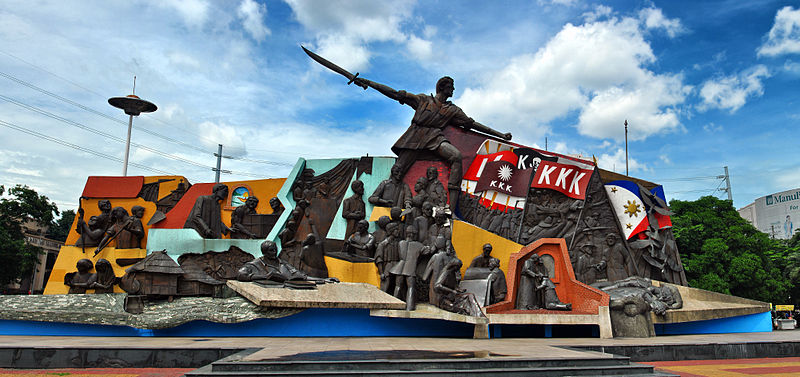
Bonifacio Shrine is a public park and plaza located just north of the Manila City Hall Its centerpiece is the monument to Filipino revolutionary Andrés Bonifacio and the Philippine Revolution fronting Padre Burgos Avenue.
The Bonifacio and the Katipunan Revolution Monument, situated within the grounds of the Bonifacio Shrine and also in the park is the Victims of Martial law Memorial Wall was inaugurated at the park. There is a musical dancing fountain in front of the monument. I watched the show needing a rest after the long day.
City Hall. A 1941 building, it is long and low and has a striking octagonal clock tower. it is hard to see from the street. In front is an underground tunnel, the only way to cross the very busy street. Architectural Delights
It was then a 2.2 km walk through Rizal Park back to the hotel. I ate butter chicken at a halal restaurant near the hotel
ON Stone House Hotel Manila for the second night.
Day 9 Fri Dec 26
I had another walk about day seeing no museums, assuming they would all be closed on Boxing Day but they were all open. It was hot, humid ana overcaast.
Robinsons Place Manila. A large 2-story mall with its own brand and several high-end brands. I ate at the BK here. It is only a block from Stone House Manila.
Our Lady of Remedies Parish – Malate Church.
Roxas Boulevard. This the large 6-lane street that runs close to the water for about half its length and then is more inland around the SM megamall. Urban Legends.
Our Lady of Remedies (Malate Church). This section of the city dates to 1588. It was used by the British forces in 1762. Damaged by the earthquake of 1863 and run by the Augustinians. Single nave with round arcades forming the outside walls. Nice stained glass of many different styles. Amazingly empty for a Filopino church.
Aristocrat Restaurant. Opened in 1937, it is open 24 hours and very popular. Prices were quite cheap in the 300-400P range. Large window look out to the ocean. A waitress said their BBQ was the most popular. Hospitality Legend
Manila Zoo. Elephants, giraffe, zebra and lion, birds, crocodiles. Nice enclosures but still much better for children. 300P, 260 reduced.
PASAY
Star City. Closed. Theme Park
Philippine International Convention Center. One block has no windows and the other tons of windows. Both have large overhands. Attractive.
Coconut Palace. A government building made almost entirely of coconut wood and husks. Has rounded gables and is lovely. Grounds nice with many palms.
Museo ng Sining, GSIS. Most is under renovation. The one gallery open is mediocre and has all new art from 2025. There are several outstanding pieces in the lobby, the result of a competition. A watercolour with rusted nails and two hammers was lovely. The hallways also have some great art. I love photorealistic art and there was a lot of it. Even though the art was not extensive, I liked more here than most modern art museums. Free
SM Mall of Asia. This gigantic mall is on the water with the views one of the main draws. Has a convention centre, amusement park (across the road and very juvenile), IMAX, and cinemas, The arena is outstanding architecture.
Dessert Museum. All kinds of fake desserts arranged by theme. This is only for children, and little children at that. All the free ice cream you can eat in 15 minutes. I went here because of the category. Bizzarium 899P, 720P reduced. 2.1 km walk from the Dessert Museum to the church.
National Shrine of Our Mother of Perpetual Help (Baclaran Church). An art deco design, it has five naves, the lateral ones formed by arcaded arches. Despite no service, it was still 20% full. In the lobby is a crusified Christ. Everyone was laying their hands on it and praying.
I then walked through the absolutely chaotic street market under the sky train. There were thousands of shops extending for about one kilometre and millions of people. How do all these make any money as margins must be razor thin. I finally took the LRT to the Ayala malls (20P).
MAKATI
Then pass the largest concentration of malls on Earth: first the huge Ayala 1, then the large Glorietta 2 (one of five Glorietta malls), then the small Landmark Mall and finally Greenbelt Mall. Another sprawling mall, it has a realistic forest, ponds, theatres and more restaurants.
Ayala Museum. Filopino art and history. 850P for foreigners. I saw only the free exhibit on floor 2: layered photos from the now defunct Manila Chronicle newspaper from about 1962-70. Shows clothing and hairstyles contrasting with police, soldiers and protesters, and government officials. Free
Getting around as a pedestrian here is almost impossible. There are no crosswalks and metal barricades block access to the streets which have a metal barricade down the middle. The one underpass simply went across Makati Street. Walk down about one block to cross to see the field tower.
Nielson Field Tower. This is from the old Manila International Air Terminal building, the first main large airport in Manila (and obviously when discontinued, the site for all the malls. Free Architectural Delights

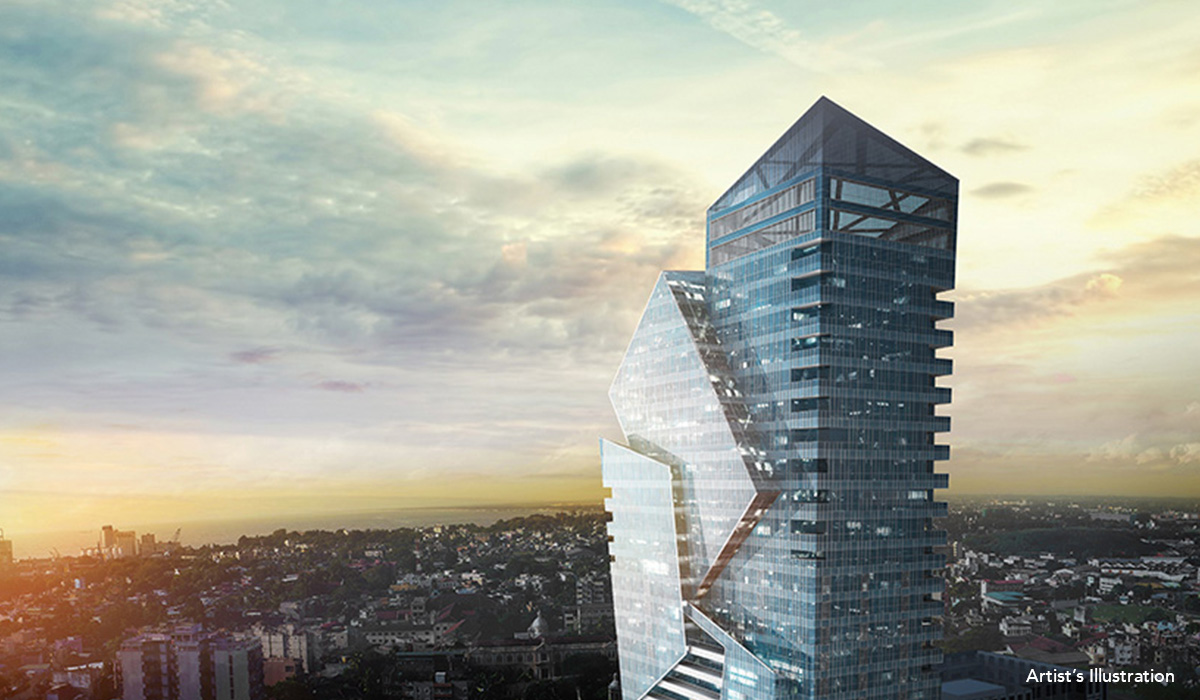
Century Spire. A 60-story tall mixed-use skyscraper part of a large development. Built between 2014-2022, the glass-clad tower is divided into three branches with varying heights. Between the two highest tower shafts is a diagonal glass structure that includes penthouses. The lower third floors are offices and the upper floors are residential. Architectural Delights
I then took a Grab back to my hotel. I asked the driver how Filopinos spent Christmas as they all seemed to be out and about in the parks, shopping or going to church, and not spending any time at home. The big Christmas meal happens at midnight. Before that, they drink to get drunk until the meal (often pork belly). Then they drink again. Fights often erupt.
ON Stone House Manila for third night.
Day 10 Sat Dec 26
My third big walk about day in Maniila. I had reserved this for most of the museums that I had incorrectly assumed would be closed on Christmas day and Boxing day.
Hobbit House. Permanently closed. Bizzarium
Museo Pambata. Established interactive children’s museum featuring hands-on exhibits & theatrical shows. I didn’t go
Museum of the History of Ideas. Run by the University of the Philippines, exhibits are on education, folk medicine, diseases (especially cholera), surgery, a great old dental chair with hand pumped drills and the role of the university in health care. 75P, 60P reduced
Paco Park. A cemetery with a double wall and completely round, Nice gardens. A mausoleum has the grave of Governor General Ramonm Llabal and held the body of Jose Rizal from 1896-1912. Urban Legend
These next three sites are in Rizal Park.
Lapu Lapu Monument (Statue of the Sentinal of Freedom). A large bronze statue of an indigenous man in a loin cloth and turban and leaning on a sword. Lapu Lapu killed Magellan in 1521.
NATIONAL MUSEUMS OF THE PHILIPPINES: Anthropology, Natural History, Fine Arts and the Planetarium. All require you to register at the front, which can be a labourious wait. No water allowed. All free.
National Museum of Natural History. I only saw the first floor: some great specimens of petrified wood, meteroites, ammonites. Free
National Museum of Anthropology. 5 floors. 5th has store rooms of jars, 4th has scripts, and a great exhibit on the wonderful textiles with their intricate designs, of the Philippines, rice culture, and the 3rd floor has mat weaving, Bangsamore art (Islamic) and pots. Free
National Museum of Fine Arts. Great exhibit on art deco with some wonderful furniture, appliances, jewelry and buildings. Art of the Japanese atrocities. The third floor has a nice open atrium. Abstract sculpure. Free
San Agustin Church. This is the oldest church in the Philippines (1587) as its structure survived many earthquakes. Of the Baroque Churches of the Philippines (WHS), the common and specific attributes of the churches are their squat, monumental and massive appearance, which illustrates a fortress/protective-like character in response to pirates, marauders and the geologic conditions of a country that is prone to seismic activities. The churches are made either of stone (tuff or coralline limestone) or brick and consolidated with lime.
The choir has 68 carved chairs. They display specific features such as retablos (altars) of high Baroque style – particularly seen in San Agustin Church, in the volutes of contrafuertes (buttresses), in wall buttresses separating criptocollateral chapels –(particularly seen in San Agustin Church, and in the iconography of the ornately decorated naïf/folk pediment expressing the local understanding of the life of Christ and demonstrated by the use of local elements (papaya, coconut and palm tree reliefs).
Unfortunately, there was a wedding happening and you could only look in from the door. There was wonderful stone carving on the ceiling of the portico and the main single nave. After a long time in the museum, I thought I could enter but there was another wedding.
Museo de San Agustín (Convent Museum). Wow, don’t miss this, maybe the best Christian religious museum in the world. Built by the Augustinians in 1571 (bamboo), burned in 1583, and again in 1586, rebuilt of stone from 1586-1604 and survived WWII. Two wonderful floors surrounding a lovely cloister with great exhibits with wood carving, polychromes, Ivory relics, botanical drawings, and ceramics. The stairs are 13 m high and consist of 44 granite blocks brought from Canton in 1786-88. And to believe that most of it was looted by the British. 200P.
Bahay Tsinoy, The Chinese Filipino museum, it has many dioramas showing the outsize role of Chinese in the culture of the Philippines. They were forced to live in parian, or ghettos just outside Intramoros. In 1600, they revolted and of 30,000, 25,000 were killed. A second revolt in 1686 resulted in another 6,000 deaths. The location of the parian was moved 9 times and in 1876, eight of them were closed leaving only Binondo. They had roles in tobacco, lumber, alcohol production, soup, and banking. In WWII, many were guerrilas. 200P
ON Stone House Manila for the 4th night
Day 11 Sun Dec 28
Car rental Avis. Cost 22,000 including a 10,000P deposit that is returned minus tolls.
Grab to the Avis Car Garage out in SE Manila (454P+118 toll). They didn’t have the subcompact I reserved and was required to get a more expensive car.
My plan was to drive south through Luzon, and go to the closest town, Santa Elena to claim it as a NM region. I should have known there would be problems when it took 3 ½ hours to drive 128 km.
Festival Mall. A huge mall with amusement parks, cinemas and the usual range of stores and restaurants. Has a glass roof.
Bahay ni Dr. Jose Rizal, Calamba. His birth house and where he was raised. A lovely large house with a veranda and period furniture. Free
Makiling Botanic Garden. A garden run by the University of the Philippines (College of Forestry and Natural Resouces) with endemic plants of the Philippines, stuffed eagles and snakes. 60P
The Roman Catholic Parish of Santiago Apostle, Paete. A baroque church dating to 1580, it was destroyed by earthquakes in 1717, 1880 and 1987 which it all seemed to survive because of its massive buttresses. Murals and wood panels, gilt chapels and retabla, nice stained glass, and a wood ceiling and dome. Lovely inside.
Roman Catholic and Apostolic Church of Pakil. Wow, don’t miss this church with its wonderful ceiling covered in frescoes, and gilt retabla with many saints. The side entrance is elaborate.


Kamay Ni Hesus Healing Church, Luchan. I counted 45 painted statues, a large Mary on a small hill and a huge Jesus at the top of the mountain. The church is a large octagon that appears almost round with stained glass windows, including a large one at the back of the altar.
Pagsanjan Gorge
Cavinti Falls. Reached by a short boat trip through the gorge that requires a tour for about 2,000P. A single drop waterfall that the boat goes behind.
Note, I didn’t go here because of time constraints.
GO TO LUZON CENTRAL
RETURN FROM CENTRAL LUZON
Day 13 Tue Dec 30
After staying in Tagaytay City overnight, I left my poor BnB at 6:45 and spent an hour (only get a free hour of wifi at Starbucks in the Philippines). I then drove back to Manila.
Aguinaldo Shrine. Former home of the Philippines president Emilio Aguinaldo, the leader of the revolution against the Spanish, then the US and the first president of the Philippines. In a lovely house with a 5-story tower, see his artifacts, weapons and history. He died in 1964. Free
Paranaque Cathedral, Paranaque. Built between 1638-50, it’s a single nave church with a lovely coffered ceiling and Ways of the Cross. Surprisingly empty (rare in Filipino churches).
MAKATI
Yuchengco Museum. Located in the RCBC Plaza building, the only parking was in their underground garage (60P). Museum was created to house the art collection of Ambassador Alfonso T. Yuchengco, a businessman, diplomat, collector, philanthropist, and patron of the arts. I like Philippino contemporary art, and this museum had lots of nice pieces. 200P, 100 reduced.
Makati Museum. Makati is a center for finance, commerce, culture, arts and home to many embassies and has the largest skyline in the Philippines, Population: 309,770 people, but because of people working in the central business district, Makati’s daytime population swells to 3.2–4.2 million people with the highest GDP per capita in the Philippines. Makati is one of the most well-known shopping hubs of Metro Manila, including the massive Ayala Center. Free

Malacañan Palace. The official residence and office of the president of the Philippines, The main building is an elegant villa in the Spanish colonial style, stretching on the Pasig River’s northern bank. It has ornate Spanish features such as shady patios, arches, balconies, and window grilles. Inside, spectacular features—many embellished during the regime of Ferdinand Marcos—include a grand main staircase in burnished woods and a beautiful music room. The palace complex includes other buildings, such as the guesthouses and government offices, notably Kalayaan Hall, the grand 1920s executive building, which now houses a museum telling the story of past rulers.
The palace was originally built in 1750 as the private summerhouse of a Spanish aristocrat, Don Luis Rocha. It was purchased by the state in 1825, but it was not until the official home of the Spanish governor-general was destroyed in an earthquake in 1863 that it became the seat of government. It continued to house colonial governors-general when the Philippines came under U.S. control in 1898 before becoming the official residence to the Filipino presidents after the country gained full independence in the 1940s.
Continual expansion and restoration have substantially changed the palace since it became the home of the ruler. The most extensive changes, both inside and out, took place during the 1970s, when it was occupied by Ferdinand and Imelda Marcos. In 1986 when Marcos was overthown, the palace was briefly occupied by protesters. Since then, most presidents, with the exception of Gloria Macapagal Arroyo, have resided in a smaller house on the grounds of the Malacañang Palace.
The area around the palace is a maze of gates and roads and the palace area can’t be reached.
San Sebastian Church. A gothic cathedral with two bell towers that ascend into spires. Made of metal manufactured in Belgium, the first church here was built in 1591, EQ in 1611, 1859, 1863 and 1889 damaged it. San Sebastion was a 1st century Roman martyr and the land donor requested the name. The church is a patron of the afterlife, soldiers and an advocat against the plague.
UST Museum of Arts and Sciences. A ecclectic university museum with paintings, religious artefacts, zoology, botany and snakes. Free
QUEZON CITY
Quezon Memorial Shrine. A 219 foot tall monument to President Manuel Quezon with a museum in the base. Born in 1878, he was a lawyer who joined the Filipino army in 1899 to fight the Americans and was president from 1935-44. He spent the war in exile in the US and died in 1944 from tuberculosis. His ornate marble casket is in the centre of the museum. The shrine is three columns with two “saucers” at the top. Free
Presidential Car Museum. In the same large park as the shrine, this was interesting to read about the advances in protection initiated over the years. The cars were: 1935 Cadillac (Quezon and MacArthur), 1937 Chrysler, 1942 Packard (a gift from Japan), 1940 Cadillac, 1955 Chrysler Crown, 1955 Cadillac, 1960 Cadillac, 1980 Lincoln limo (F Marcos with digitized gauges, and keyless entry, his wife had a 1960 Rolls Royce ridden in by QEII, Tito, Shah of Iran, Olav of Norway and John Lennon), 1986 MB (donated by Germany, the first with bulletproof glass), 1986 MB, 1993 MB limo (run flat tires, engine block protection from snipers), Also a Willys jeep. Free
UP Sunken Garden. A very large round area of grass with no trees that was sunken. Urban Legend:
Shoe Museum. All sizes with the highlight the Imelda Marcos shoes. Shoemaking equipment, a shoe phone and other great shoes. Marikina was a shoe making centre. 100P
People Power Monument. in 1993, is an 18-meter-high landmark commemorating the peaceful 1986 EDSA Revolution that restored democracy to the Philippines. Features 36 figures from Philippine society uniting for democracy, and serves as a key site for national commemorations and protests along EDSA, noted for its symbol of Filipino unity and freedom.

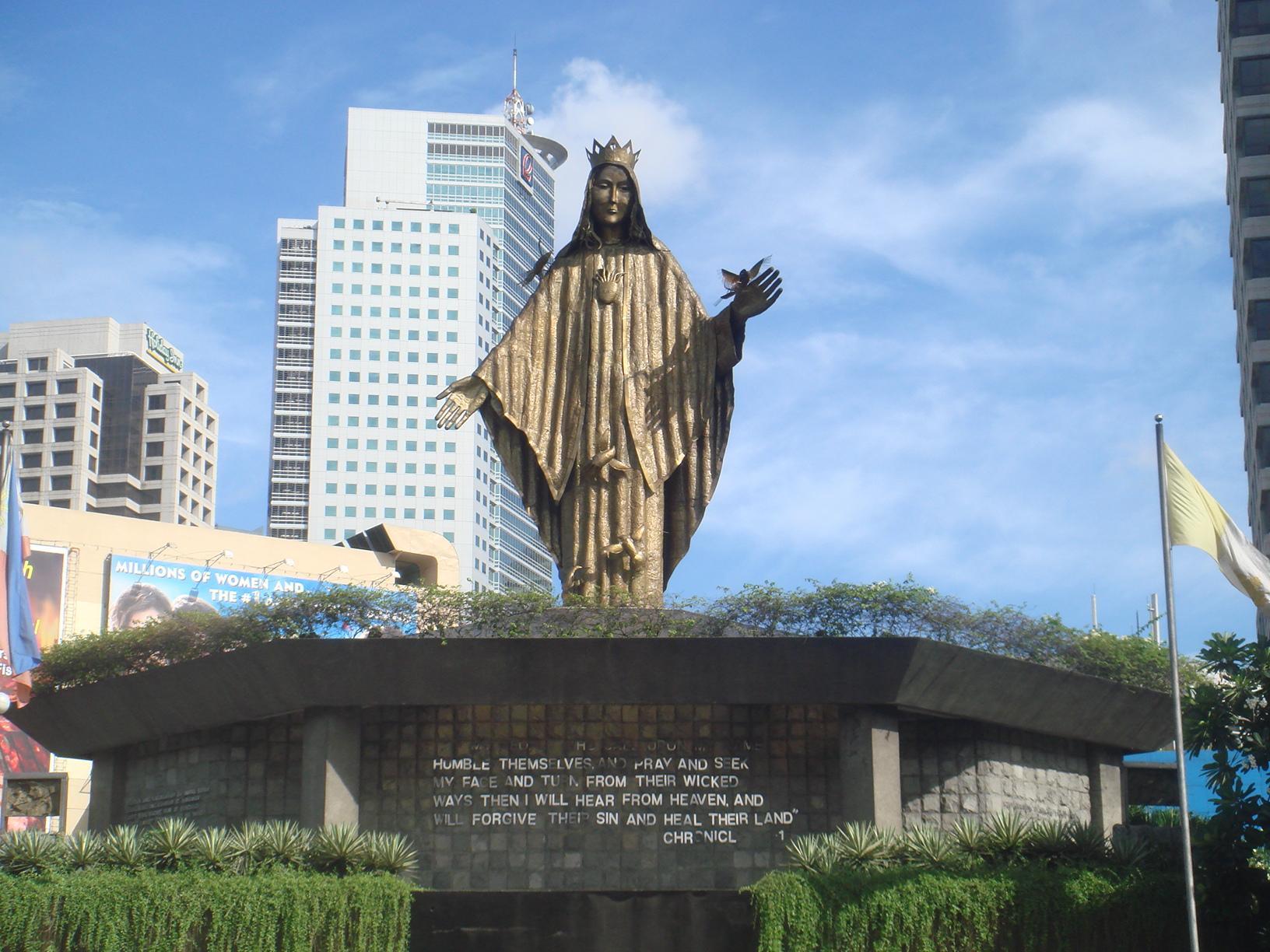
A large bronze with her arms outstretched.
SM City North EDSA. Another massive Filipino mall.
Guadalupe Church (National Shrine of our Lady of Guadalupe, Makati. Modern art deco church with no pillars despite being very wide. Many polychomes on sides but no chapels. Two big chandeliers and fans. Modern altar.
EDSA Shrine (Mary, Queen of Peace Shrine) is a small church built in 1989 to commemorate the People Power Revolution, the shrine is the site of two peaceful demonstrations that toppled Presidents Ferdinand Marcos in 1986, and Joseph Estrada (the EDSA Revolution of 2001 or EDSA II).
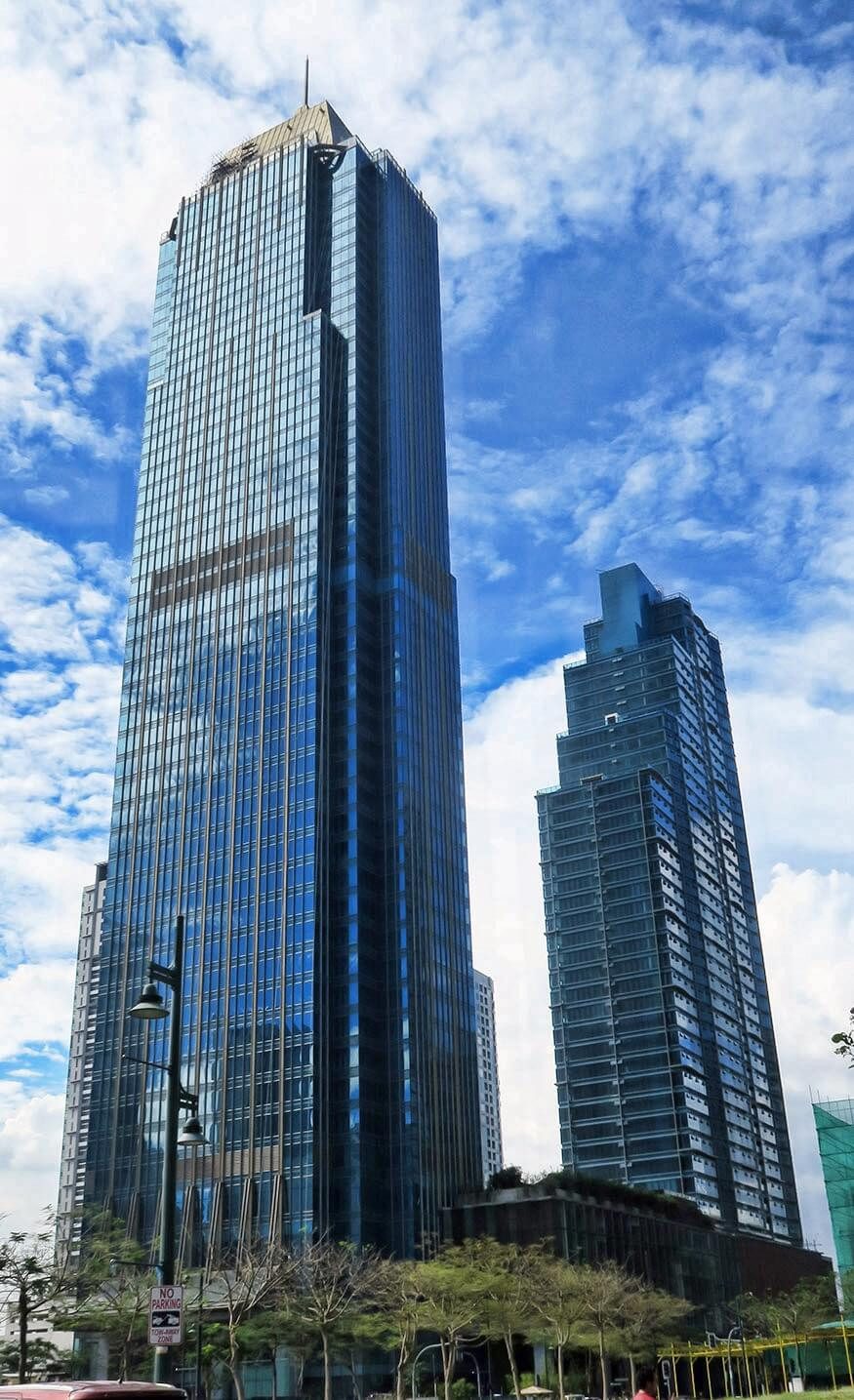
Grand Hyatt Manila is a 318 m (1,043 ft) mixed-used skyscraper, located in Bonifacio Global City. It is the tallest building in the Philippines since its completion in 2017. The building is part of Federal Land’s Grand Central Park mixed-used complex. The Metrobank Financial Center serves as a common podium of the building with the Grand Hyatt Residences, a 45-storey condominium skyscraper. The building pinnacle height is 318 m (1,043 ft) while its height up to its roof is 250 m (820 ft). It has 66 counted floors. The hotel has 461 guest rooms. It also hosts three major restaurants namely The Grand Kitchen, No. 8 China House, and The Peak. It also has meeting and events rooms covering 2,281 m2 (24,550 sq ft). Architectural Delights
Venice Grand Canal Mall, Taguig. A lifestyle mall development with a replica of the Venetian grand canal with gondola ride tours. The canal is 200 meters (660 ft) long, and 15 meters (49 ft) wide. The mall also has replicas of St. Mark’s Campanile in Piazza San Marco, the Rialto Bridge, and the Ponte de Amore Bridge, which includes an interactive love locks installation.
I returned the rental car to Avis, and got a Grab to my hotel
ON Red Doorz @ Hotel Rosemarie. A tiny room (about 18″ on two sides of a single bed and a barhroom. CA$21 for two nights. The walls are covered in great jigsaws puzzles.
Day 14 Jan 31
A quiet day reading and playing bridge.
ON Red Doorz for the seonc night
Day 15 Jan 1, 2026
By far the cheapest day to fly
Flight. Manila to Bangkok @07:20-10:00. Cebu Pacific
Thailand Travel Arrival Card: tdac.immigration.gc.th. Beware, this is free and there are many scams that charge 50-100 for the service.
Bangkok to Changdu @18:20-22:20 Sichuan Airlines
Changdu to Vancouver @01:00-22:20 (Jan 1)
Slept in Vancouver Airport
Day 16 Jan 2, 2026. Train to West Georgia, bus 237 to Horseshoe Bay, Ferry to Departure Bay, Nanaimo @11:05-12:49, Island Link bus to Courtenay @12:47-14:35. Picked up by my brother. Home!
