
Scientists estimate there are about 10,000 stars for every grain of sand on Earth’s beaches. Astronomers calculate that the observable universe holds roughly 200 billion trillion stars (that’s a 2 followed by 23 zeros). In comparison, all the sand on every beach and desert on Earth adds up to around 7.5 quintillion grains (7.5 × 10¹⁸).
Why So Many Stars? The universe is vast. Our own galaxy, the Milky Way, has around 100–400 billion stars, and that’s just one galaxy among an estimated 2 trillion galaxies in the observable universe. Each galaxy carries billions or even trillions of stars.
THE MILKY WAY
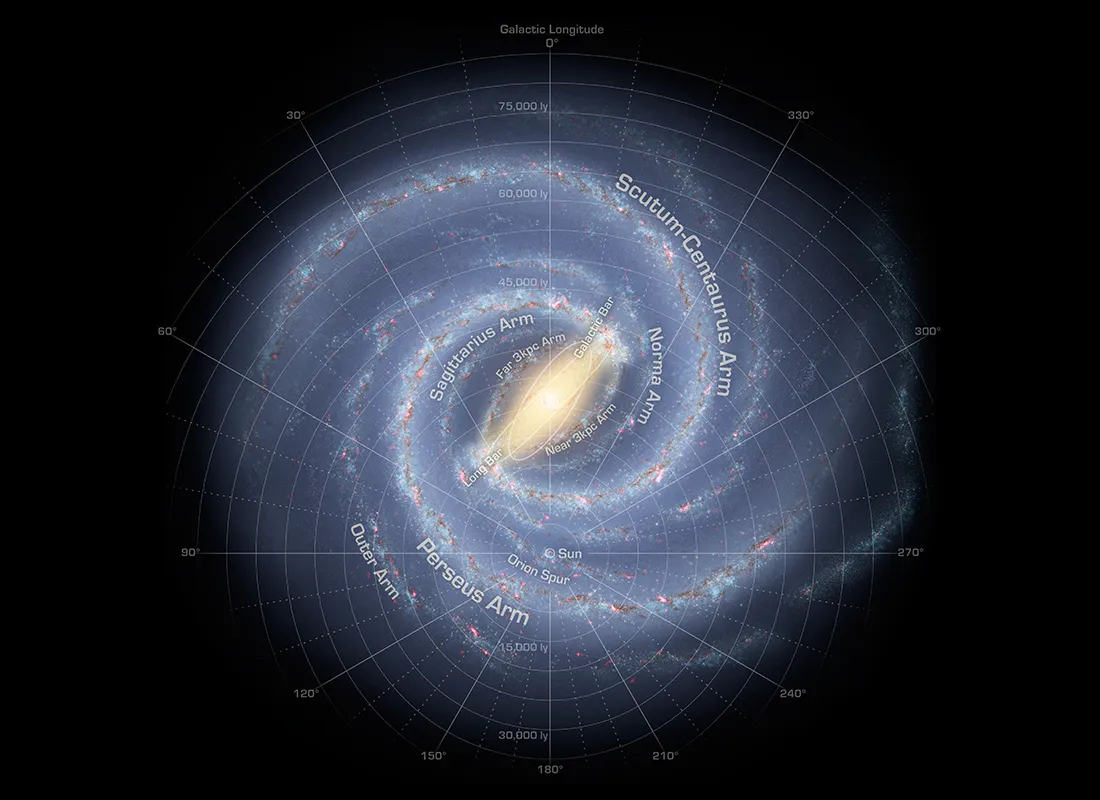
The size of the Milky Way. To answer this question, a spaceship moving at 100 percent of light speed across the Milky Way Galaxy which is huge, stretching 100,000 light-years across. Hence, it will take us 100,000 years to travel from one edge of the Milky Way Galaxy to another. Our home galaxy is packed with 100-400 billion twinkling stars, and probably just as many planets spinning around them, ranging from 800 billion up to 3.2 trillion.
At the center, a giant supermassive black hole called Sagittarius A* sits, as heavy as 4 million suns, swallowing anything nearby. Smaller black holes hide in the galaxy’s twisty arms.
Even though it’s so wide, the Milky Way is super thin, only 1,000 light-years thick—like a cosmic pancake! So if we travel through its thickness, it will take us only 1,000 light-years to escape our home galaxy. The Milky Way is just one spiral galaxy, out of over 2 trillion galaxies that make up the observable Universe.
And even if we decide to fly across it with our spaceship, we will never get to the end of the Universe as our cosmos is expanding faster than the speed of light.
It takes our Sun 250 million years to orbit the Milky Way. Our solar system is located about 26,000 light-years away from the center of the galaxy.
When we look up at the night sky, every star visible to the naked eye belongs to our own galaxy, the Milky Way. Despite the galaxy containing hundreds of billions of stars spread across a vast spiral structure, our view is limited to only a tiny fraction of them, those relatively close to our solar system. The vast majority of stars remain far beyond our sight without telescopes. This means that when we gaze at the heavens, we are not seeing the whole galaxy but just a small local neighbourhood of stars, giving us only a glimpse of the true immensity of our galactic home

The Milky Way Band is the hazy, cloudy band stretching across the sky and is the combined light from billions of stars, gas, and dust in the flat plane of our galaxy. Not only are they all in the Milky Way, but they’re also relatively close to us. Even though the Milky Way is at least 100,000 light-years across, most of the stars you can see with the naked eye are only hundreds of light-years away. The vast majority of the individual stars that can be seen all lie within a ‘bubble’ of space around the Sun, about 10,000 light-years across. The most distant one visible with the naked eye is 16,000 light-years away. The billions of stars that lie outside this region are too distant to be seen individually, and their starlight appears to coalesce into the misty band known as the Milky Way. It appears as a band, rather than all over the sky, because the Galaxy is relatively flat. So when you see the Milky Way from a dark sky site, you’re looking along the plane of the Galaxy.
While we see thousands of stars within the Milky Way, we can see a few other galaxies, which are collections of billions of stars, but not their individual points of light.
Andromeda Galaxy (M31): Two million light years away is a fuzzy patch visible in the Northern Hemisphere, representing its billions of stars. With the naked eye, it appears as a faint, blurry patch of light, not as distinct as stars like those in the Milky Way. You are NOT seeing individual resolved stars in Andromeda,
In about 4.5 billion years our Milky Way galaxy will collide and merge with the neighboring Andromeda Galaxy. Though galaxies seem vast and distant, gravity is slowly pulling these two giants together at incredible speeds. When they finally meet, stars, planets and cosmic clouds will be reshaped into a massive new “super galaxy”. Surprisingly the chances of individual stars colliding are very small, since galaxies are mostly empty space. Instead, their structures will stretch, twist and swirl in a spectacular cosmic dance that will last billions of years. The night sky of future Earth, if it still exists will be filled with breathtaking views of colliding star systems marking one of the most dramatic events in the history of the universe
Each galaxy holds billions of stars and trillions of worlds making Earth’s place in the cosmos unbelievably tiny. What seems like everything to us is, in truth, an almost invisible speck in a universe so immense that human imagination can barely scratch its surface. Every star you can see with the naked eye is within this yellow circle.
If the Sun were reduced to the size of a white blood cell the Milky Way would span the size of the continental United States. This comparison shows how immense our galaxy truly is stretching about 100,000 light-years across and containing hundreds of billions of stars. Despite the Sun being incredibly large compared to Earth it becomes almost insignificant on the galactic scale. This perspective emphasizes both the vastness of the Milky Way and the small place our solar system occupies within it.
FORMATION OF ELEMENTS
Earth may be around 4.5 billion years old, but the story of its gold is far older. Gold, along with other heavy elements like platinum and uranium, was not created on Earth itself. Instead, it was forged in the hearts of massive stars and during the explosions known as supernovas.
In these cataclysmic events, the extreme temperatures and pressures allowed lighter elements, like hydrogen and helium, to fuse into heavier ones. When these stars exploded, they scattered those precious elements across the universe. Over time, this stardust merged into clouds of gas and dust that eventually formed our solar system.
That means every piece of gold on Earth, whether in jewelry, electronics, or buried deep underground, was created billions of years before our planet even existed. In a way, gold is a reminder that we are made of the universe’s oldest and most powerful events.
WATER
The Sun formed about 4.6 billion years ago making it older than Earth which came into existence shortly after at around 4.5 billion years ago. However the water on our planet tells a much older story. The hydrogen atoms in Earth’s water were created in the Big Bang nearly 13.8 billion years ago while the oxygen atoms were forged in the hearts of massive stars that lived and died long before our solar system was born. These ancient elements combined in interstellar space to form water molecules which were carried to the young Earth by comets and asteroids. This means that the water flowing in our oceans, rivers and even within us is billions of years older than the Sun itself connecting us directly to the earliest moments of the universe
OXYGEN
Many people believe that trees are the primary source of the oxygen we breathe but the truth is more fascinating. While forests especially rainforests do play an important role in producing oxygen and balancing carbon dioxide, the majority of Earth’s oxygen actually comes from the ocean. Tiny marine organisms called phytoplankton carry out photosynthesis, just like plants on land and they are responsible for producing around 50–80% of the oxygen in our atmosphere. These microscopic life forms float near the ocean’s surface, absorbing sunlight and carbon dioxide and in the process, they release vast amounts of oxygen that sustain life on Earth.

