
Christians must reclaim Jesus from his Church.
The election of the elders of an evangelical church is usually an uncontroversial, even unifying event. But this summer, at an influential megachurch in Northern Virginia, something went badly wrong. A trio of elders didn’t receive 75 percent of the vote, the threshold necessary to be installed.
“A small group of people, inside and outside this church, coordinated a divisive effort to use disinformation in order to persuade others to vote these men down as part of a broader effort to take control of this church,” David Platt, a 43-year-old minister at McLean Bible Church and a best-selling author, charged in a July 4 sermon.
Platt said church members had been misled, having been told, among other things, that the three individuals nominated to be elders would advocate selling the church building to Muslims, who would convert it into a mosque. In a second vote on July 18, all three nominees cleared the threshold. But that hardly resolved the conflict. Members of the church filed a lawsuit, claiming that the conduct of the election violated the church’s constitution.
Platt, who is theologically conservative, had been accused in the months before the vote by a small but zealous group within his church of “wokeness” and being “left of center,” of pushing a “social justice” agenda and promoting critical race theory, and of attempting to “purge conservative members.” A Facebook page and a right-wing website have targeted Platt and his leadership. For his part, Platt, speaking to his congregation, described an email that was circulated claiming, “MBC is no longer McLean Bible Church, that it’s now Melanin Bible Church.”
What happened at McLean Bible Church is happening all over the evangelical world. Influential figures such as the theologian Russell Moore and the Bible teacher Beth Moore felt compelled to leave the Southern Baptist Convention; both were targeted by right-wing elements within the SBC. The Christian Post, an online evangelical newspaper, published an op-ed by one of its contributors criticizing religious conservatives like Platt, Russell Moore, Beth Moore, and Ed Stetzer, the executive director of the Wheaton College Billy Graham Center, as “progressive Christian figures” who “commonly champion leftist ideology.” In a matter of months, four pastors resigned from Bethlehem Baptist Church, a flagship church in Minneapolis. One of those pastors, Bryan Pickering, cited mistreatment by elders, domineering leadership, bullying, and “spiritual abuse and a toxic culture.” Political conflicts are hardly the whole reason for the turmoil, but according to news accounts, they played a significant role, particularly on matters having to do with race.
“Nearly everyone tells me there is at the very least a small group in nearly every evangelical church complaining and agitating against teaching or policies that aren’t sufficiently conservative or anti-woke,” a pastor and prominent figure within the evangelical world told me. (Like others with whom I spoke about this topic, he requested anonymity in order to speak candidly.) “It’s everywhere.”
Michael O. Emerson, a sociology professor at the University of Illinois at Chicago, told me that he and his research team have spent the past three years studying race and Christianity. “The divisions and conflicts we found are intense, easily more intense than I have seen in my 25 years of studying the topic,” he told me. What this adds up to, he said, is “an emerging day of reckoning within churches.”
The aggressive, disruptive, and unforgiving mindset that characterizes so much of our politics has found a home in many American churches. As a person of the Christian faith who has spent most of my adult life attending evangelical churches, I wanted to understand the splintering of churches, communities, and relationships. I reached out to dozens of pastors, theologians, academics, and historians, as well as a seminary president and people involved in campus ministry. All voiced concern.
The coronavirus pandemic, of course, has placed religious communities under extraordinary strain. Everyone in America has felt its effects; for many Christians, it’s been a bar to gathering and worshipping together, sharing Communion and performing baptisms, and saying common prayers and participating in rituals and liturgy. Not being in community destabilized what has long been a core sense of Christian identity.
But there’s more to the fractures than just COVID-19. After all, many of the forces that are splitting churches were in motion well before the pandemic hit. The pandemic exposed and exacerbated weaknesses and vulnerabilities, habits of mind and heart, that already existed.
The root of the discord lies in the fact that many Christians have embraced the worst aspects of our culture and our politics. When the Christian faith is politicized, churches become repositories not of grace but of grievances, places where tribal identities are reinforced, where fears are nurtured, and where aggression and nastiness are sacralized. The result is not only wounding the nation; it’s having a devastating impact on the Christian faith.
How is it that evangelical Christianity has become, for too many of its adherents, a political religion? The historian George Marsden told me that political loyalties can sometimes be so strong that they create a religiouslike faith that overrides or even transforms a more traditional religious faith. The United States has largely avoided the most virulent expressions of such political religions. None has succeeded for very long—at least, until now.
The first step was the cultivation of the idea within the religious right that certain political positions were deeply Christian, according to Marsden. Still, such claims were not at all unprecedented in American history. Through the 2000s, even though the religious right drew its energy from the culture wars—as it had for decades—it abided by some civil restraints. Then came Donald Trump.
“When Trump was able to add open hatred and resentments to the political-religious stance of ‘true believers,’ it crossed a line,” Marsden said. “Tribal instincts seem to have become overwhelming.” The dominance of political religion over professed religion is seen in how, for many, the loyalty to Trump became a blind allegiance. The result is that many Christian followers of Trump “have come to see a gospel of hatreds, resentments, vilifications, put-downs, and insults as expressions of their Christianity, for which they too should be willing to fight.”
Tim Schultz, the president of the 1st Amendment Partnership and an advocate for religious freedom, told me that evangelicalism was due a reckoning. “It has been held together by political orientation and sociology more than by common theology,” he said. The twin crises of the summer of 2020—COVID and a heightened awareness of enduring racial injustices—exposed this long-unnoticed truth.
Some of the most distinctive features of the evangelical movement may have left it particularly vulnerable to this form of politicization. Among religious believers, evangelicals are some of the most anti-institutional, Timothy J. Keller, the founding pastor of Redeemer Presbyterian Church, in Manhattan, told me. The evangelical movement flourished in this relatively anti-institutional country at a particularly anti-institutional time. Evangelical ministries and churches fit the “spirit of the age,” growing rapidly in the 1970s, and retaining more of their members even as many mainline denominations declined.
At the same time, Keller argues, that anti-institutional tendency makes evangelical communities more prone than others to “insider abuse”—corruption committed by leaders who have almost no guardrails—and “outsider-ism,” in which evangelicals simply refuse to let their church form them or their beliefs. As a result, they are unrooted—and therefore susceptible to political idolization, fanatical ideas, and conspiracy theories.
“What we’re seeing is massive discipleship failure caused by massive catechesis failure,” James Ernest, the vice president and editor in chief at Eerdmans, a publisher of religious books, told me. Ernest was one of several figures I spoke with who pointed to catechism, the process of instructing and informing people through teaching, as the source of the problem. “The evangelical Church in the U.S. over the last five decades has failed to form its adherents into disciples. So there is a great hollowness. All that was needed to cause the implosion that we have seen was a sufficiently provocative stimulus. And that stimulus came.”
“Culture catechizes,” Alan Jacobs, a distinguished professor of humanities in the honors program at Baylor University, told me. Culture teaches us what matters and what views we should take about what matters. Our current political culture, Jacobs argued, has multiple technologies and platforms for catechizing—television, radio, Facebook, Twitter, and podcasts among them. People who want to be connected to their political tribe—the people they think are like them, the people they think are on their side—subject themselves to its catechesis all day long, every single day, hour after hour after hour.
On the flip side, many churches aren’t interested in catechesis at all. They focus instead on entertainment, because entertainment is what keeps people in their seats and coins in the offering plate. But as Jacobs points out, even those pastors who really are committed to catechesis get to spend, on average, less than an hour a week teaching their people. Sermons are short. Only some churchgoers attend adult-education classes, and even fewer attend Bible study and small groups. Cable news, however, is always on. “So if people are getting one kind of catechesis for half an hour per week,” Jacobs asked, “and another for dozens of hours per week, which one do you think will win out?”
That’s not a problem limited to the faithful on one side of the aisle. “This is true of both the Christian left and the Christian right,” Jacobs said. “People come to believe what they are most thoroughly and intensively catechized to believe, and that catechesis comes not from the churches but from the media they consume, or rather the media that consume them. The churches have barely better than a snowball’s chance in hell of shaping most people’s lives.”
But when people’s values are shaped by the media they consume, rather than by their religious leaders and communities, that has consequences. “What all those media want is engagement, and engagement is most reliably driven by anger and hatred,” Jacobs argued. “They make bank when we hate each other. And so that hatred migrates into the Church, which doesn’t have the resources to resist it. The real miracle here is that even so, in the mercy of God, many people do find their way to places of real love of God and neighbor.”
The way our sensibilities are shaped determines who we are, including the order of our loves. For many Christians, their politics has become more of an identity marker than their faith. They might insist that they are interpreting their politics through the prism of scripture, with the former subordinate to the latter, but in fact scripture and biblical ethics are often distorted to fit their politics.
Scott Dudley, the senior pastor at Bellevue Presbyterian Church in Bellevue, Washington, refers to this as “our idolatry of politics.” He’s heard of many congregants leaving their church because it didn’t match their politics, he told me, but has never once heard of someone changing their politics because it didn’t match their church’s teaching. He often tells his congregation that if the Bible doesn’t challenge your politics at least occasionally, you’re not really paying attention to the Hebrew scriptures or the New Testament. The reality, however, is that a lot of people, especially in this era, will leave a church if their political views are ever challenged, even around the edges.
“Many people are much more committed to their politics than to what the Bible actually says,” Dudley said. “We have failed not only to teach people the whole of scripture, but we have also failed to help them think biblically. We have failed to teach them that sometimes scripture is most useful when it doesn’t say what we want it to say, because then it is correcting us.”
Teaching people how to think biblically would help, Dudley added, as well as teaching people how to disagree with one another biblically. “There is a lot of disagreement in the New Testament, and it gives us a template for how to listen to each other to understand rather than to argue,” he said.
Many Christians, though, are disinclined to heed calls for civility. They feel that everything they value is under assault, and that they need to fight to protect it. “I understand that,” Dudley said. “I feel under assault sometimes too. However, I also know that the early Christians transformed the Roman empire not by demanding but by loving, not by angrily shouting about their rights in the public square but by serving even the people who persecuted them, which is why Christianity grew so quickly and took over the empire. I also know that once Christians gained political power under Constantine, that beautiful loving, sacrificing, giving, transforming Church became the angry, persecuting, killing Church. We have forgotten the cross.”
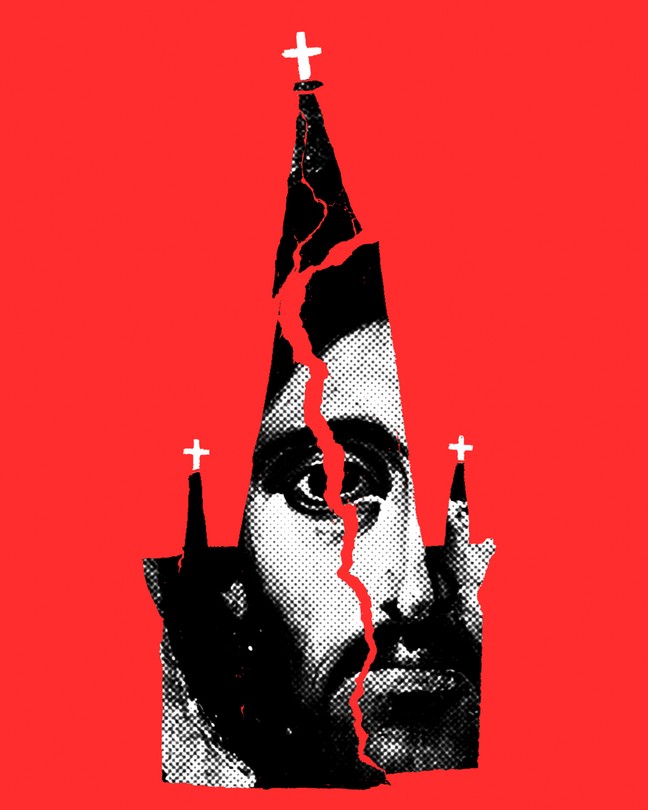
Dudley, my high-school and college classmate, left me with this haunting question: How many people look at churches in America these days and see the face of Jesus?
Too often, I fear, when Americans look at the Church, they see not the face of Jesus, but the style of Donald Trump.
The former president normalized a form of discourse that made the once-shocking seem routine. Russell Moore laments the “pugilism of the Trump era, in which anything short of cruelty is seen as weakness.” The problem facing the evangelical Church, then, is not just that it has failed to inculcate adherents with its values—it’s that when it has succeeded in doing so, those values have not always been biblical.
But of course Trump did not appear ex nihilo. Kristin Kobes Du Mez, a history professor at Calvin University and the author of Jesus and John Wayne: How White Evangelicals Corrupted a Faith and Fractured a Nation, argues that Trump represents the fulfillment, rather than the betrayal, of many of white evangelicals’ most deeply held values. Her thesis is that American evangelicals have worked for decades to replace the Jesus of the Gospels with an idol of rugged masculinity and Christian nationalism. (She defines Christian nationalism as “the belief that America is God’s chosen nation and must be defended as such,” which she says is a powerful predictor of attitudes toward non-Christians and on issues such as immigration, race, and guns.
Du Mez told me it’s important to recognize that this “rugged warrior Jesus” is not the only Jesus many evangelicals encounter in their faith community. There is also the “Jesus is my friend” popular in many devotionals, for example. These representations might appear to be contradictory, she told me, but in practice they can be mutually reinforcing. Jesus is a friend, protector, savior—but according to one’s own understanding of what needs to be protected and saved, and not necessarily according to core biblical teachings.
“Evangelicals are quick to label their values ‘biblical,’” Du Mez told me. “But how they interpret the scriptures, which parts they decide to emphasize and which parts they decide to ignore, all this is informed by their historical and cultural circumstances.” That’s not simply true of this one community, she added, but of all people of faith. “More than most other Christians, however, conservative evangelicals insist that they are rejecting cultural influences,” she said, “when in fact their faith is profoundly shaped by cultural and political values, by their racial identity and their Christian nationalism.”
Gender plays a role here as well, according to Du Mez. Over the past half century, evangelicals have tended to depict men and women as opposites. “They believe God ordained men to be protectors and filled them with testosterone for this purpose,” she said. Women, on the other hand, are seen as nurturers. The fruits of the spirit—love, joy, peace, patience, kindness, gentleness, and self-control—are deemed appropriate feminine virtues. “Men, however, are to exhibit boldness, courage, even ruthlessness in order to fulfill their God-appointed role,” Du Mez explained. “In this way, the warrior spirit and a kinder, gentler Christianity go hand in hand.”
Du Mez pointed out that even men who embrace a kinder, gentler version of masculinity— servant leadership, for example—may tip into a more rugged, ruthless version when they deem the situation sufficiently dire. And for more than half a century, she said, evangelical leaders have found reason to deem the situation sufficiently dire. They rallied their congregations against the threats of communism, secular humanism, feminism, gay rights, radical Islam, Democrats in the White House, demographic decline, and critical race theory, and in defense of religious liberty.
“Evangelical militancy is often depicted as a response to fear,” she told me. “But it’s important to recognize that in many cases evangelical leaders actively stoked fear in the hearts of their followers in order to consolidate their own power and advance their own interests.”
Du Mez is somewhat more sympathetic toward ordinary evangelicals than she is toward powerful evangelical leaders. She acknowledges that many evangelicals have genuinely sought to follow God’s will; they were directed to believe what they do by pastors, Bible-study leaders, Christian publishers, and Christian radio and television programming. “Many have sought certainty in turbulent times,” she said, and they know that challenging these narratives may well involve the loss of meaningful communities.
Fear has played a central role in the explosion of conflict within American evangelical churches. “Dwelling on fear and outrage is spiritually deforming,” Cherie Harder, president of the Trinity Forum, told me. “Both biblical wisdom and a large body of research holds that fear and grace, or fear and gratitude, are incompatible.” She quoted from one of the New Testament epistles: “Perfect love drives out fear.”
There are moments, of course, when fear is an appropriate and necessary response, but there are risks when it becomes a constant presence. “Fear and anger should presumably function as alarm systems—and an alarm is not supposed to stay perpetually on,” Harder said. It is not the onset of fear or anger that is most dangerous, she said, “but stoking it, cultivating it, and dwelling within it that distorts and deforms.”
And then there is a regional component to the crisis of evangelical Christianity. Claude Alexander, the senior pastor of the Park Church in Charlotte, North Carolina, told me we must come to terms with the “southernization of the Church.” Some of the distinctive cultural forms present in the American South—masculinity and male dominance, tribal loyalties, obedience and intolerance, and even the ideology of white supremacism—have spread to other parts of the country, he said. These cultural attitudes are hardly shared by every southerner or dominant throughout the South, but they do exist and they need to be named. “Southern culture has had a profound impact upon religion,” Alexander told me, “particularly evangelical religion.”
The conservative writer David French, who lives in Tennessee, has written about the South’s shame/honor culture and its focus on group reputation and identity. “What we’re watching right now in much of our nation’s Christian politics,” he wrote, “is an explosion not of godly Christian passion, but rather of ancient southern shame/honor rage.”
Pastors now find themselves on the front lines of this conflict, their congregations splitting into warring camps. I spoke with 15 of them, and what I heard was jarring. They told me that nothing else they’ve faced approaches what they’ve experienced in recent years, and that nothing had prepared them for it.
Scott Dudley of Bellevue Presbyterian Church said he knows of several pastors who have not just quit their churches but resigned from ministry, and that many others are actively seeking to switch careers. “They have concluded that their church has become a hostile work environment where at any moment they may be blasted, slandered, and demeaned in disrespectful and angry ways,” he said, “or have organized groups of people within the church demand that they be fired.”
Several months ago, I spoke with one such pastor, who had not only resigned from his church, a congregation of the Presbyterian Church in America, but had also decided, at least for now, to leave the ministry altogether. He told me that he felt undermined by people in his congregation, including by some whom he had trusted but who, it turned out, were less animated by spiritual matters than by political agendas. This former pastor used the word betrayal in our conversation; he talked about the pain this episode has caused him and his wife. In his words, “The gentleness of Jesus was utterly discarded” by those who felt he wasn’t championing their cultural and political agendas aggressively enough.
“They don’t care about the relational collateral damage,” he said.
In a similar vein, I recently had a conversation with a senior pastor who is planning to leave his position soon; he’s not yet sure where he’ll land, or even whether he’ll stay in the ministry. He has simply been worn down by the divisions within his church. He has not been the target of outward hostility, but he can feel the ground shifting beneath his feet. He feels that he is growing apart from people in the congregation; there’s no longer the same sense of common purpose. He is watching the collapse of an evangelical movement to which he has devoted much of his life. At one point, as we talked about what is unfolding within American Christianity, his eyes welled with tears.
Bob Fryling, a former publisher of InterVarsity Press and the vice president of InterVarsity Christian Fellowship, an evangelical campus ministry, has been part of a weekly gathering of more than 150 individuals representing about 40 churches. He’s heard of conflicts “in almost every church” and reports that pastors are exhausted. Earlier this year, the Christian polling firm Barna Group found that 29 percent of pastors said they had given “real, serious consideration to quitting being in full-time ministry within the last year.” David Kinnaman, president of Barna, described the past year as a “crucible” for pastors as churches fragmented.
The key issues in these conflicts are not doctrinal, Fryling told me, but political. They include the passions stirred up by the Trump presidency, the legitimacy of the 2020 election, and the January 6 insurrection; the murder of George Floyd, the Black Lives Matter movement, and critical race theory; and matters related to the pandemic, such as masking, vaccinations, and restrictions on in-person worship. I know of at least one large church in eastern Washington State, where I grew up, that has split over the refusal of some of its members to wear masks.
“There have always been mean people who cloak their unkindness in religious devotion,” one minister in a conservative denomination told me. “The New Testament itself is pretty clear about that.” But, he added, the conflicts have grown more widespread and more intense. “Without doubt you’ll see—you already are—a ton of pastors quitting,” he said. ”Most pastors actually hate conflict. So if you’re going to pay me one-quarter of what I could make on the market, why put up with this?”
In his own church, some of the elders are devoted to culture-war politics. “These guys can be a special kind of relentless, and I don’t think I’ve had it as bad as many,” he said. “But when we’re stressed out, trying to be public-health experts without the training to do that, trying to keep our own families from blowing up with COVID stress, getting criticized from both sides at once, and then having folks doing whatever they can to ruin us and get us run out of town— we’d love to just be trusted as friends and shepherds. I understand why many folks have just said, ‘I’m done.’ I’m not there yet, but I hardly think I’m above it or guaranteed not to. I just pray to Jesus to not let me throw in the towel.”
The historian Mark Noll’s 1994 book, The Scandal of the Evangelical Mind, will be rereleased next year. In the forthcoming preface, which Noll, himself an evangelical, shared with me, he argues that in various spheres—vaccinations, evolutionary science, anthropogenic global warming, and the 2020 elections, to name just a few—“white evangelicals appear as the group most easily captive to conspiratorial nonsense, in greater panic about their political opponents, or as most aggressively anti-intellectual.” He goes on to warn that “the broader evangelical population has increasingly heeded populist leaders who dismiss the results of modern learning from whatever source.” And he laments the “intellectual self-immolation of recent evangelical history.”
“Much of what is distinctive about American evangelicalism is not essential to Christianity,” Noll has written. And he is surely correct. I would add only that it isn’t simply the case that much of what is distinctive about American evangelicalism is not essential to Christianity; it is that now, in important respects, much of what is distinctive about American evangelicalism has become antithetical to authentic Christianity. What we’re dealing with—not in all cases, of course, but in far too many— is political identity and cultural anxieties, anti-intellectualism and ethnic nationalism, resentments and grievances, all dressed up as Christianity.
Jesus now has to be reclaimed from his Church, from those who pretend to speak most authoritatively in his name.
Too many Christians have “domesticated” Jesus by their resistance to his call to radically rethink our attitude toward power, ourselves, and others, Mark Labberton, the president of Fuller Theological Seminary, told me. We live in “an era of acute anxiety and great fear,” he said. As a result, too often Christians end up wrapping Jesus into our angry and fearful distortions. We want Jesus to validate everything we believe, often as if he never walked the face of this Earth. What we’re witnessing can be explained “more by sociology than Christology,” he said.
Unlike in the Sermon on the Mount and the parable of the Good Samaritan—unlike Jesus’s barrier-breaking encounters with prostitutes and Roman collaborators, with the lowly and despised, with the unclean and those on the wrong side of the “holiness code,” with the wounded souls whom he healed on the Sabbath—many Christians today see the world divided between us and them, the children of light and the children of darkness. Blessed are the politically powerful, for theirs is the kingdom of God. Blessed are the culture warriors, for they will be called children of God.
For many of us who have made Christianity central to our lives, the pain of this moment is watching those who claim to follow Jesus do so much to distort who he really was. Those who deform his image may be doing so unwittingly—this isn’t an intentionally malicious enterprise they’re engaging in; they believe they’re being faithful—but it is nonetheless destructive and unsettling.
I believe the portrait I’ve painted in this essay is accurate, but it is also, and necessarily, incomplete. Countless acts of kindness, generosity, and self-giving love are performed every day by people precisely because they are Christians. Their lives have been changed, and in some cases transformed, by their faith. My own life has been immeasurably blessed by people of faith who have walked the journey with me, who have shown me grace and encouraged me in difficult moments. But I can recognize that while also recognizing the wreckage around us.
Something has gone amiss; pastors know it as well as anyone and better than most. The Jesus of the Gospels—the Jesus who won their hearts, and who long ago won mine—needs to be reclaimed.
+++++++++++++++++++++++++++++++++++++++++++++++++++++++++
The Evangelicals Who See Trump’s Viciousness as a Virtue
At the National Prayer Breakfast, the president tested his audience’s commitment to Christian ethics.
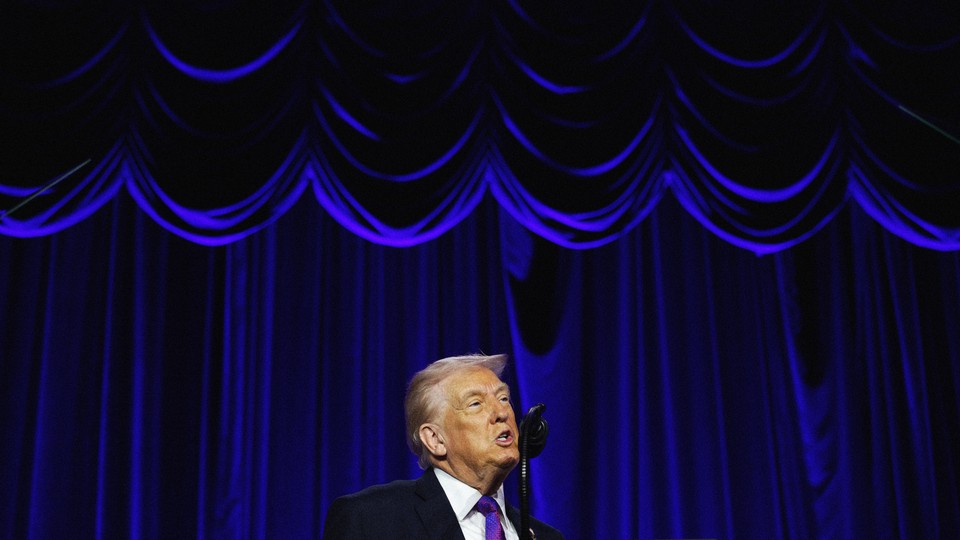
The National Prayer Breakfast was founded in 1953, when President Dwight Eisenhower accepted an invitation to join members of Congress to break bread together. Every president since has participated, regardless of party or religious persuasion. It offers an opportunity, according to its organizers, for political leaders to gather and pray collectively for our nation “in the spirit of love and reconciliation as Jesus of Nazareth taught 2,000 years ago.”
Donald Trump never got that memo—or, if he did, he’s found ways to ignore it.
In a rambling, 75-minute speech at the Prayer Breakfast yesterday, we saw the quintessential Trump. His comments were grievance-filled, narcissistic, conspiratorial, factually false, divisive, and insulting. He referred to his critics as “lunatics.” He engaged in projection, comparing them to “dictators” and “the gestapo.” He labeled Republican Representative Thomas Massie a “moron” because he won’t cast legislative votes the way Trump wants. Joe Biden is “Crooked Joe,” while Jacob Frey is “the horrible fake mayor” of Minneapolis. Trump praised El Salvador’s authoritarian President Nayib Bukele—Bukele has referred to himself as “the world’s coolest dictator”—for his “very strong prisons.” (The prison that Trump celebrates, Centro de Confinamiento del Terrorismo, known as CECOT, is notorious for its cruel and inhumane conditions.) Trump emphasized that Bukele—who also spoke at the National Prayer Breakfast—is “one of my favorite people.”
Trump took credit for churches “coming back stronger than ever” and for religion being “hotter than ever.” He claimed he has “done more for religion than any other president”—apparently, before the age of Trump, Christians couldn’t say “Merry Christmas” in public—and argued that his predecessors in the White House “bailed out” on religion. “I don’t know how a person of faith can vote for a Democrat. I really don’t,” he said, adding, “They cheat.”
The spirit of love and reconciliation that Jesus of Nazareth taught 2,000 years ago was not particularly evident in the words of the president. Of course, it never has been. No matter. The audience of some 3,500—the great majority of whom undoubtedly claim to be followers of Jesus—responded to Trump’s remarks with a standing ovation.
It is testimony to the marketing genius of Donald Trump that he never sold himself to Christians as one of them—pious, devoted, merciful, forgiving, irenic, biblically literate, a faithful husband and father, a man of high moral standards. Instead, he sold himself as their protector. He didn’t hide his cruelty or his belief that the ends justify the means; doing so would have been impossible for him because they are central features of his personality. So he did the opposite: He presented himself to Christians as a fierce, even ruthless, warrior on their behalf. It worked. He built a huge, loyal, fanatical following.
At the National Prayer Breakfast, Trump recounted comments made about him by Robert Jeffress, the senior pastor of the First Baptist Church in Dallas and a stalwart Trump ally for a decade.
According to Trump, the case Jeffress made on his behalf in 2016 went like this: “He may not have ever read the Bible, but he will be a much stronger messenger for us.” It was Jeffress who said at the time, “I want the meanest, toughest SOB I can find to protect this nation.”
Jerry Falwell Jr., then the president of Liberty University, put it this way in a 2018 tweet: “Conservatives & Christians need to stop electing ‘nice guys’. They might make great Christian leaders but the US needs street fighters like @realDonaldTrump at every level of government b/c the liberal fascists Dems are playing for keeps & many Repub leaders are a bunch of wimps!”
Tony Perkins, an ordained Southern Baptist minister and the president of the Family Research Council, a prominent evangelical activist group, admitted in 2018 that he and other evangelicals gave Trump a “mulligan” on his multiple affairs and hush-money payments to a porn star for a simple reason: Evangelicals “were tired of being kicked around by Barack Obama and his leftists. And I think they are finally glad that there’s somebody on the playground that is willing to punch the bully.” When asked what happened to turning the other cheek, Perkins replied, “You know, you only have two cheeks. Look, Christianity is not all about being a welcome mat which people can just stomp their feet on.”
They thrill to watch Trump savage his critics, and their devotion grows with every dehumanizing word, with every merciless act.
If Henry VIII earned the title “Defender of the Faith,” why not Donald Trump?
It is odd to see the very same evangelicals who claim the Bible is inerrant and who criticize fellow Christians about matters such as ordaining women—on the grounds that they are being unfaithful to what Paul wrote in one of his Epistles, an interpretation that many biblical scholars dispute—dismiss Jesus’s most famous sermon. For these Christians, the teachings of the son of God take a back seat to the pronouncements of the king of Mar-a-Lago.
Much of today’s evangelical world sees Trump’s viciousness not as a vice but as a virtue, so long as it is employed against those they perceive as their enemies, against those whom they resent and for whom they have a seething hatred. Unless you’ve spent time in the evangelical world, fully appreciating the level of antipathy that exists toward Democrats and progressives is difficult. The only thing that exceeds it is the loathing reserved for the Christians and conservatives who broke with Trump because their commitment to their faith, and to cherished moral truths, required them to speak out against him.
What i am describing isn’t true of all Christians, thankfully. Some have found the cumulative effect of Trump’s assault on Christian ethics too much. The Catholic Church and its American pope, Leo XIV, are speaking out prudentially but forcefully against the actions of the Trump administration. Mainline denominations, including the United Methodists, are stepping up. My friend Mark Labberton, a former president of Fuller Theological Seminary and a Presbyterian (PCUSA) pastor, traveled to Minneapolis to express solidarity with the people of that city after an ICE agent killed Renee Good. He joined many others in peaceful protests in subzero temperatures. Other pastors and theologians I respect, several of whom were formative in my journey of faith, signed a statement titled “Christ Alone: A Call to Faithful Resistance.” It nowhere mentions the president or his party, but it does take a prophetic stance “in a time of fear and capitulation in both the Church and in our civic life.”
“In this moment we specifically call on the Church and peoples across the political spectrum to recognize the clear and present danger of rising authoritarian rule to all of us, especially the most vulnerable,” the statement says. “We commit ourselves to resisting cruel or oppressive means of control and to standing in solidarity with the oppressed, the marginalized, and the silenced.”
Even among evangelicals, support for Trump is hardly universal, and many pastors I know are quite disturbed by the damage he and his administration are doing. Yet they know full well that many within their congregations voted for Trump and still align themselves with the Republican Party. These ministers are therefore hesitant to speak out not only from the pulpit but in any capacity. They want to keep their head down.
That’s understandable. The best pastors I know are instinctively wary about speaking out politically; that’s not why they got into ministry in the first place. They don’t feel that it’s their job to offer political commentary, nor do many of them feel especially equipped to do so. They also realize that many people go to church seeking a safe haven from politics. They believe, too, and with some justification, that to take a stand, even with great care, might well split a congregation.
Evangelical denominations and pastors, though, even those who are not deeply immersed in politics, are generally willing to speak out on culture-war issues that have political and sometimes legislative implications. I’ve seen this happen many times over the years.
So the reluctance to take a prophetic stance in the realm of politics and culture is less a principled unwillingness than a selective one. Ministers, like most of the rest of us, are likely to wade into controversial waters only when it’s safe—in their case, when there is overwhelming agreement within a congregation on a set of issues. They speak out when the response from those in the pews is a resounding “Amen!” rather than even a handful of voices saying, “Oh no you don’t!”
I don’t pretend these are easy matters for pastors to face. A minister of a conservative congregation might tell himself that the downside to speaking out against the sins of the authoritarian right, even judiciously and without partisan rancor, is too costly. They may fear that their ministry will be damaged, that offended parishioners will tune them out, and that they will gain nothing concrete.
But aren’t prophets esteemed precisely for their willingness to tell difficult truths to the people of God? For being steadfast in the face of fierce criticism; for denouncing social injustice and idolatry, including political idolatry, when it’s unfashionable to do so; for issuing warnings when others fall silent; and for calling people to repentance during times of moral blindness?
Non-maga evangelical pastors are going to face a set of difficult questions during the next three years: Under what conditions, if any, are you willing to speak out when a president and his administration repeatedly violate Christian ethics? Will you stay silent even when acts of cruelty, lawlessness, and injustice aren’t the exception but the norm? How much more indecency do you need to see before you act?
My colleague Jonathan Rauch, an eminently fair-minded, reasonable, and wise writer, recently explained why, after heretofore avoiding the term, he has come around to the belief that Donald Trump’s governing style qualifies as fascist.
Even if you disagree with Rauch’s conclusion, it’s still worth wrestling with his catalog of the president’s misdeeds, broken into 18 categories. And the case Rauch makes—that although America is not a fascist country, it has a fascist president—will almost certainly become stronger over time.
At some point, then, it may become nearly impossible for pastors who are not fully on board with MAGA to look away, to stall for more time, to let others do the heavy lifting, or to tell themselves that things aren’t so bad, that silence is golden. A healthy church culture, like a healthy family culture, brings things into the open. It doesn’t avoid or close off conversations.
Labberton, the Presbyterian pastor, once told me that the more highly contentious an issue is, the more likely he is to want to discuss it with his congregation in a way that is honest, open, and biblically informed. Of course, there will be a diversity of opinions. That’s not something to run from; it’s something to learn from.
“Our reality is sufficiently complex that we need to invite one another along for the journey,” Labberton said. We need to invite one another into respectful conversations. “Together we need to instigate a long journey into God’s mercy and justice.” Pastors, and the congregations they lead, have to hope that we can summon the courage to go where God’s mercy and justice lead us.
“Seldom, if ever, do I pause to answer criticism of my work and ideas,” Martin Luther King Jr. wrote. But when a group of white Alabama clergymen declared him an outside agitator whose efforts were “unwise and untimely,” he decided to respond. The result was “Letter From Birmingham Jail,” one of the most important documents in U.S. history.
This letter, like all of King’s greatest works, cannot be understood apart from his Christian faith. Faith shaped his views on ethics and human dignity. It also gave him the courage to create tension in the cause of justice. “I am grateful to God that, through the influence of the Negro church, the way of nonviolence became an integral part of our struggle,” he wrote.
The white pastors in Birmingham had a case to make. They didn’t want what they called “days of new hope” in Birmingham to be undone by “extreme measures” that would cause divisions. King, one of America’s great prophets, saw things differently. He wept over the laxity of the Church and reminded it of its high calling—not to be the master or the servant of the state, but rather its conscience.
I imagine that all of the white pastors I know think that if they had been a minister at that time—especially if they were a minister of churches that were made up of white segregationists—they would have found a way to speak up rather than be silent, would have stood with King instead of those who urged caution in the name of unity.
The question now comes again in our time: What does it mean for the Church to be the conscience of the state?
