
GREATER TOKYO
Day 4 Thur Nov 13
Train from Yokohama to Aoto Station, Keikye Main LIne direct.
ON Hotel Akai. CA$37
Day 5 Fri Nov 14
Train to Narita Airport
Pick up a camper van from Samurai Camper vans near Narita.
++++++++++++++++++++++++++++++++++++++++++++++++++++++++++++++++++
Day 17 Thur Nov 27
i finished writing about all these sites and then erased them so am not going to put in all the work again. Here is a list of what I saw. It was a nightmare drive with at least 4 major traffic jams.
Tama Art University Library. All arches. Architectural Delight.
Day 18 Fri Nov 28
This was the day to return my camper van and drove across north Tokyo to see sites not possible from the metro. I wrote extensive bits of all these and lost them in a copy and paste operation.
Jindai Botanical Gardens.
Tohogakuen School of Music. Architectural Delight.
Tokyo Daibutsu.
Akatsuka Botanical Garden.
Windwheel.
Tobu Museum.
Statue of Konkichi Ryotsu.
Dutch Windmill De Liefde. A real working windmill.
National Museum of Japanese History. I came here only to see the WWII exhibit, which was very small in Gallery 6. No atrocities are mentioned, not even Pearl Harbour. 600Y
I returned to Samurai Campers, paid the 35,000Y toll (no speeding tickets, no parking fines and no damage was charged for), hitchhiked back to Yakgawa Train Station and took the train to Ueno.
Ameya Yokochō. A shopping district that the hostel sits in.
ON Ueno Station Hostel Oriental I, Men only. CAD42/night. One of the cheaper hostels in Tokyo. The bed was hot and stuffy. One 10-foot-long desk to work at on the 4th floor (with an onsen), but a massive room of recliners.
I decided to stay here for four more nights.
TOKYO
Day 19 Sat Nov 29
A big walk about day to see NM sites in Tokyo.
I had used over 16GB of my allotted 20GB because of all the Google Maps in my 2-week drive, so I purchased a SIM for 5 days with unlimited data for 2500Y from Yodobashi Camera.
Shitamachi Museum. This community of Tokyo is detailed in a number of good exhibits. From the Edo period (1603-1868) through to 1960. The 7.9 Great Kanto earthquake of 1923 and the subsequent fire destroyed 50-90% of all neighbourhoods. Air raids in 1945 in WWII destroyed large parts of the district. After 1960, Western clothing and styles were adopted. This discusses transportation and changes in households. Large exhibit on hairstyles. 300Y
Former Iwasaki House Garden. This was the former residence of Iwasaki, the founder of Mitsubishi, built in 1896. First, see the “Swiss cottage”, a log-style house used as a guest house with a billiard room. See the Japanese wing with about four of the original 12 rooms used as living quarters, and the Western wing, a grand mansion used for socialization. See all of the two stories, basically empty rooms with great wood coffered ceilings, Doulton bathrooms and fireplaces. 400Y, 200Y reduced.
Nezu-ji. Pass the four guardians and the main Shinto shrine, known for its tunnel-like tori gates and nice gardens. Free
Rikugien Gardens. A 2+ km walk out of the way, this mountain and pond style garden is based on dividing Chinese poetry into 6 categories. 300Y, 150Y reduced.
Ginza District. Traditional shopping street since the 1950s with around 60 stores & restaurants. Very busy pedestrianized street.
Asakura Museum of Sculpture. Asakura Fumio’s studio and house built in 1907. Many nice works in different styles. His famous cat sculptures were not on display. the home is unusual as it is reinforced concrete painted black. 500Y
Yanaka. Traditional artisan district with many temples, cemeteries and traditional houses that survived the EQ and air raids.
Yanaka Cemetery. A massive cemetery covering many blocks. One could spend all day here seeing the many types of tombs. The most impressive are the large rock “stela”. Most have two silver cups, an incense burner and candle holders. Some impressive tombs were those of Nakaumura Masano (1830-92), an educator and Herrn Hermann Ritter Dr Phil. There are many trees and a lovely walk across to get to the next site.
Kanei-ji. A Buddhist temple dating from 1635 with many statues and a 5-story pagoda.
All the rest of these sites are in Ueno Imperial Grant Park. .
Tokyo National Museum. The Black Gate was the main gate of the Ikeda elite samurai residence, which was moved here in 1954. Exhibits included sculptures of the guardian gods and a wonderful wood Amida Buddha from the 1100s, lacquer ware, samurai swords, the Ainu people, archaeology (Japan first settled 40,000 years ago, pottery started 13,000 years ago. and bronze items from 2,400 years ago, including gold metalwork. 1000Y, Free if over 70.
National Museum of Nature and Science. A 1600-year-old Yakusugi tree, stuffed critters, dinosaurs, and astronomy with some early telescopes. 630Y, free reduced.
THE ARCHITECTURAL WORK OF CORBUSIER, An Outstanding Contribution to the Modern Movement WHS — National Museum of Western Art. One of 17 WHS of Courbusier (Charles-Édouard Jeanneret, 1887-1965. He used the Golden rule: average human height 183 cm to average navel height 113 cm = 1:618 with a ceiling height of 226 cm (the average height of a man with upstretched arms.
The building is of his typical reinforced concrete with an exposed aggregate facade. Religious art. 17th and 18th century European art, Renoir, Monet. Degas, Rodin, Paul Signac. Permanent exhibit 500Y, Free reduced.
Tokyo Metropolitan Art Museum. The free exhibits were undecipherable Japanese calligraphy. Most were here to see the Van Gogh exhibit 2300Y, 1600Y reduced. This was a poor exhibit with massive crowds. I had to look across 4 rows of bodies to read the pictures title. A lot of the exhibit was videos about Van Gogh, there were few famous paintings, and the show was supplemented with the art of many others.
Ueno Zoo. Famous for its pandas, it has lovely enclosures for the usual tigers, elephants, gorillas, and many birds. I was one of the last admissions at 4 pm. 600Y, 300 reduced
Statue of Saigo. A bronze of a heavy-set man in a robe with a samurai sword and a dog on a leash in his right hand. This statue is of the legendary samurai Saigo Takamori, one of the most influential samurai in all of Japan. A man often dubbed as the ‘last true samurai’, the statue is an iconic Ueno landmark.
Takamori was the inspiration behind the Hollywood blockbuster film ‘The Last Samurai’. A man of many talents Takamori led Japanese fighters during the 1877 Satsuma Rebellion, and also wrote poetry under the name Saigo Nanshu.
The Ueno Royal Museum. The only private art museum in Ueno Park, it has no permanent exhibitions and shows contemporary art, calligraphy, manga, hanga prints and ukiyo-e in the museum’s collection.
ON Ueno Station Hostel Oriental I, Men only. I am staying here for 6 nights to see as much of Tokyo as possible.
Day 20 Sun Nov 30
Akihabara Electric Town. A shopping district concentrating on electronics, from the giant, Yodobashi to many small shops concentrated in a few block area. Urban Legends
Kanda Myoujin Shrine. A Shinto shrine dating to 1616 with a vibrant vermilion colour palette and gold embellishments. A wedding was happening with the bride in a very unusual, big, white hat.
Football Museum. Google Maps said the location was in the middle of the street (Football Museum signs were above all four traffic lights), but there was no museum there. I asked a man with excellent English, and he couldn’t find the museum. I walked a few streets away, and he ran after me, saying that the museum had been closed for 2 years.
Tokyo Waterworks Historical Museum. Unfortunately, only in Japanese. Exhibits on dams, pipes, valves, hydrants, maps, photos, and a lot of ancient wood pipes. Free
The Baseball Hall of Fame and Museum. In the main baseball stadium, there was a hall of fame with a hundred plaques of inductees, uniforms of all 12 teams in the professional baseball league, many balls, bats and gloves, trophies and baseball cards. 800Y, 500Y reduced.
Koishikawa Korakuen Gardens. A very large garden dating from the 17th century, very busy on a Sunday, with ponds, large trees, and bridges. 300Y, 150Y reduced.
Yashukan Museum. A museum with memories of the “enshrined” (soldiers, samurai and nurses killed on the battlefield). Has dolls, a Zero fighter and many documents. Only in Japanese and not at all interesting. 1000Y, no reduction.
Yashukan Shrine. A 1869 Shinto shrine next to the museum is celebrating 2.5 million Japanese war dead, and 1000 “war criminals” with a garden, a large tori gate. It is controversial, and the last two emperors have not visited it.
National Showa Memorial Museum. Shows the daily life of Japanese citizens before, during and after WWII. There were many hardships and concessions the people had to endure – rationing, air raids, war widows, electrification, reviving ports and rebuilding the country. All Japanese except for a few English-speaking signs announcing major exhibits. 400Y, 360Y reduced.
National Museum of Modern Art. Cezanne, many cubist works (Max Ernst), photos of war crimes around the world by Tomako Yoneda, a lovely Kandinsky (one of my favourite artists), 500Y, free reduced to the permanent collection.
It was then a lovely 2.5 km walk around the Imperial Palace grounds, all protected by a large moat.
Imperial Palace. Seen by a guided tour Tuesdays to Saturday from 9 – 12 with 300 tickets available on a first-come/first-served basis. I crossed the Imperial East Gardens at Kita-Lana-bashi Mon Gate and exited at the Ote-Mon Gate. Lovely. A large area outside of the central moated area is park with many manicured pine trees.
Hibiya Park. A Western-style park with ponds, flowers, tennis courts, outdoor music venues, playgrounds and halls.
Imperial Hotel. A large, 5-star hotel with a great lobby area – high ceilings and the large Rendezvous Lounge.
Maison Hermes. Six floors of high-end fashion – shoes, bags, jewelry, watches (one price tag was 32,420,000Y), bedding, dishes, crystal and more. The exterior is made of large glass blocks.
Seiko Museum. Six floors of the history of time keeping (natural to man-made) and exhibits on the many innovations of Seiko. The sign at the door said all reservations were taken for the day, but I went in, and they admitted me. Free
Ginza Wako. An iconic department store, known for its bento.
Vampire Cafe. A unique themed restaurant where all the waiters are dressed up and play their parts well. Six and seven-course meals are offered, but the food is mediocre, the included drinks have little alcohol, and the service is extraordinarily slow, often taking over 2 hours to get your meal. Unfortunately, it didn’t open until 5 pm, and I couldn’t wait. I took the elevator up to the 7th floor, and it opened onto a small reception desk and a skeleton scarecrow.
Mandarin Oriental. A five-star hotel on the top nine floors of a 38-story sky scraper. I tried to enter the elevator but was blocked – “for hotel guests only”. The advertised lowest price was 81,000 yen.
Nakagin Capsule Tower. An iconic 1970s apartment building made up of independent furnished pods plugged into a central structure. It was not well-maintained and deteriorated until it was eventually abandoned. And when I tried to find it, a high construction fence surrounded it, and it was basically demolished except for some of the ground floor. Vintage.
Advertising Museum Tokyo. An advertising and marketing museum covering the Edo period to the present day. Only in Japanese, so it had little meaning. Free
Dentsu Building is a skyscraper housing the corporate offices of Dentsu. 48 floors rise to 213.34 m (700 ft), the twelfth-tallest building in Tokyo. It was designed by French architect Jean Nouvel and completed in 2002. It sits beside the Hamarikyu Gardens. It has collectors on the roof to utilize rainwater for its plumbing system, as well as ceramic dots on the windows which, in concert with computerized window shades, control climate control expenditure. The Dentsu building has 70 elevators, including a special elevator reserved only for VIPs and executive management.
Hamarikyū Gardens. Unusually, this garden has a Tidal Pond, and the garden is surrounded by a seawater moat filled by Tokyo Bay. It was remodelled as a public garden on the site of a villa belonging to the ruling Tokugawa family in the 17th century. There is a teahouse in the centre, accessed by two bridges, a peony garden, a plum tree grove and flowers. 200Y
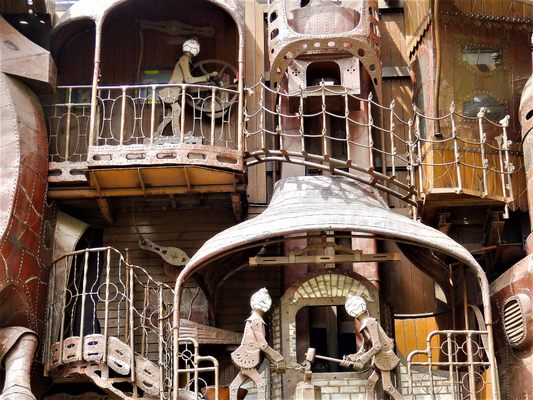
Giant Ghibli Clock. Wow, don’t miss this amazing clock, a huge stampunk-style clock designed by filmmaker Hayao Miyazaki, with lights and many animated parts. Shows are on the hour: M-F at 12, 13, 15, 18 and 20 o’clock. On Saturdays and Sundays, the times are extended to 10 am and 10 pm. Go early as the show begins about 3 minutes before the hour.
It was not easy to find as it sits on the large walkway above several big streets and is accessed by an escalator.

After a very long day, I took the Ginza metro 5.3 km back home.
ON Oriental Capsule hostel for the third night. CA$27.
Day 21 Mon Dec 1
My third walkabout day in Tokyo.
Fire Museum. Has trucks, a helicopter and interactive exhibits oriented to children. Free
Shinjuku Gyoen National Garden. A 144-acre park with huge grassy areas, greenhouses and specific gardens. I passed through the Japanese garden (bridges, tea houses, the Taiwan Pavilion, ponds). 500Y, 250Y reduced
Isetan Shinjuku. Department store. First established as a kimono store in 1886, it is now a high-fashion store with many luxury brands. I need underwear, but the cheapest ones were over 4,000Y. Six floors, the underwear was in B1, and it took many questions to find it.
Kabukicho. An adult-oriented district with nightlife, clubs, pubs and prostitutes.
New Robot Restaurant. In Kabukicho, it is permanently closed, but the large sign on the side of the building is still there. When it was open, it was described as a tourist trap with mediocre food, but about the experience with the staff in robot outfits, loud music and dancing girls in costumes. It was 8,000Y plus food.
Cross the street at the iconic huge intersection that everyone crosses at once.
The Giant 3D Cat. This is a large video screen on top of the 4-story Blue Elephant building. The cat appears 9 times in a cycle between ads and a lizard that navigates a mushroom patch. The cat is white, black, and brown. 1. speaks into a microphone 2. meows chaio, 3. peeks around the edge of ads 4. lies on its back and yawns 5. sniffs at door 6. sleeps with paws crossed 7. peeks halfway out of a small round “window” 8. knocks three objects off the edge and 9. stretches.
Omoide Yokocho Memory Lane. A 2 metre wide lane with many small shops, most closed when I was there.
Sampo Museum of Art. Landscape art with the present exhibit on Canaletto (1696-1765) and 50 other artists. 1800Y, no reduction, so I didn’t go in.
Tokyo Mode Gakuen. A skyscraper with novel architecture that houses a vocational school, fashion, tech, design and a medical school. It tapers to and bottom and has a grid of triangles on the facade.
![Tokyo Mode Gakuen Cocoon Tower, Design School building, Shinjuku, Tokyo, Japan, Asia[20062047121]の写真・イラスト素材|アマナイメージズ](https://static.amanaimages.com/imgroom/cen3tzG4fTr7Gtw1PoeRer/20062/20062047121.jpg)
Memorial Museum to Soldiers in Siberia. On the 33rd floor (find the right elevator bank) of the Shinjutu Sumitoma sky scraper, this chronicles the plight of Japanese POW stationed in Manchuria and after the war were taken to brutal forced labour gulags in the Soviet Union. See maps, uniforms, personal objects (including many home-made objects) and several dioramas. They were repatriated in 1946-47, but still had poverty in Japan. Free
Tokyo Metropolitan Government Building is the seat of the Tokyo Metropolitan Government, which governs the special wards, cities, towns, and villages that constitute the Tokyo Metropolis. It consists of a complex of three structures, each taking up a city block. The tallest of the three is Building No.1, a tower 48 stories tall that splits into two sections at the 33rd floor. It is the tallest city hall in the world. The other two buildings in the complex are the eight-story Tokyo Metropolitan Assembly Building and Building No. 2, which has 37 stories. The two panoramic observation decks, one in each tower on floor 45 (202 meters (663 ft) high), are free of charge to the public and open between 9:30 and 22:00 on alternating days.
Bunka Gakuen Costume Museum. An exhibit of outlandish art dresses from the International Fashion Art Biennial in Busan, South Korea. Many use recycled materials and fabric in unusual ways. Free
Shinjuku Tower. The second-tallest building in Shinjuku, Tokyo, it was completed in 1994. It is owned and managed by Tokyo Gas, which operates a regional cooling center on-site, which provides heating and cooling to the high-rise district of Nishi-Shinjuku, and supplies electricity to the adjacent Tokyo Metropolitan Government Building.
Shinjuku Park Tower is a single building consisting of three connected block-shaped elements: S tower, which is 235 m (771 ft) tall with 52 stories, C tower, which is 209 m (686 ft) tall with 47 stories and N tower, which is 182 m (597 ft) tall with 41 stories. Floors 1 to 8 are occupied by retail stores, floors 9 to 37 are office floors and floors 39 to 52 are occupied by the luxury Park Hyatt Tokyo hotel, which includes a swimming pool with panoramic views of the city.
Yoyogi First National Gymnasium. Built for the 1964 Tokyo Olympics, it has a dramatic roofline. I went in and watched a few games of the All Japan Intercollegiate Volleyball Championship 2025. It was very high calibre volleyball. The building had four volleyball courts.
ON Oriental Capsule for the 4th night
Day 22 Tue Dec 2
My fourth big walkabout day in Tokyo
National Diet Building houses the National Diet of Japan. The House of Representatives is in the south wing, and the House of Councillors is in the north wing. It was completed in 1936 and is constructed entirely of Japanese materials, with the exception of the stained glass, door locks, and pneumatic tube system. It has a pyramid roof and tower. It can’t be entered.
Hie-jinga Shrine is a Shinto shrine. It’s June 15 Sannō Matsuri is one of the three great Japanese festivals of Edo. It was first recorded in1478. The shaden was lost to the Great Fire of Meireki of 1657, and it was rebuilt in 1659. It is in the first rank of government-supported shrines. The shaden was lost again to the bombing of Tokyo during World War II. The present structure dates from 1958.
It has several National Treasures: a tachi (single-edged sword), 14 Important Cultural Assets, 13 swords and one naginata.
Thankfully, there were escalators to get up the hill, as it is on a tall hill.
Akasaka Asada. A truly traditional Japanese restaurant and commonly used by businessmen.
The State Guest House Akasada Palace was originally built as the Imperial Palace for the Crown Prince in 1909. The palace is designated as an official accommodation for visiting state dignitaries since 1974. The main building is a Neo-Baroque style Western building, resembling in particular the Hofburg Palace and the Palace of Versailles. It is one of largest buildings constructed during the Meiji period. The palace is surrounded by a 3.25 km path unobstructed by road crossings. The footpath is approximately 3.25 km long (roughly 2 miles). It is popular for afternoon tea and viewing the grounds for free. Requires a tour to see the inside.
Meiji Jingu Garden. A large urban park with Olympic facilities, an indoor skating rink, a driving range, ball diamonds, and tennis courts.
Olympic Museum. I Meiji Jingu Garden it is housed on the first two floors of Japan Sport Olympic Square, an administrative center for the 2020 Summer Olympics. The area around Japan Sport Olympic Square was developed as Tokyo Olympic Park with statues, the Olympic symbol, and a replica of the Olympic cauldron from the 1964 Summer Olympics (Tokyo), 1972 Winter Olympics (Sapporo), and 1998 Winter Olympics (Nagano). The museum has photos, uniforms, medals, art and the story of the three Olympics held here. 500Y, 400Y reduced
Spiral. A square 6-storey building that apparently has a spiral staircase ramp in the back. The area was closed for Xmas decorations, so I couldn’t confirm this.
Nezu Museum of Art. Japanese and East Asia art venue. Exhibits were painting on silk and Chinese bronzes. 1000Y, no reduction
The National Art Centre Tokyo. Making Art in Japan 1989-2010, British art 90s (very good), plus permanent collections.
ON Oriental Capsule for the 4th night
Day 23 Wed Dec 3
My fifth and last walkabout day in Tokyo. It seemed that everything was 1-2 km apart, so it was a lot of walking.
Matsuoka Museum. Matsuoka Shouten (1894-1989) had wide-ranging business interests were wide-ranging, including cold-storage, hotels and real estate, preparatory schools and more. At 80 years of age, he decided to share his grand collection with the public. In 1975, he founded the Matsuoka Museum of Art, which opened in 2000. Exhibits include Egyptian to Roman, sculpture, Buddha and Hindu sculpture, and from his collection of 1,800 items. 1400Y no reduction
Museum of Yebisu Beer. A good history of Yebisu – started in 1887, trying to produce a German-style beer. It started the first beer hall in Japan, has a bar in Ginza and has won several international awards for its beer. Free
Tokyo Photographic Art Museum. Three exhibits, all atrocious photography. It seems that if you make large prints, or prints on special paper like silver gelatin, or do B&W, someone thinks you are good. But none of these photographers had any sense of light or composition. The last exhibit by Pedro Costa was very artsy; the entire show was in total darkness, and guides used flashlights to guide you. The photography was not inspiring, and all I wanted to do was get out of there. 1680Y, 1000Y reduced
Tokyo Metropolitan Teien Art Museum. Back to Modern − Graphic Design from West Germany. I have been to several Brauhaus exhibits in Germany and saw nothing new. 1400Y, 700Y reduced
Meguro Parasitological Museum. Many specimens in small to some larger glass jars, but only with the scientific name and no history so this was also a waste of time. One had to explore using video screens to learn much. Free
Musashi-Koyama Shopping Street “Palm”. Several blocks long, this is a covered street with a huge variety of smaller stores, none brand-name.
Togoshi Ginza Shopping Street. Also, several blocks long, this was “open-air” and appeared to have more everyday essentials.
My plan was to see the following, but transportation to the last 4 was difficult, I was tired and didn’t see: Archi Depot, The National Museum of Emerging Science and Innovation Japan (Miraikan), Unicorn Gundam, Rainbow Bridge, or Toyosu Market.
Garden of Unborn Children. 400 stone dolls with red crocheted “hats”, red aprons, a small toy windmill, cups for flowers and
Tokyo Tower a.k.a. Japan Radio Tower is a communications and observation tower completed in 1958. At 332.9 m (1,092 ft), it was the tallest tower in Japan until the construction of Tokyo Skytree in 2012. It is a lattice tower inspired by the Eiffel Tower, and is painted white and international orange to comply with air safety regulations.
The tower’s main sources of income are tourism and antenna leasing. FootTown, a four-story building directly under the tower, houses museums, restaurants, and shops. There are two observation decks. The two-story Main Deck (formerly known as the Main Observatory) is at 150 m (490 ft), while the smaller Top Deck (formerly known as the “Special Observatory”) reaches a height of 249.6 m (819 ft). The tower is repainted every five years, taking a year to complete the process.
In 1961, transmission antennae were added. They are used for radio and television broadcasting and now broadcast signals for media outlets such as NHK, TBS Television, and Fuji Television. A taller digital broadcasting tower, known as Tokyo Skytree, was completed in 2012. Tokyo Tower has become a prominent landmark and frequently appears in media set in Tokyo.
ON Oriental Capsule for the fifth night.
Day 24 Thur Dec 4
Onsen early.
Train Ueno – Aota – Narita Airport.
Flight. China Eastern QT25QH
NRT T2 @13:50 – PVG (Pudong) T1 MU 524. 1′ 40′
Pudong T1 @18:10 – 19:20 WNZ T2 FM9527 (Shanghai Airlines)
Picked up at the Wenzhou airport by Anna
I didn’t do a post on this short Chinese visit.
GO TO INDONESIA
