
Rogue orcas are thriving on the high seas—and they’re eating big whales
A fourth type of Pacific killer whale may live miles offshore from California and Oregon, preying on whales, other dolphins, and sea turtles.

By Melanie Haiken
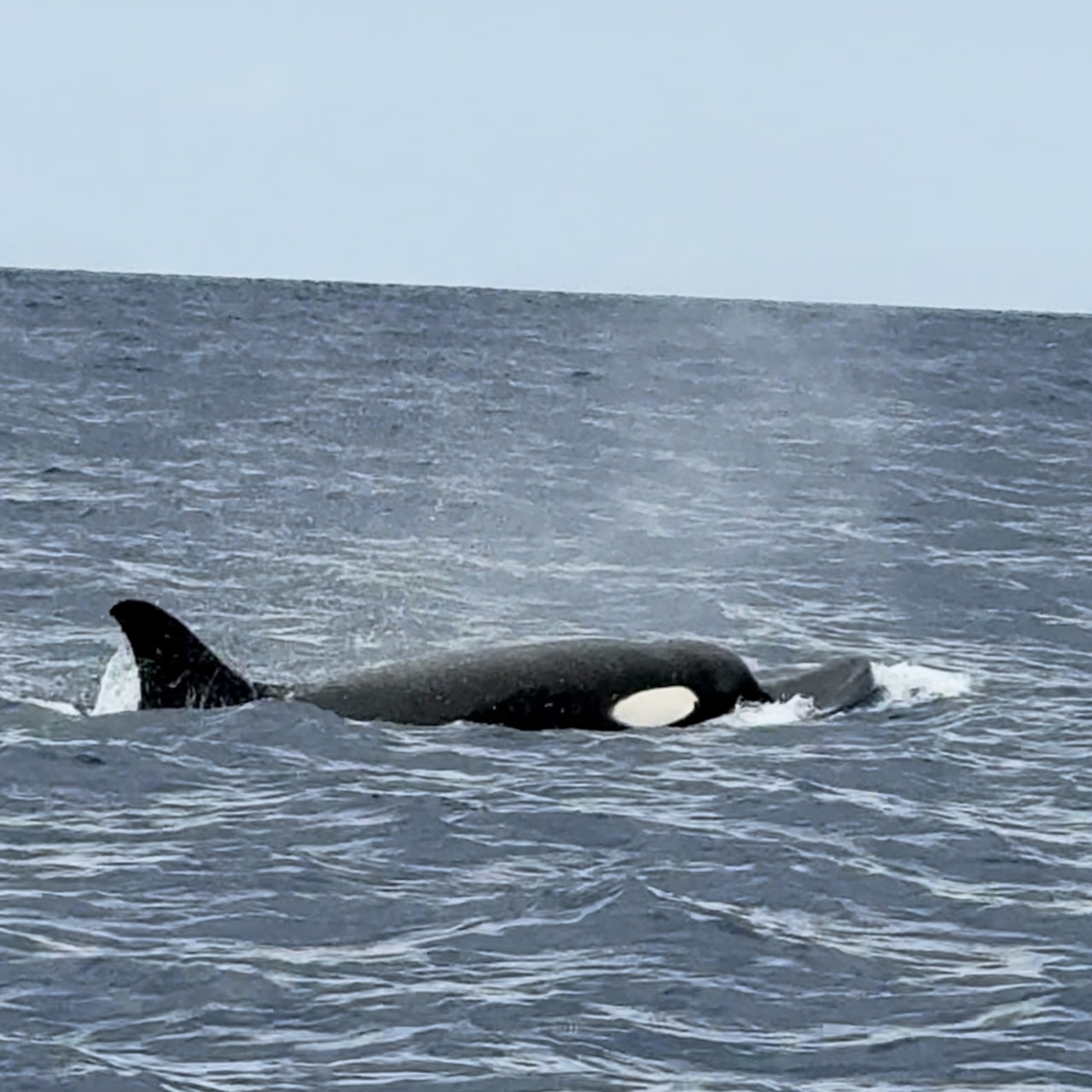
Most orcas tend to stick to coastlines, from the Antarctic dwellers that make waves to knock seals off ice floes to the liver-extracting brothers around Cape Town. But now, scientists have found what could be a brand-new population of killer whales: Animals that ply the high seas, hunting large whales and other sizable prey.
These open-ocean denizens have been spotted at numerous locations far from Oregon and California, many of them well beyond the continental shelf, where waters can reach depths of 15,000 feet, according to a recent study in Aquatic Mammals.
There haven’t been any real studies, at least in the North Pacific, looking at killer whales in the open ocean. It was kind of a shock when … we saw animals that were out in this open ocean habitat and were completely different from the other ecotypes we know.
Killer whales in the Pacific are grouped into three ecotypes: Residents, which live close to shore and eat salmon and other fish; offshores, which live farther out and also eat fish; and transients, also called Bigg’s, the only orcas previously known to eat mammals. (See 13 fantastic photos of orcas.)
Scientists could not match the 49 whales in the new study with any known orcas through photos and descriptions, which are based on their unique dorsal fins and saddle patches, the gray or white pattern on an orca’s back.
This means the animals are either a subgroup of the transient ecotype or an entirely unique population, says McInnes, who is also a research associate with the Pacific Wildlife Foundation.
The team could also differentiate the population, dubbed the oceanics, from other known orcas due to scars or bite marks from the parasitic cookie-cutter shark, which only occur in the deep ocean.

Beyond individual variations, the oceanics don’t look like other known ecotypes, for example sporting a large gray saddle patch or no saddle patch at all.
The open ocean doesn’t support a lot of large predators; it’s often described as a giant desert, so we weren’t expecting to find so many different animals, so we’re excited to carry on more research. We really just don’t know yet what is happening with the killer whales in the open ocean. This is the mystery behind what we hope to do next.
Following the prey
Our knowledge of orcas living in the open ocean is limited, as it’s difficult to find the widely distributed animals in a boat. Yet the recent paper, a mixture of literature review and new observations, discovered nine instances in which marine mammal researchers, fishermen, and tourists observed whales in the northern Pacific Ocean between 1997 and 2021.
In the first documented incident, researchers watched a large pod of killer whales attack a herd of nine adult female sperm whales, managing to separate one from the pack and kill it. Other pods also hunted and ate an elephant seal, a pygmy sperm whale, a Risso’s dolphin, and a leatherback sea turtle.
With detailed records from each such encounter, the researchers plotted geo-referenced locations, determined water depth, and compared photos in databases to determine that the 49 whales sighted could potentially be a new ecotype.
It’s possible that this new population formed as prey drew them farther from shore.

Mammal-eating killer whales are doing well, and their numbers are increasing as seal and other whale populations have rebounded since whaling and sealing became illegal.
While prey overall is less abundant in deep-sea waters, killer whales may still find that habitat is more appealing than competing with the larger populations of resident whales closer to shore (Watch video: sperm whales vs. orcas.)
To this end, McInnes and colleagues hope this study will spark efforts to document the new whale population through genetic sampling, satellite tagging, acoustic tracking, further photo identification, and additional field observation.
Team Orca
Climate change is affecting some populations of killer whales, such as those in Antarctica, which depend on seals that live on the rapidly decreasing ice. On the U.S. West Coast, a decline in salmon has reduced a population off Puget Sound, Washington.
Worldwide, however, the species is thriving, and coming more into contact with people in coastal areas. Orcas ramming and even sinking boats off Spain made headlines in 2023, with some people rooting for the animals as fighting back against human domination.
Killer whales are probably the most widely distributed vertebrate on the planet. They are everywhere. With many tourist cruises available worldwide, everyone should put seeing a killer whale, whose males can reach lengths of 27 feet, on their bucket list. This is the biggest apex predator we have on the planet today. We haven’t seen anything like it since dinosaurs roamed the Earth.
++++++++++++++++++++++++++++++++++++++++++++++++++++++++++++++++++++
Watch orcas and dolphins team up to hunt—a possible scientific first
Researchers in Canada mounted cameras on orcas to spy on their behaviors and were amazed by what they saw.
With all the splashing, it was hard to tell what was happening under water. As the orcas surfaced to take a breath, dolphins were darting around their heads, but the water was so murky that the scientists didn’t have any idea what the animals were doing.
Using drones and cameras attached to the orcas, scientists have finally been able to learn something about the interaction between these two species that astonished them: the northern resident killer whales, also known as orcas, and Pacific white-sided dolphins seemed to be hunting together.
Researchers in British Columbia recorded 25 occasions where orcas followed dolphins diving down to find food. The authors think this is the first record of orcas and white-sided dolphins collaborating to hunt. The encounters were documented in a new study, published in Scientific Reports.
In one instance, the dolphins got involved after the orcas had caught a salmon. “As they were chomping down, there’d be bits of fish that would escape the [killer] whale’s mouth—like, a cloud of blood and scales,” says study author Sarah Fortune, assistant professor in the oceanography department at Dalhousie University in Nova Scotia, Canada. “And then we’d see dolphins coming around near the head to go after those fragments.”
It’s unclear if this is a new behavior or something the two species have always done. The finding may have resulted from improved technology like drones and lightweight underwater cameras that give scientists a better look at the animals’ lives. But some experts worry it’s a sign of a sparse food supply.
Fish-eating killer whales
There are three distinct orca populations—called ecotypes—in the northeastern Pacific, each with a different appearance, habitat, and diet.
“We have the transients, which are mammal hunters—[they eat] seals, sea lions, dolphins, porpoises and large whales,” says Josh McInnes, a marine ecologist with the Oceanic Research Alliance in California who wasn’t involved in the study. “Then we have offshore killer whales, which are much more rare… they eat sharks and fish.”
This study focused on resident killer whales, the third ecotype, which eat fish.
This salmon species is at risk of extinction, so the researchers wanted to know if the northern residents had enough to eat.
They attached suction cup tags—that popped off a few hours later—to individuals off Vancouver Island in British Columbia. The tags had forward-facing video cameras to capture an orca’s-eye-view, while drones analyzed the orca’s body condition from above.
Collaborating to hunt
The researchers noticed that “the killer whales were orienting towards the dolphins who were going after the salmon,” Fortune says. The two species weren’t just hunting the same prey at the same time—they were collaborating. “There was some organization to the chaos.”
The animals even stayed together at around 197 feet deep, cloaked in almost total darkness. “You could still occasionally see the silhouettes of several dolphins near the head of the killer whale,” she says.
Perceiving each other’s clicks means “they’d be reading each other’s sonar,” says McInnes.
Although more research is needed to confirm this is an example of cross-species communication, it “would be really fascinating if it is true,” he says.
Advantages of hunting together
The researchers don’t know why the orcas and white-sided dolphins are hunting together, but they think there must be some advantage for both species.
“In nature, mutualism—where both parties benefit—is the most likely reason that you would have two disparate groups coming together,” says Ari Friedlaender, professor of ocean sciences at UC Santa Cruz, who wasn’t involved in the study.
Northern resident orcas specialize in hunting salmon, while white-sided dolphins eat small fish, such as herring and anchovy. McInnes wonders if the killer whales can more easily locate salmon when hunting with a larger group of dolphins.
Meanwhile, the salmon “are too large for the dolphins to eat,” he says, but they can feed on scraps left by the orcas.
This teamwork might be more necessary if food is scarce. “The more eyes looking out for food, the better,” says Friedlaender. “By working together, you can increase the amount of food that each individual gets.”
Spying on the underwater world
Northern resident orcas had previously been observed with Pacific white-sided dolphins, but it was difficult for scientists to determine the nature of their interaction from the boat. “You see them for one second. They surface, they dive, they’re gone for minutes,” says McInnes. “Cold, temperate water is very green. We can’t really see a lot.”
One theory has been that the dolphins feel protected from predators—like mammal-eating transient orcas—with the fish-eating residents nearby. McInnes had wondered if the dolphins were “like pesky little teenagers bugging somebody,” but the study authors saw no evidence of antagonization, such as charging, biting, or swimming away.
The authors of this new study want to do more research to determine how common this behavior is, whether residents catch more salmon when hunting with dolphins, and if this affects their health and reproduction.
Conserving Chinook salmon
If these collaborations are new, it could be a warning sign. “What’s happening to the environment that’s necessitating this novel behavior?” says Friedlaender. “Are they coming about because of a pressure that’s being exerted on those animals?”
Chinook salmon are threatened by warming temperatures and receding water levels in their spawning rivers as well as overfishing. The ripple effect of a dwindling population would be felt through the food web.
If future studies show orcas and dolphins foraging together more often when food is scarce, it could suggest a need for stricter conservation to protect salmon stocks and the marine animals that rely on them.
++++++++++++++++++++++++++++++++++++++++++++++++++++++++++++++++++++
Killer whales deploy brutal, co-ordinated attacks when hunting
Their techniques are passed down through the generations

THE whales that roam the waters of the Monterey Submarine Canyon, off the coast of California, are brutal animals. When hunting grey whales, they target mother and calf pairs, chasing them until the calves begin to tire. At that point the killer whales separate the grey whales by manoeuvring between them or dragging the calves away by their tail flukes or fins. Once a calf is separated from its mother, the killer whales incapacitate it by bludgeoning it with their heads and tails before drowning it by leaping atop its blowhole to keep it below the surface.
The killer whale (Orcinus orca) is a diverse species, boasting several isolated populations around the world that occupy varying—and, in several cases, still little described—ecological niches. Two recent studies have shed some light on the unique hunting cultures of the killer whales that stalk the deep waters off the north-east Pacific Ocean.
Distinct killer whale populations are known as “ecotypes” and can differ in size, colour and body proportion. Where their ecological ranges overlap, ecotypes rarely interact and do not appear to interbreed. Most of what makes killer-whale ecotypes distinct is their culture—socially learned behaviours that killer whales are known to transmit from one generation to the next. These include preferences for different marine prey species and the collaborative strategies used to locate, hunt and kill them, potentially honed over millennia. Different killer-whale ecotypes even communicate using distinct “dialects” made of clicks, whistles and calls, with “accents” that differ between pods.
The most studied killer-whale ecotypes are the three that occupy the north-east Pacific coastline, from northern Alaska to southern California. “Offshore” killer whales, up to 6.6 metres long, patrol distant waters in pods of 100 to 200 individuals, hunting pelagic fishes like sharks. “Resident” killer whales, around 7 metres in length, stalk the coastline in pods of up to 25 individuals, targeting coastal fishes (primarily salmon). Finally, “transient” killer whales, each up to 8 metres in length, are found across both shallow and deep coastal waters and pursue marine mammals, including cetaceans (whales and dolphins), as well as pinnipeds (sea lions and seals). While “inner-coast” transients stalk shallow waters near the shore, “outer-coast” transients hunt in the deep open waters along canyons at the edge of the continental shelf.
To understand these transient killer whales better, Josh McInnes from the University of British Columbia in Canada led a team that analysed 261 sightings of killer whales around the Monterey Submarine Canyon System collected by surveys and whale-watching vessels. The dataset included almost 100 predation events. Publishing their results in the journal plos one, Mr McInnes found patterns in behaviour of outer-coast transients that differed from those of their inner-coast cousins. The latter ambushed harbour seals, sea lions and the occasional otter, while the former tended to perform co-ordinated dives in their hunt for larger mammalian prey.
Outer-coast transients appear to have developed specialised strategies—such as the repeated battering and drowning of grey whale calves—because their prey is bigger and takes more time to subdue. Like most specialised killer-whale hunting behaviours, these strategies are thought to be honed, down the generations, as a form of cultural knowledge.
While studying the outer-coast transients, Mr McInnes also stumbled upon hints of a previously undescribed population of killer whales that were big-game hunters of an entirely different class. Writing in the journal Aquatic Mammals, his team described nine offshore encounters with 49 killer whales between 1997 and 2021. These killer whales were seen killing sperm whales, pygmy sperm whales and large Risso’s dolphins, as well as scavenging on leatherback turtles.
The attack on sperm whales, which can grow to around ten times larger than adult killer whales, was a particularly impressive show of predatory force. On October 21st 1997, between 15 and 35 killer whales were observed hunting a herd of nine sperm whales over the course of four hours. The sperm whales were subjected to repeated waves of aggressive attack, injuring all of them and severely injuring several before one sperm whale was finally isolated from the herd and killed. Out of the surviving sperm whales, three are thought to have died from the wounds they sustained and it is possible the entire herd later succumbed to its injuries.
Little more than that is known about these killer whales for now, except that they are identifiable by characteristic circular scars left by bites from cookie-cutter sharks, which suggest these hyper-aggressive creatures stalk the deep waters of the north Pacific.
More data, especially of the genetic kind, will need to be collected from both outer-coast transient killer whales as well as their newly discovered cousins terrorising the pelagic waters of the north Pacific, before scientists can fully describe the new ecotypes and add them to marine-biology textbooks. Nevertheless, the discoveries are a reminder that biodiversity is not just about the diversity between species but also within them. Killer whales seem to exist in many more shades than just black and white. ■
++++++++++++++++++++++++++++++++++++++++++++++++++++++++++++

Vengeance—or playtime? Why orcas are coordinating attacks against sailboats
The common denominator in dozens of incidents appears to be a mature female named White Gladis.
Why the attacks may have started
A recent paper in the journal Marine Mammal Science found that the attacks involved nine whales in two groups: a trio, sometimes a quartet, of juveniles; and a mixed-age group led by a mature female named White Gladis. Given that White Gladis was the only mature female involved, the paper’s authors speculated that she had been involved in an accident with a boat and engaged in retributive behavior, which was then copied by the younger whales.
When it started happening, I did think that maybe a female or her calf had been nicked by a propeller or rudder on a boat, because every single time they seem to go for the rudder. And it’s all on sailboats.
However, not everyone is convinced that the orcas’ actions have any malevolent intent. Notably, the orcas’ focus is very specifically on the boats; none have shown any interest in the people on board, even when those people have had to scramble into lifeboats when their vessels started sinking. Some think it’s just as reasonable to suggest that they’re doing this because they can, because it’s fun.
A new form of play
Strager spoke to a biologist who was on board the boat that sunk in November, “and he said, ‘We didn’t feel any aggression.’ And, to me, that’s actually a strong testimony. Because I think when you are interacting regularly with animals, and you’re used to reading them, you can feel an aggressive intent, and they didn’t.”
If the orcas are indeed playing, it may suggest that, in time, the boat attacks could end when the whales get bored. Orca populations around the world have been observed engaging in a new behavior for no obvious reason than that they appear to enjoy it and then, just as suddenly, dropping it and moving onto something else. Orca researchers call these play routines “fads.”
Olsen, for example, has observed killer whales off Alaska playing with a piece of kelp for an hour: dragging it around on their fins, dropping it, circling back around and then picking it up in their teeth and swimming around with it some more. Strager has observed similar behaviors in orcas off the coast of Norway.
“For a while we saw them playing around with jellyfish,” she says. “They would swim with them on their snouts and would try to keep them on for as long as possible.”
There’s no benefit from this behavior, and the orcas were not eating the jellyfish, Strager notes.
“Sometimes we also see them whack little auks … small Arctic birds, they just lie on the surface of the sea to rest, and the orcas will come and whack them,” which she thinks is also a form of play.
Olsen questions whether we will ever truly understand the motivation behind the behavior, or whether we even really have the capacity to figure it out.
The whale brain has been evolving separately for 50 million years. It’s hard to get a whale into an MRI, we don’t even know which parts of the brain are dedicated to which activity. It’s hard enough for us to explain behavior in humans and in primates that are closely related to us.
Facing retaliation
Only this population has shown any interest in attacking boats, and it is a small one: the Marine Mammal Science paper cited an estimate of just 39 individuals.
The population in this region is under threat from tuna fishing, pollution, noise and, indeed, ship strikes. They are among the most polluted marine mammals in the world, so their breeding success is not good. It’s a very stressful environment for them..
And now, added to the existing stressors is the prospect of retaliation. Now they are becoming feared in the area, and there are reports of people suggesting you should pour diesel on top of them if they attack your boat, that you should put firecrackers in the water or ignite dynamite. I understand if people are afraid. But it’s really a very dangerous situation for the killer whales.
One local group, the Atlantic Orca Working Group, catalogues interactions between whales and boats so that sailors can learn which areas to avoid.
++++++++++++++++++++++++++++++++++++++++++++++++++++++++++++++++++++
Watch orcas team up to hunt great white sharks in rare video
The killer whales ripped the liver out of a shark and passed it around—only the second time orcas have been seen engaging in this behavior.
A pod of killer whales chased a young great white shark, immobilized it and then bit its liver out of its body. Researchers documented this rare interaction in the journal Frontiers in Marine Science, representing what they say is the first example of this behavior in the Gulf of California and the second worldwide.
The study adds to a growing body of research on killer whales, also called orcas, hunting great white sharks.
“The footage that they’ve gotten for this study is incredible,’’ says Isabella Reeves, a predator biologist at Flinders University in Adelaide, Australia, who was not involved in the research. Especially is rare is the depiction of the whales sharing the prey with each other, she says: “There’s very few high-quality instances where we actually see that occurring, especially documented to this extent.”
In the Gulf of California, the body of water that separates the Baja California peninsula from Mexico’s mainland, marine biologists Erick Higuera, Francesca Pancaldi, and their team have closely studied a group of killer whales since 2018. They call it “Moctezuma’s pod,” after one of the individual whales that was first spotted in 1992 and was nicknamed for the Aztec emperor.
Over the years, they observed these orcas using diverse strategies to hunt a vast array of prey: from rays to whale sharks, stingrays and bull sharks.
Documenting the hunt
In August 2020, while the team was out at sea following the pod to conduct their research, the killer whales started hunting. Higuera quickly flew his drone to record the action.
Just days later, after downloading the footage, Higuera realized that the pod he recorded was hunting something unexpected: young great white sharks.
To hunt a juvenile great white shark—which is usually around 6.5 feet long—the killer whales would run it down, bite it and try to flip it on its back. In this position, the shark would become paralyzed, making it easier for the whales to bite their prey without being bitten back.
The members of the pod would take turns keeping the shark belly up, and toward the end of the attack they would bring it underwater. After about two minutes they would reappear, and one of the killer whales would hold the shark’s fatty, calorie-rich liver in its mouth.
The team recorded the Moctezuma’s pod again in August 2022, hunting one young great white shark in the same location where they spotted the first two predations. This time, the team didn’t see the orcas turning the shark upside down to kill it.
‘’The footage gives us a very clear look at how the interaction unfolds, which we’ve only been able to document directly in a few places globally,” says Alison Towner, a marine biologist at Rhodes University in South Africa who wasn’t involved in the new study.
(Why are these orcas killing sharks and removing their livers?)
Putting the behavior in context
Orcas have been documented hunting great white sharks in other parts of the world such as New Zealand, California and South Africa. They have mainly been seen hunting adults—which are 13 to 16 feet long—and studies in some areas showed that when one individual is hunted by killer whales, all the others move away from that area en masse to avoid the predators.
In this case, the Moctezuma’s pod seems to be targeting juveniles, say Higuera. ‘’They might be coming to this particular spot where we saw them just to hunt juvenile great whites,’’ which are probably easier to hunt, as “more naive than adult great whites,” he says, and might not know how to escape killer whales—which are their only predator. ‘’But I couldn’t doubt that they also hunt semi adults and adult great whites in this area, it’s just that we haven’t seen it yet.’’
Climate change may also be playing its part in this rare interaction. Scientists say that due to warming waters and other factors, the nurseries of these sharks might be moving—with great whites increasing their presence in the Gulf of California, presenting the orcas living there with a juicy opportunity to hunt them.
But Reeves notes that it’s too soon to draw conclusions on the effects that killer whales might have on the great white sharks living in that area. “It’s complex, and we can’t risk oversimplifying these interactions,” she says.
On the other hand, Towner, who wrote her doctoral dissertation on orcas displacing white sharks in South Africa, says the behavior could become a problem for great white sharks populations, especially if it becomes frequent.
‘’White sharks are slow to mature, long-lived, and produce few offspring, so they’re vulnerable to added pressures,” she says. In South Africa, for example, white sharks have left sites where they congregate in large numbers because of attacks from killer whales. ‘’That displacement can move them into areas where the risks from fisheries or shark control gear are higher—so the indirect effects matter as much as the predation itself.’’
++++++++++++++++++++++++++++++++++++++++++++++++++++++++++++++++++++
AN ORCA POD HUNTS A PYGMY SPERM WHALE
Whale watchers in Madeira captured the astonishing moment orcas took down the deep-diving marine mammal. The predatory behavior had never been documented in the region. A pygmy sperm whale was attacked by a pod of orcas off the coast of Madeira. Orcas preying on marine mammals are rarely seen in the region.
By Melissa Hobson
December 2, 2025 NATIONAL GEOGRAPHIC
As the whale watching boat slowly approached, the passengers saw something strange in the water—an 80-foot cloud of red-brown liquid. Just minutes later, an orca hurled a small whale into the air. Dark red fluid gushed from its body. A member of the three-orca pod forced the whale under the water, holding the thrashing animal below the surface.
One of the orcas then approached the boat with its prey in its mouth, and then she looks at us like, hey, look what I got? They never thought for a second it was going to be a mammal.
What Dávila Pardo didn’t know at the time was that she may have documented the first known instance of orcas hunting a marine mammal in Madeira, a Portuguese island territory in the northeast Atlantic Ocean. Dávila Pardo recently published her account of the whale attack in the journal Marine Mammal Science where she and her coauthors noted finding no other examples of such behavior in the region. However, it’s the fourth global record of orcas hunting pygmy sperm whales.
A unique self-defense strategy
When they saw the picture for the first time, they thought “oh my God, that’s blood. It was very dark,
But it wasn’t blood. When pygmy sperm whales feel threatened, they release a reddish intestinal fluid as a form of self-defense. Like a squid’s ink, this substance obscures the whale, giving it a chance to get away.
But it didn’t work on the orcas. With the killer whale’s sophisticated echolocation, it’s like having a military submarine tracking you.
Pygmy sperm whales are deep diving animals that live far from shore so are rarely seen by humans.
They prefer offshore habitats usually in waters of 400 meters (1,300 feet) or more. These orcas, as apex predators, have developed a coordinated foraging strategy that can efficiently target this deep-water species.
Killer whales are only seen around Madeira a handful of times each year, and not much is known about the local population. Although orcas had been recorded hunting whales and dolphins in the nearby Azores and the Canary Islands, the video of such a rare event in Madeira still surprised scientists.
Neither Lott nor de Stephanis are aware of previous records of killer whales hunting pygmy sperm whales in Madeira.
Understanding a mysterious predator
When they spotted the three individuals earlier that day, they thought they might start hunting. There’s no reason for these animals to stay this long. More clues soon started to emerge.
Dávila Pardo had never heard of pilot whales and beaked whales interacting, but she’d also seen the two species together earlier that same day.
“I said, ‘maybe there’s something bigger in the area, and that’s why the beaked whales are trying to defend themselves by finding shelter with the pilots’,” she says. Pilot whales have previously been seen swimming after orcas, perhaps to scare them off. The gruesome hunting scene followed shortly after.
Around the world, there are several distinct types of orcas—known as ecotypes—that have different appearances, behaviors, and prey. Many eat fish, offshore killer whales have been recorded hunting sharks, and orcas in the Pacific Northwest are best known for hunting and eating mammals like seals.
Evidence that the Madeira population also eats mammals is “just a fascinating discovery,” says de Stephanis. He had heard theories that orcas in the area might feed on marine mammals, but this confirmation, and that they attack deep diving species, was particularly surprising.
Lott was surprised that the three individual orcas weren’t found in photo identification databases from the Madeira Whale Museum and the citizen science program Happywhale, which might suggest they are a transient pod. “Adding these ‘mystery orcas’ to the literature will contribute to a larger scale understanding of orca movement,” he says.
If killer whales in Madeira are hunting mammals, it might also spell trouble for the island’s critically endangered monk seals of which there are fewer than 30 adults. Are we looking into something that could possibly be a problem for this population?
To answer this and additional remaining questions, she says she and other local experts need more observations of their behavior. By sharing her paper, she wants to get out the message: “these are our orcas. Have you guys seen them around? We need help.”
